Posted by: Dana Nicholson | May 29, 2011

Blogging for Profit

I came across this article from the New York Times about different ways bloggers are making enough revenue to support themselves and their families.  Since we all are now experienced bloggers I figured this was something we all could maybe use one day because honestly, how awesome would it be to blog for a living?

Photo Credit: Blaugh.com

The article talks about more than just sidebar advertising as a source of revenue.  One of the most effective methods is to implant a link to a vendor offering the product or service you are blogging about, called contextual ads.  Selling merchandise and uploading videos promoting products are other ways bloggers get paid for blogging.

A book deal is the holy grail for bloggers.  Most of us have probably seen Julie and Julia, the movie about a food blogger who worked her way through Julia Child’s cookbook.  Well, both int he film and real life her blog was turned into a book.  Making that type of money first means that we need to become influencers, and in the words of Donna Z. Davis “mavens of our chosen industry.”  It will be challenging getting to the point where we can be full-time bloggers; but the good news is that we all have something to strive for when it comes to our blogs.

Posted by: lennabo | May 27, 2011

Coolest Brands for Generation Y

At the annual Sunday Times Generation Next 2011 Brand Survey awards, brands that were selected by Generation Y (between the ages of 8 and 22) were recognized as the coolest in the local youth market.

With so many different forms of technology in society, this generation is able to voice their opinions and views on many different issues and topics across different kinds of social media. Enver Groenewald, GM of advertising revenue and strategic communications at The Sunday Times says, “Any brand, looking to strategically break through into the youth market, needs to know what this market ‘likes’,” . “As the buying force of tomorrow, youth need to be validated as consumers, as they have the potential to make or break a product or service.”

By polling 7200 young South Africans with their opinion on fast food outlets, cell network providers, celebrities and fashion brands, the survey can interpret what the youth is in to these days and what will ultimately sell and be consumed. It will show what they view as “cool” regardless of their financial constraints and give marketers insights in to trends. What they found when it came to cellular phones was very interesting, they survey named the BlackBerry the “Coolest Brand Overall” title as well as “Coolest cell phone and “Coolest high-tech gadget.” This surprised me because I really thought the Iphone would take the “Coolest cell phone” and “coolest high-tech gadget” titles. It seems like in America, they are so popular it’s interesting to think that they may not even be as available in other countries like South Africa. As for the “Coolest Brand Overall”, I noticed that BMW was second on the list while  Coke was third. This was really strange for me, because it seems like Coke would easily place first, it’s such a common brand, I wonder why Blackberry would ever trump both of those.

Craige Fleischer, regional director Southern Africa at RIM, the company behind the BlackBerry solution adds, “Generation Y’s choice of the smartphone for the coolest brand overall reflects the importance it has assumed in the increasingly connected lives of a tech-savvy generation. They have become the choice of South Africa’s youth because they are both aspirational and affordable.”


Posted by: Whitney | May 27, 2011

Deactivating Facebook

A few days ago I finally followed through with deactivating my Facebook, and it was a really interesting process.

Before I deactivated, I went through a few steps. First, I downloaded a .zip file of all my Facebook information. The .zip file had all of my messages, wall posts, photos and videos since 2007 in one folder. Needless to say, it was creepy.

Next, I investigated what it meant to deactivate. Could I still get to my photo fan page? What if I wanted to get back on Facebook someday? While I was trying to find all this information, I found a new little box you have to click if you want to keep your old privacy settings. If you didn’t happen to find this little box, a lot more people could see your photos. It’s under the main page of privacy settings (not your photo privacy settings). I unchecked the box, and decided not to deactivate just yet.

Then, I went to the deactivate page. It picks five of your friends Facebook thinks you are closest with, displays a picture of the two of you, and then says that person “will miss you…” It may have been a little more effective if they displayed statuses you won’t see again, or people you used to be close with, but aren’t anymore. It didn’t pick my family or my friends from high school, and I thought that was weird. Instead, Facebook picked people I see everyday (like my roommate).
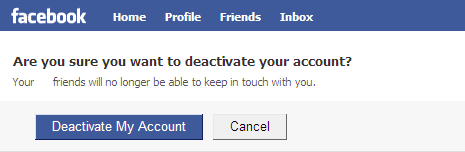
Before you can delete–oops, I mean, “deactivate”– Facebook, you have to select a reason why you are deactivating your Facebook. When you select a reason, it tells you the reason you selected is not a good enough reason to delete. It gives you a link telling you how to block someone, change your password or privacy settings. When I didn’t see my reason, I clicked other. Uh-oh, error page. You can’t delete without explaining your reason. So, instead, I chose that I had another Facebook account (I had to create another one to manage my photography page), and they don’t argue with that reason.

So, after a very long process, I officially no longer have my Facebook profile.  Before an hour of being Facebook-free, my mother had noticed that my Facebook was missing. Somehow she equated not being able to find my Facebook with not being able to find me. She wrote on my photography Facebook wall asking where I was. She changed her status to say that she couldn’t find me. I had no calls on my phone, no text messages, and no emails from her. I received a text from my cousin asking why my mom was freaking out about where I was. As I was reading that text, my roommate called to tell me that my mom was looking for me. Finally, I called my mom and explained I deactivated my Facebook. I also told her that she can text me, email me, or call me before I would read a Facebook post anyway.

The next morning I got a few texts like, “WHY DID YOU DELETE YOUR FACEBOOK?” and, “Facebook death?” No one could understand why I did it, and especially as a PR student. Why would you delete your Facebook? And it’s true! I feel really hypocritical. I just wish I could delete–or I guess I mean, “unfriend”– a lot more people from Facebook with out offending anyone!

I know that I’ll end up bring my Facebook back pretty soon, but probably in a week or so. I’m way too busy to waste away a few hours on Facebook this week, but it is a pretty great tool. For example, researching Dannon on Facebook for J543 this week was extremely for my research. Instead of waking up and checking Facebook, I’ll check my e-mails, Twitter, and blog. It’s so much more productive!  Maybe I can get myself in the habit of doing that, reading news, and then checking Facebook.

Posted by: hwsmith | May 26, 2011

Is Google Getting Back at Facebook?

According to Times Techland, at Google’s Big Tent conference on Internet privacy a representative announced, “We’re not creepy enough to recognize your face.” Schmidt, Google’s representative, was referring to the application Facebook provides its users where they use a database which allows a computer to recognize and identify your face, my face, or anyone’s face within your friend list. Google explained how this application is only made possible by sorting pictures of “recognized” faces in a photographically encyclopedic database, claiming “the technology’s accuracy is surprising and very concerning.” Schmidt personally made a nudge at Facebook stating, “We’re kind of creepy, but not that creepy.”

You can’t help but wonder if Google purposely brought up these internet privacy issues to get back at Facebook for the smear campaign it planted against Google just weeks ago. If so, I think Google did the better job at humiliating Facebook, raising legitimate concerns about Facebook’s intent. It raises questions about security. Why do they need to recognize pictures with names? Although it may be convenient for the person uploading pictures since Facebook immediately tags the photos, it remains completely unnecessary and crosses new privacy boundaries. I agree with Google, the fact that such a database exists is “creepy.”

Posted by: sarahbrown90 | May 25, 2011

SheSays Brings Women In Advertising Together

Today @advertisingweek tweeted about a new blog that was posted about a networking website called SheSays. I decided to follow the link and check it out and I’m so glad I did. The blog talked about a networking site called SheSays. This site was founded by Alessandra Lariu and Laura Jordan Bambach when the two realized that there were not many women in the creative departments. The website was formed as a support group for women in the field and a way to connect them all. The site even has its own award they give out to women called “The Golden Stiletto.” This award is given to amazing women who have stepped it up and have done some amazing things.

“The world is pretty much half men, half women. So why are there hardly any females in the creative departments of most digital agencies? We decided to stop chatting about it and do something. SheSays holds events, where top females in the industry share their thoughts and help people get started and work their way up.” This quote is on the home page of the website and I think gives a pretty good idea of why the website exists.

I am not just a PR major, but an advertising major as well so information like this is awesome for me. I know there are many others who are double majoring in those two things as well so I thought I would share this site with the rest of the class in case you haven’t heard about it. I definitely suggest you check it out.

Posted by: deniseschenasi | May 25, 2011

Landing A Job Abroad

I came across an interesting article on twitter today discussing 10 important tips for landing a job abroad. USA TODAY College outlined 10 simple tips that I found especially helpful because lets face it, landing a job after graduation is stressful enough, but to attempt to search for a job abroad is that much more intimidating. So, here are the tips summarized from what I feel are the most important points. You can check out the article for yourself here.

1. Have your resume/CV and your portfolio online: Well, we are already one step ahead for this step! Apparently, those who are doing the hiring are interested in the simple convience behind online hiring. Our e-portfolio’s make this extremely simple for them to view all of our work and brand ourselves online. According to Communication Strategist and Consultant Nate Riggs, “Managers looking for a job candidate often have dozens, if not hundreds, of applications to review. If they can identify suitable professionals who have an online brand and the digital credentials to back it up, there becomes less of a need to page through stacks of paper resumes.”

2. Be specific and targeted in your job search: This tip was especially interesting. Because it can be extremely difficult to search “around the world jobs”, they recommend narrowing your search to a city you are interested in and then changing your Facebook/social networking site to the location that you wish to move. Apparently, this is one of the best ways to “be found”.

3. Search for a virtual internship in the city you want to work: There is a chance the company will be interested in hiring you; and, if they are not they might recommend you to someone who is.

4. If you can’t intern, find other ways to gain experience: Write a guest blog for a company, edit content or conduct research. Intern virtually.

5. Take advantage of social networking to build relationships: Simple enough. Network on Twitter, blogs, etc.

Check out the rest of your tips for yourself, they’re pretty self explanatory. This site really has encouraged me to try to establish myself better online and to make better use of my professional Twitter and blogging. I hope these simple tips help you, too!

Posted by: Dana Kelly | May 24, 2011

Profanity in the age of transparency

Following a link from the @mashable Twitter account, I read an article titled “47% of Facebook Users Have Profanity on Their Walls.” This came as no surprise to me because I can guarantee that I fit into this near-majority demographic. The study comes from Reppler, a firm that offers online reputation strategies, and it surveyed 30,000 Facebook users. The results show the most common curse words used, etc. However, what I found most interesting from Mashable’s article was the following statistic: male undergrad students reference alcohol in their profiles 85.5% of the time. For the purpose of this blog post, I will assume that females undergraduates have a similar if not equal percentage.

If the vast majority of college students display their alcohol use on social media, how will our future employment be affected? I make a genuine effort to control the content I publish on social media sites, but I cannot say the same about my friends. If a friend posts a picture of me drinking and adds a profane comment, I have lost control of my individual brand. However, I don’t think that I should have to change my lifestyle in order to hide from Facebook’s grips.

It is a lesson I hear everyday in my three journalism classes: monitor your Facebook! I am aware that future employers will Google me prior to an interview and my digital footprint will be on display. Are they seriously going to judge profanity and/or alcohol references when the majority of college students inching closer to graduation have these vices on their profiles? I maintain a private profile for a reason, but I remain anxious about what my friend’s post. The study reveals that 80% of our users who have profanity on their Facebook Wall have at least one post/comment with profanity from a friend, meaning despite my precautions, others have not yet caught on.

I’ve adapted professional Twitter and Linkedin accounts, but will these suffice? I am struggling to define the line of appropriateness on a social media platform such as Facebook when the majority of users my age are guilty of the same cardinal sins.

Article

While I was doing what I do best (not paying attention) during class today, I came across this article while fumbling through my Pulse News app from Business Insider on my iPhone called “Why I Will Never, Ever Hire A ‘Social Media Expert'”. To put it lightly, I was appalled by what I read.

In summary, the article claims that no company should hire a social media expert onto their team because it is a waste of money on payroll. The author even goes on to say that, “Being an expert in social media is like being an expert at taking the bread out of the refrigerator.” He does have a point in saying that the goal is to make an amazing sandwich, meaning that social media is just another facet of marketing and customer service… but to me, a social media expert should understand this, too, and be able to make that sandwich into a gourmet meal.

What bothers me most is that the author makes it seem that “social media experts” are completely uninformed as to what the goal of marketing to an audience is. He claims that it’s about transparency. It’s about relevance. It’s about using the tools to market to an audience that wants to help your story. “Social media experts’ don’t know this. They’ll build you a fan page, and when all that work doesn’t convert into new sales, they’ll simply say, “Well, we’ll just post more.” Are you kidding? I may be only halfway through my major classes, but I like to think I have a pretty firm grasp on all of the concepts covered in the article. And for him to say, in capital letters I might add, “THEY CAN’T WRITE.” Well, to hell with you! You shouldn’t be writing at all, you uninformed, arrogant jerk.

I may be overreacting. I wouldn’t call myself a “social media expert” because I have learned that with my personality, I cannot and will not hold a job that consists of spending hours upon hours at a desk in front of a computer. I have learned that yes, I love my major and am so glad I chose to study public relations. But I love it because I can do more than become a “social media expert” with all of the experience and knowledge I have acquired over the past three years. So maybe this Peter Shankman jerk isn’t addressing me, but he in his article he is telling a few of my fellow classmates, whom I respect and admire for their social media expertise, to “go die in a fire,” and I’m NOT okay with it.

I want to point out that he closes with this, ”

Social media is not “cool.” MAKING MONEY IS COOL. Social media is simply another arrow in the quiver of marketing, and that quiver is designed to GENERATE REVENUE. If you’re doing anything else with social media, here’s a book of matches, and I expect to never see you again.” Dude, where have you been? Social media is cool.. get with it you old fart.

Class, read this article and tell me if you agree or disagree. Should we be offended?

Posted by: madisonbalk | May 23, 2011

Interesting Yet Important Concept…

Have you ever thought about the importance of social media during natural disasters? According to an article by the Claims Journal, the National Hurricane Center hopes to increase Facebook activity when there is a disaster on the rise. This concept of a social media site for hurricanes is very interesting, for not everyone automatically associates Facebook with tragedies.

The NHC urges that other national emergency centers apply this same strategy in order to make sure that everyone is safe and in control. They suggest that in times of natural disasters, citizens should affiliate their “statuses” with their actual safety status. If someone is in desperate need of assistance, it will be easier to make known if online.

This brings up a very important question, however; if there is a natural disaster, how can citizens be sure that their internet is working? Although this plan has some minor inaccuracies, emergency centers must be aware that not everyone who is “not okay” will have access to the internet and Facebook.

The Federal Emergency Management Agency has set up over 16 Twitter accounts, and with this people can be even more prepared and updated in case of a disaster in their city.

Social Media. Although it is used primarily for recreation, as we move even further into the age of technology we begin to see more of its important uses.

Posted by: madisonbalk | May 23, 2011

More Jobs Lost Due to Technology

Service with a smile? Not anymore…

In the UK, many McDonalds have now adopted  touch screen computers that will replace cashiers. These self-service machines will allow customers to order and pick up their own food without the help from sales representatives. Over 7,000 McDonalds locations will employ this new process.

We all know that through the growing use of technology, face-to-face interaction and communication is becoming less and less prevalent in society. Countless of jobs have already been lost because humans are being replaced with computers. What will this amount to in future generations? Will all human jobs be replaced?

« Newer Posts - Older Posts »

Categories