Posted by: Emilie Hartvig | April 28, 2011

Pepsi Gets Social

Yesterday, Wednesday April 27, PepsiCo announced the launch of a new vending machine. It is called the Social Vending Machine and a prototype is set to be released on April 27-29 at the National Automatic Merchandising Association’s One Show in Chicago.

After watching the demonstration video, my mind was blown. The vending machine does not only feature state-of-the-art technology for vending machines, but it is now a social media outlet. There are three options on the machine: buy yourself a drink, gift a drink, and connect with Pepsi’s philanthropic community “Pepsi Refresh”.

The most interesting aspect of this machine is the gift a drink option. Basically, you press the option and it takes you through steps to connect to whoever you want to buy a Pepsi for. You then write a message and you have the option to record a message. The person you are gifting receives an e-mail or text with a redemption code and with that he or she can pick up a Pepsi beverage.

Think about what this means for the future. Can you imagine a time where you meet a future employer and gift them on a hot summer day with a refreshing Pepsi drink? As technology is growing I cannot help but think that little actions like this will be more than acceptable in a professional world, or at least in the social media world.
Posted by: lennabo | April 27, 2011

Brand Yourself: A Foolproof System

So I know we have discussed this countless times in class, but I noticed that a lot of these points are important enough to be discussed in more detail. I came across this article when one of my fellow PR students tweeted about it, and I caught on to some new tricks to help brand myself and jump start my career path. I really liked how this article talked about making sure your “strategically telling the story you want to tell.” I think this is a good concept that every student should be thinking about, once you are able to communicate your story effectively to employers, you will be able to sell your brand based on what your good at (aspects of your story).

Step 1: Talks about being strategic. First identify yourself as an overlap between the person you want to become and the person employers are dying to hire. What a great piece of advice. Often we don’t think that those could possibly be two separate people, yet it’s more common than not to find the person we want to become does not have a clue how to interview well.

Then start your research and experiences early. I know a lot of this information is obvious to us as PR students but I wanted to take the opportunity to showcase this as an issue that many students aren’t thinking about taking full advantage of. This article also talked about finding the company website that you want to work for and take a look at what they are searching for in potential employees, then start your brand by becoming that person.

When it comes to getting experience, of course we search for internships and opportunities to work for employers who have a similar to the kind of atmosphere we would like to develop a career in, but how exactly do you get famous?

This leads us to

Step 2: Get Famous. This article defines branding yourself as getting famous, although I don’t necessarily agree that is the most important thing that a young PR professional should be thinking about, I do believe it’s a great way to jump start your motivation to become and influential. You can shine your name in a positive light on the Google search page by taking leadership roles, cleaning up your Facebook page, getting a LinkedIn account and beginning to blog, but my favorite part of this section was the ability to tell your own story to get you famous. Your achievements, goals, and experiences are all a part of your story, the story of your brand. The highlights that are in that story, is what is going to get your brand famous.

Posted by: Emilie Hartvig | April 26, 2011

Another Way Facebook is Taking Over the World

Have you tried using or heard of Groupon or Living Social? In a nut shell, these two websites offer coupons for stores in your local area at discounted prices. Some of these coupons are actually great deals and I recommend checking them out.

Do you know who else is starting this coupon phenomenon? Facebook. Of course Facebook is doing something like this. I bet Mark Zuckerberg is ticked he didn’t think of the idea first. Their version of the coupon site is called “Facebook Deals“. At the moment, they are offering coupons to a few cities but I have no doubt that this will explode.

What is Facebook going to do next?

Posted by: Whitney | April 26, 2011

Royally Sticky?

I found this tweet in my feed this morning:

Royal Wedding Day Air to be Sold in Bottles >> http://bit.ly/gPw9Rm >> most bizarre royal wedding souvenir for sure!

I clicked the link, and it really is a bottle of air with the soon-to-be newlyweds photo on it. I immediately thought that it was a ridiculous idea and this wedding hype has really just gone too far. However, I couldn’t seem to dismiss it completely. I had to at least retweet it. So why did this wedding souvenir make it to twitter? Is just just because it’s going to be at the royal wedding? Or, is it a sticky idea?

So, let’s think about it in terms of “SUCCESs,” from Made to Stick.

Simple? Yep, nothing is really more simple than air.
Unexpected? Definitely.
Concrete? It’s a souvenir! It’s easy to understand and extremely symbolic of that day.
Credibility? It’s the royal family; you can’t get much more credible than that.
Emotional? Weddings are all about emotion!
Stories? Even better! It’s a love story.

I’m still not convinced that it’s a good idea, but it’s definitely sticky. The royal aspect changes the whole situation. If it wans’t royal, it would be worthless because really, bottled air is only cool if it’s royal. Regular bottled air is not a good idea. Take the video below for example. It’s the same type of idea, but it’s not sticky.

What do you think?

Posted by: Nic Corpora | April 26, 2011

2012 presidential hopefuls announce candidacy via social media

Associated Press published a story entitled, “2012 presidential candidates `friend’ social media,” which caught my attention as the 2012 campaign season approaches. In 2008, the Obama campaign embraced and harnessed the power of social media to get its messages across to young voters. This campaign season, most candidates are communicating directly with voters in places where they spend most of their time – on social media. AP suggests, “next year’s race will be the first to reflect the broad cultural migration to the digital world.”

Mitt Romney announced his presidential candidacy with a tweet. His online director, Zac Moffatt tells AP, “We have to recognize that people have choices and you have to reach them where they are, and on their terms.” I have a feeling that the successful candidates this upcoming campaign season will be those who are most effective in strategically communicating to their constituents.

Posted by: Emilie Hartvig | April 25, 2011

Are You Important Enough to be Verified? Probably Not.

The other day I was on Twitter and someone that I followed had an interesting complaint. Cory Monteith, also known as Fin Hudson from Glee or “Frankenteen” on Twitter, was recently unverified on Twitter. He posted six tweets about the matter.

“I have been un-verified! oh, the pain…”

“You’re completely right! blah blah blah blah blah oooOOoooo eeeeeee RT @imelmooy License to be super-random and claim innocence! W00t!”

“…youre right! :’) *tears* RT @heyjackieb stop seeking verification from twitter. you don’t need validation from a social networking site”

“IM NOT ME ANYMoRE! WHO AM I?!?! EXISTENTIAL ANGST.COM”

As of right now, he has been re-verified but that is not a concern of mine. What I wonder is why is it just celebrities or other popular public figures who get verified? Yeah, I understand that people will make fake Twitter accounts claiming he or she is someone like Lady Gaga or Anderson Cooper but what about us? What about everyone else who uses Twitter?

The more I learn about social media, the more I realize the impact it will have on my professional life. Now, I’m not saying I am a public figure but I would still like to be verified as me so no one else could try to pretend to be me. I think the public deserves the right to be verified. I think it is important for people to know that who ever he or she is tweeting is a real person.

Posted by: Trey Sims | April 25, 2011

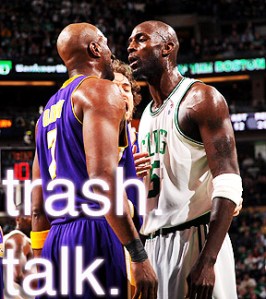
Trash Talk Leaves Stain on NBA’s Record

Trash Talk

Should NBA trash talk be televised?

There currently conflicting messages being thrown around in the NBA. The first says that the “NBA Cares”, but the next delivers quite the opposite message. The NBA Playoffs are in full swing and every move seems to be getting noticeably more intense and every action more magnified. Although trash talk has always been an integral (and sometimes advantageous) part of the NBA, sensitive mics and hi-def cameras glued to every square inch of the arena are giving audiences an eyeful.

In the  heat of competition a lot of things get said that players will ultimately forget about by the end of the game, but when these instants get replayed they look bad- I mean, really bad. Although trash talk is usually not audible, anyone watching an NBA game will find themselves lip-syncing four letter words from players’ mouths all too frequently. These three second moments get turned into thirty-second clips and then get flipped on to YouTube within minutes- and voilà! A brief moment is transformed into an unforgettable clip that will surely be viewed a few thousand more times. Thanks to this cycle and the effectiveness of social media, the NBA now has its own archive of verbal slip ups and mouthed swears embedded across YouTube, and this makes for a PR nightmare.

Without a helmet to hide behind like other pros, the NBA is rolling out bigger fines and more of them to athletes and coaches who continue to voice their frustration. Contrary to many league officials, I do not believe it should be up to NBA players to regulate their in game behavior. The NBA would be wise work out a deal with their network affiliates to decrease the number of expletives that reach its audiences. The number of close-up follows and even showing replays of players trash talking and swearing  does well to produce dramatic effect, but it does not bode will for the NBA’s PR goals. Changing this could potentially have a huge impact on reducing the amount of foul NBA video circulation.

Posted by: hannakd | April 25, 2011

Your online presence and privacy

It seems as though I am constantly having to re-do my privacy settings on my Facebook.  Month after month, a new update, a new agreement, a new something, effects the way my Facebook is presented to my friends, and the world. In the last year I have deleted about 200 photos, mainly photos from my careless high-school days when employment was just an afterthought, but today when your online presence is just as important as anything, making sure that my Facebook is completely private is something that I am constantly worrying about.

As many times as I check all the boxes that signify that only my friends can see my profile, there are so many ways for people to access it if they really want too. So why put these privacy settings up in the first place? To make users feel somewhat secure? Don’t get me wrong, I love Facebook, Facebook takes up a lot of my time, but if we all know that nothing is ever truly private why do we continue to worry about what is on our pages, why don’t we just delete our Facebook’s? Time and time again I consider deleting my online presence, but never do I actually follow through.  I will continue to update my privacy settings, as long as Facebook continues to change them, but when will it be the last straw for users? With every privacy change, I loose a little trust in the site, so when will I finally get over collecting friends? I don’t want to delete something that represents me, but I also don’t want to have to continue to censor myself for somebody I don’t even know. It all comes down to how private a user truly wants to seem to the online world, and if they want those pictures from the weekend festivities up or not.

Posted by: kristakhauk | April 25, 2011

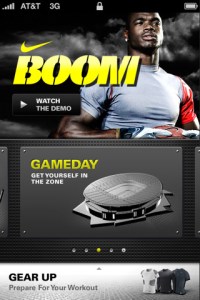
Nike. Boom.

Here at the University of Oregon, I think it’d be an understatement when I say that Nike is a pretty big deal. In regards to updates in the world of Nike — as of February 2011, the business launched Nike BOOM, an iPhone application that syncs your music to your dynamic training workouts. Simply choose your favorite sport, type/length of training (such as intervals) and elite coaches and athletes of your choice will give you blasts of motivation when you need it most during your specific workout.

What’s even better is that the app is free! Nike has literally found every which way to integrate its brand into our lives and push us to “Just Do It.”


Posted by: deniseschenasi | April 24, 2011

Location-Based Services: Traceable?

I came across a Wall Street Journal article the other day and was a little taken aback. On my iPhone, I often get alerts asking if I’d like to turn the “location” on/off when running an app, going to fandango, using maps, etc. I usually think nothing of this and simply click accept. However, after reading this article, I am now a bit skeptical about having the location option turned on.

Android and Apple phones regularly transmit locations back to Google and Apple servers, according to data and documents analyzed by the Wall Street Journal. According to the article, recent research found that an Android phone collected location data every few seconds and sent it to Google several times an hour. Apple disclosed that it receives this information about two times a day. Both companies state how users have the option of turning off location-based services and that any information that is sent to Google is anonymous and untraceable. However, many people are unaware that location-based services are turned on by default until a user manually turns it off. Also, certain features such as maps, do not properly work when location is turned off. Even more alarming is that recent research has shown that it can be traced back to the phone through a unique ID that is tied to the phone. Apple has not responded to requests for comments on these recent findings.

From now on, I am going to think twice about whether I want location services turned on when using my phone. Who really knows where information about where I am/what I am doing is going? If Google is regularly receiving this information, who else has access to it? Apple is only adding more fuel to the fire by not responding to requests for comments on the matter. If anything, this makes me even more skeptical to use location services.

« Newer Posts - Older Posts »

Categories