Posted by: lmbshepard | February 17, 2012

From the classroom to the real world

This class has already earned its tuition back in practical use at work and in another StratComm class.

One of the choice nuggets I put to work on Monday was advising another government communicator on the downside of switching from .GOV to .COM (www.rockvillemd.gov). I shared what we learned regarding how .com, .edu and .gov are ranked in search. I don’t know what they decided to do but the information was included in a report to her Council.

Another piece of information I learned last Saturday was put to use immediately as I finished a social media paper for Marketing 610. I was writing about the marketing potential of Pinterest. Learning about “nofollow” links and how they impact Google rankings in this class allowed me to add a very important limitation to my analysis of Pinterest’s marketing potential.

I am looking forward to seeing what tomorrow brings with our guest speakers from I-Site.  On a side note, I worked with I-Site three years ago when we rebuilt www.GreshamOregon.gov and can’t say enough good things about them. I guess tomorrow will be from the real world to the class room.

Posted by: Donna Z. Davis, Ph.D. | February 15, 2012

And on to SEM/SEO we go!

This month we’ll be hearing from the folks who are attending the University of Oregon’s search engine marketing (SEM) and search engine optimization (SEO) workshop at the George S. Turnbull Center in Portland. Thanks to Kent Lewis, President of Anvil Meida and Hallie Janssen, CEO at Anvil for their inspiring and informative presentations last Saturday! Looking forward to the insights of ISITE Design, Bing and Google during our next two Saturdays.

Posted by: jessica | December 4, 2011

Broadband services monitor illegal downloading?

Did anyone else know that this is going on?  Just the other day, I was informed that Century Link (my internet provider) can limit my access and use if they suspect illegal downloading.  My friend who works at a coffee shop says that Century Link has them on some sort of probation right now for too many customers illegally downloading.  So I did a quick search and came up with this:

Big Brother: Hollywood & Your Internet Provider Will Be Checking Your Download Activity to ‘Protect You’

Does anyone have any more information?  I’m just curious.

Posted by: Donna Z. Davis, Ph.D. | November 30, 2011

Need something to read?

As we talk about information overload and link fatigue, I thought I’d share some other tidbits for your reading pleasure. The news is so full of important and relevant information based on our discussions of late! With that in mind, check these out when you have a moment to catch your breath and ponder.

First amendment and Twitter! http://1forall.us/freetotweet/
and…
Think about the balance between regulation and freedom of press as heard on NPR just this morning! Familiar with Rupert Murdoch? We didn’t even really discuss tabloid press! Check this out: http://www.npr.org/2011/11/30/142929296/british-panel-told-phone-hacking-was-necessary

Posted by: sdiaz05 | November 28, 2011

Citizen Journalist Credibility

Professional journalists regardless of who they work for are assumed to be credible and trained.  In the hiring process, they had to meet some professional standard in order to secure their job.  Therefore, regardless of whether the reader agreed with the journalist’s story, opinion or position, the journalist is at least seen as someone that is a trained professional.

“Citizen Journalists” on the other hand can be useful.  I’m sure many of them are trained and know what they are doing and can produce good work.  However their information is automatically wide open for speculation and questioning.  Their credibility is always in question, even if it’s a good story.  A good writer can make a story believable.

I was once working on a class project related to interpersonal communication in relationships.  In doing my research I ran into a blog that contained what appeared to be good content.  This blogger had a strong following.  I attempted to reach to owner of the blog and eventually made contact.  In our communication, I complimented his blog and work.  I asked him what his educational background was and what makes him a “relationship expert.”  He told me that he doesn’t have a formal background in interpersonal communications or relationships for that matter.  It was all opinion based on what he has experienced, seen others experience and informal untrained polls he takes.

I felt bad for his followers because many of them had genuine issues they were discussing and they appeared to believe what he posted.  Maybe that’s why they followed because they heard what they wanted to hear.  I un-friended him.

Someone else asked the question “How do you decide which sources are credible and which sources are not?”  That’s probably how.  You just have to chase them down and ask for their credentials, training and sources.

My questions:

Is it worth chasing down the credibility of a citizen journalist to decide if you will believe their story?

At what point to you give them credibility and start believing what they write?

I’m a 21st century digital boy, I don’t know how to read but I’ve got a lot of toys… — Bad Religion, “21st Century (Digital Boy)“, 1990

Call me a dinosaur. Or a traditionalist. Or just a plain old stick-in-the-mud. But those who readily anoint “citizen journalism” as the inevitable successor to legacy journalism need to pull out their ear buds, set down the iPad and slowly back away for a minute.

Digital technology has indisputably  transformed how we communicate, interact, learn and even think. And it’s certainly had a huge effect on journalism as well as individuals and communities vis-à-vis the concept of “citizen journalists.” But revolutionary tools do not automatically equate to a revolution.

Technology and social media are tools. Means to an end. And while those means have achieved remarkable ends in journalism, activism and communication in general, they’re also just as frequently used as self-indulgent vehicles for tunnel-visioned narcissism. To wit, Kim Kardashian has 6.8 million Facebook “likes” and 11.5 million Twitter followers. Thomas Friedman has 17,000 and 67,000.

Digital tools undoubtedly increased organizers’ ability to mobilize (and to some extent sustain) social movements like Occupy. But relatively few protesters appeared to have anything more than cursory knowledge of the underlying issues and grievances the movement is purportedly founded upon.

What this week’s readings underscored for me is that digital technology, social media and “citizen journalism,” are tools that can be reasonably effective but also significantly flawed unless three fundamental issues (training, expertise, funding) are adequately addressed.

Our “140 characters or less” society is often reliant on style (and speed) over substance.  But real journalism, whether it’s conducted by citizen or legacy journalists, is painstaking work. Original, un-aggregated reporting of any significant depth requires time, resources and due diligence. For now, most of that heavy lifting is still done by the dinosaurs.

Discussion questions:

How has digital technology and social media helped—and hurt—social movements like Occupy?

What distinguishes a “citizen journalist” from an active, engaged citizen with a WiFi connection?
It is said that the Internet was supposed to unite people and facilitate two-way communication (Srinivasan, 2011, p. 1).  Yet, what impact does it have on creating a physical environment for dialogue or mobilizing people? In a 2009 study done on the impact of social media on public relations practice, Wright and Hinson report that findings clearly indicate public relations practitioners believe the emergence of social media have changed the way they communicate.  There is considerable agreement that blogs and social media are more personal because they bypass traditional mass media to get to audiences and create direct dialogue. 

 Respondents to the study’s questions generally agreed that blogs and social media have had a huge impact moving public relations in the direction of facilitating more two-way communication by opening up direct channels of communications between organizations and their publics (Wright & Hinson, 2009).  It concluded that bloggers are themselves becoming influential opinion leaders and the instantaneous 24/7 nature of social media brings new meaning to the concept of “dialogue.” The study, however, does not address the impact social media has on facilitating social movements that promote the continuation of direct dialogue outside of the digital world.

 Class discussion questions:

  1. Do social media offer possibilities for mobilizing social movements outside of the digital world?
  2. If so, what would this mobilization of people look like?
  3. Could this movement be both physical and digital in nature?


Posted by: acecasanova | November 28, 2011

To you traditionalists…. Come OOONNNN!!!!

So as I’ve been working endlessly on gathering as much information about this week’s readings as possible, I snapped.  The massive amount of information on the web fried my brain and I shut down from information overload, or as I read in another blog, link fatigue.  Before I shut down I was captivated by the debate over the worth of the “Citizen Journalist” and the idea of “transparency is the new objectivity.”  As a recent blogger I have just one thing to say to traditional journalists; “COME OOONNNN!!!!”

Alright, so a lot of traditional journalists see the good in blogging.  The idea that bloggers are the “breaking news,” and in all reality realize that as a journalist, they can really gain from reading our short little stipends that, albeit could very well be rumored Facebok Fodder, is still none the less, an interesting story.  Now I understand that many blogs can be misleading Mr. Pressman.  I understand that media literacy is essential for us, the user, to weed out the good from the bad.  Yet to those who are resistant to the revolution, you should really find a way to  be our friend and befriend technology.  The internet is rapidly taking over your field buddy and if you don’t wake up and smell the fresh tweets then you’ll be left behind.

Questions:

What are your “media literacy” criteria when you see a blog or a Facebook news post?

Were the 7 ways to thinking like a modern day journalist helpful to you in thinking critically about what you read?

Do you feel pictures help to create transparency or do we sometimes rely too much on pictures to tell the story?

Posted by: bburatti | November 28, 2011

Free Journalism

The Internet liberates citizens to report freely without the constraint of requiring licensed spectrum or large capital outlay.  Its instant access allows for stealth journalism. Instead of stapling posters to telephone poles in the middle of the night, rebels post and tweet.  Incidents are no longer confined to eye witnesses. This is one of the greatest promises of the Internet and demonstrates where citizen journalism is best used.  It provides the extra cameras, the unfiltered raw footage, and the undercover access that cannot be delivered by any other means.

The Guardian’s invitation to have citizens help investigate expenses contained in 400,000 documents is a good example of how non-journalists can assist paid journalists. This is no different than calling in an expert to provide perspective on a specialized topic. It’s just a broader scope.

David Watts Barton’s piece about hyperlocal websites exposes the difficult truth about citizen journalism when it forms the basis for entire websites.  It replaces paid journalists with free, untrained labor.  It rewards quantity over quality.

For paid journalists working with a new timeline for story distribution, I think it’s naïve to think that users consume a blog differently than a posted article in the editorial section.  If information is available, the user doesn’t distinguish between a reporter tweeting, blogging, or posting it to the home page.  While journalists now deal with the story continually in progress, the expectation of high quality should remain the same on every platform.

Discussion questions:

  1. Users expect information on the web to be free.  What does that say about the value we ascribe to reliable information?
  2. When is content generated by users appropriate and when is it not?


Posted by: lorihowell | November 28, 2011

How visually literate are you?

You have around five seconds to capture my attention as a reader. That’s about as long as a virtual hug.

While it’s critical to use every tool to get your point across, including infographics and data, it’s most important to be accurate.

Kimberly Turner, on PROBLOGGER, offers helpful guidelines for building your own infographics, including tips for doing your research and citing your sources.

I’m also enamored with the British website Information is Beautiful, recently introduced to me by my friend and colleague, Cora Crary. This resource is full of inspiring visuals and new ideas for telling your story through data.

As people who work in the industry, it’s sometimes easy to recognize bad facts or bias; but that’s not always the case for the community contributor. I appreciate the encouragement offered by Josh Catone on Masable in “Why New Media Literacy Is Vital for Quality Journalism.”

Josh wonders, “What happens if media literacy training doesn’t keep up with the acceleration of the information stream? What happens as the line between trained and citizen journalism continues to blur? What happens if our kids can’t pick out fact from fiction?”

That day — the digital future — has already arrived.  As a consumer, I see the line between content and ads blurring all the time.  As a professional, I know I need to slow down, check facts, and train others to take more care.

Questions: 1) How do the proliferation of infographics change the fact checking landscape? 2)How have the tools for fact checking changed in the past decade? 3) Has it gotten easier or more difficult?

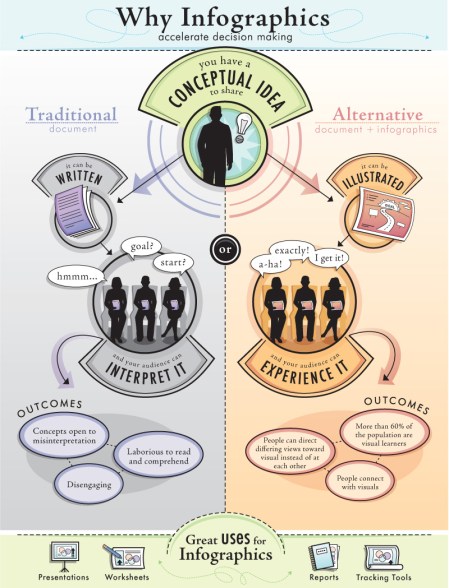
An inforgraphic promoting infographics from Resource Link in Brisbane, Australia

An infographic promoting infographics courtesy of Resource Link in Brisbane, Australia

« Newer Posts - Older Posts »

Categories