Posted by: governmentdistrust | November 2, 2015

Spreadable Media Spans Oceans

How many people who have access to multimedia have not see this?

https://www.youtube.com/watch?v=9bZkp7q19f0

Believe it or not, this by far is the most viewed Youtube video of all time. This video has more than doubled the second most viewed video of all time. To date this video has been viewed more than 2.44 billion times! Henry Jenkins said “If it doesn’t spread, it’s dead” (1), so how did a music video from South Korea become a global sensation?

In a post by Nigel Hollis, he breaks down the top 10 reasons why this video became so universally liked. Summed up he lists the number one reason that this video is so popular is that “The Music is Catchy: The Rhythm is Simple and Repetitive.” However it’s the last reason that pushed this video over the top with staggering numbers. “Peer pressure: Now that the video has been seen by so many people, peer pressure encourages people to watch the video in self-defense – “What? You still have not watched it? Lame!”” (2) It’s amazing to think that this video that’s been seen 2.44 billion times started with one person who viewed it, thought it was funny, catchy, and had some scenes that related to them and their culture, so they put in on their Facebook page. Their friends saw it and put it on Twitter and so on.

For this post to make any sense then you have seen it too.

1.) http://henryjenkins.org/2009/02/if_it_doesnt_spread_its_dead_p.html

2.) http://www.millwardbrown.com/global-navigation/blogs/post/mb-blog/2012/11/21/10-reasons-why-Gangnam-Style-became-a-global-hit.aspx

Posted by: MikeP | November 2, 2015

To spread content, it helps if you’re famous and rich

Chapters five and six of “Spreadable Media” are among my favorite readings of the program. The chapters embody the question that many of my close friends and clients have been trying to answer for the past decade.

How do you take your passion and turn it into something self-sustaining or profitable?

Each version of that question has different variables. Some people don’t want to live in cities. Some people don’t want to give their talent away for free. Some people don’t want to spend their creative energy on marketing.

Despite the variables, I think most agree that “spreadable content” is part of that answer.

(my buddies had over 1 million views in a month with this video, but it didn’t amount to much)

The commercial examples used in “Spreadable Media” are interesting for the purpose of discussing spreadability, but aren’t that relevant to the scenario I’m painting because (in my humble opinion) all cited successes had two things in common:

  • examples usurped people/trends that were already famous/viral
  • examples had a fair amount of financing or major corporate backing

Most people aren’t inherently wealthy or well-known (unlike this lot). Therefore, for those of us who aren’t working with big budgets, our challenge (as artists OR communication professionals) is to fine tune our communications to connect with our target audiences.

But how do we do that when we are limited by budget? What do we do when we are relatively unknown? Should we self-impose a time limit before throwing in the towel?

Posted by: tiannarachellewaite | November 2, 2015

Unfinished Content=Collaboration.

In Chapter Five of Spreadable Media: Creating Value and Meaning in a Networked Culture the authors discuss the different ways in which content producers design spreadability, or the qualities that spread content consumption. One method that immediately stood out to me was the “unfinished content.” The premise of this technique is essentially providing incomplete media to content consumers. This offers content consumers the opportunity to have their hand in the production of the content. This approach has been used in advertising, but is spilling into other realms—such as TV shows.

One innovative TV show expands on this idea of spreadability and uses it for complete collaborative efforts of multimedia pieces that are then broadcasted as segments to a TV show. It’s called Hit Record on TV (http://www.hitrecord.org/)  and is directed and hosted by Joseph Gordon-Levitt. Basically, anybody can upload creative works—video, writing, photographs, drawing, songs, lyrics—which can then be worked on or contributed to by anybody who wants to collaborate. This means that one single piece of media can have hundreds of co-producers. The best part is that each collaborator gets paid for their contributions based on the merits of their work.

How do you think collaboration on the global scale will change the media we consume and produce? Will having several co-producers strengthen or weaken the overall message being delivered?

Posted by: whatbrettsays | November 2, 2015

Supporting creator- distributed media- that’s also free to fans!

Chirault Web Comic, created by Ally Rom Colthoff

Chirault Web Comic, created by Ally Rom Colthoff

The reading in Chapter Six, Courting Supporters for Independent Media, struck a chord with me, especially when the authors referenced Scott McCloud’s book, Reinventing Comics. I thought immediately of one of my favorite web-based comics, Chirault. Created as a side project by Ally Rom Colthoff nearly a decade ago, Colthoff has always asserted that the comic remains free to fans. She does accept pledges from patrons, the money of which goes to replacing art supplies and hosting her website. The popularity of the comic has increased quite significantly over the past few years, and when fans inquired as to whether a print version would be made available, a Kickstarter campaign was created. It was very successful, and a new campaign has been launched to support a second volume.

I really enjoy when independent creators are able to continue creating what they love, with the support of the fan community. And while the artwork and story are top-notch, the popularity of Chirault has much to do with Colthoff’s insistence that her work remain free for anyone to enjoy.

Does anyone else have examples of creator-distributed media, free or otherwise?

Posted by: theartspj | November 2, 2015

The New Yorker Radio Hour

As someone who is a fan of The New Yorker magazine, but doesn’t tend to read it online, and is too cheap to buy a subscription, I’m really excited about the launch of WNYC’s The New Yorker Radio Hour (NYRH). If we consider Jenkins, Ford, and Green’s criteria for what constitutes media that is more likely to spread, The New Yorker just upped it’s chances of spreadability significantly by branching out of the field of literary magazines, and entering into the world of radio (and podcasting) in partnership with one of the most reputable, and listened to NPR affiliates in the country.

On its page on the WNYC website, the NYRH producers state that the show “is not a radio version of the magazine, but something entirely its own…” That’s great, but the radio program still draws from its parent magazine stories, interviews, profiles and other creative material that is “easily reusable.” In this regard, by affiliation The New Yorker magazine is absolutely making itself more likely to be spread. The WNYC program is only a week old, but it is already portable, and available when and where audiences want it (online). By being weekly and relevant to current goings on it will undoubtedly contribute to a steady stream of material, and much like the magazine, will capture multiple audiences.

Although the show is still under development, it has tremendous potential for success and spreadability in this new medium! Tune in, y’all!

NewYorkerRadioHour_TempMarquee

Posted by: John Herman | November 1, 2015

Bringing two countries together through “The Force”

There has been a lot of media attention recently regarding Star Wars and the franchise’s upcoming movie, but perhaps “Emperor Palpatine” winning an election in Ukraine stood out the most.

3666

Dimitry Palpatine was elected as a city councilman in Odessa. The emperor was just one of 50 Star Wars themed individuals running for public office. The year prior, a man dressed as Darth Vader ran for Prime Minister. A statue of Vladimir Lenin was transformed into Darth Vader in response to a law outlawing communist symbols.

The franchise is a huge transnational influence and its spreadablity in culture and profitable revenue has been the envy of many, however people in Ukraine are now taking it in a new direction. Despite the candidate officially changing his name in order to run as the emperor, the event drew the attention of US mass media to Ukraine’s democratic elections. This also brought awareness to the number of issues in the country, involving claims of fraudulent elections, the war, economic downfall and government corruption.


These events echo what Jenkins, Ford, and Green explained in chapter 7 of Spreadable Media, where “spreadable media practices are expanding points of contact between countries.”  Despite many reasons given for how and why a Star Wars villain won an election, what is clear is that people are sending messages through the re-purposing and reusing of media to call attention upon themselves and spark change. A message in which “two cultures are touching each other across geopolitical distances.”

Posted by: zachputnam | October 31, 2015

Spreadable Controversy

Screen Shot 2015-10-30 at 7.15.56 PM

Click the image to read Wired’s coverage of this story.

In Chapter 5, the authors of Spreadable Media identify some elements that can make something more easily spreadable. Health news stories, like this week’s “Bacon Causes Cancer” fiasco seem especially spreadable, and I’ve often wondered why. No matter how many times they contradict each other (where are we on butter now?), it seems people are always eager to read about the latest medical “breakthrough.”

In case you missed it, the WHO classified bacon as a “class one carcinogen,” along with tobacco and asbestos. Looking down the authors’ list of spreadable qualities, I think “timely controversy” is the closest match (p 213). As I mentioned, these medical news stories often contradict conventional wisdom or something the “experts” have told us before. But were we ever told that bacon is good for us? No, I think the controversy here is about what this classification means and how it should be reported.

My favorite podcast, On the Media, analyzed this story here and Ivan Oransky of Retraction Watch pointed out that “a lot of public health organizations haven’t figured out how to communicate effectively to the public.” By not providing any context or comparison, people aren’t sure what to make of it, and journalists have a tendency to make the worst of it.

Do you think some journalists were responsible for creating this spreadable controversy? Or is the onus on the WHO to do a better job explaining the news to begin with?

Posted by: moosnack | October 30, 2015

Grantland Shuts Down; Internet Buzz and Fans Upset

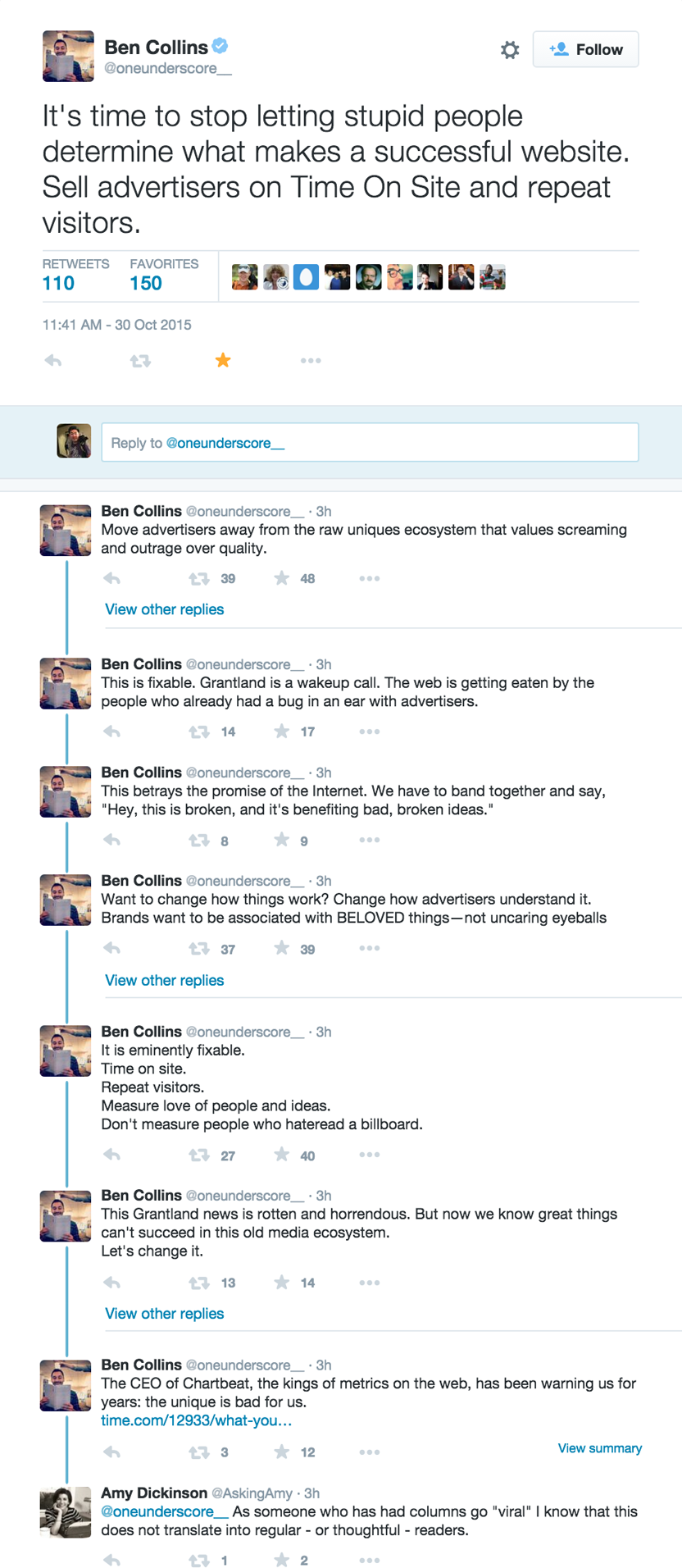
A news story generating buzz today is ESPN’s decision to shut down Grantland, a sports-related blog started by writer Bill Simmons. Many sports fans and sports writers who I follow on social media have been expressing outrage and sadness at this action, as the blog was renowned for its high-quality articles and its loyal community of readers. This happening makes me really think about some of the topics discussed in the final chapters of Spreadable Media, especially those in the conclusion. Content is becoming much more than a numbers game, and both the large media entities and the old systems of measurement are ill-equipped to provide the full story between brand-customer / website-reader and so on, in this new age. This Grantland news has sparked an intense discussion between many new media-savvy figures, and I’ve included a screenshot of a conversation on Twitter here illustrating this, and the quest for new, more accurate and comprehensive metrics.

MSC_Blog2_Oct30_M1

I also recommend going to this link, which is also a group of people exploring ways for the “new Internet” to function, for advertising, for writers to get paid adequately, and so on. Interesting read : http://randomnerds.com/this-patronizing-thing-we-keep-talking-about/
Posted by: theartspj | October 27, 2015

Freebie for Finance: REI Opts for Outside

Yesterday on Facebook I read a post from a friend of mine:

Black Friday is the epitome of how out of control the consumerism and materialism of our society has gotten. I love how REI has decided to promote spending time outdoors and with family and friends by choosing to close its doors on one of its most profitable days of the year. It’s refreshing to see a company whose values are more important to them than the bottom line.

Maybe you’ve seen this on your own timelines? Check out the #OptOutside page on REI’s website with the “spreadable” hashtag, and dramatic countdown defying the gluttony that is Black Friday in America.

This is a brilliant move by REI’s communications team to appeal to consumer emotions, and build goodwill among employee stakeholders (they’re being paid), and consumers. Doesn’t this make you want to shop at REI even more now?

REI is a retail company. Would upper management really just close all of its stores on one of the biggest shopping days of the year out of the goodness of their hearts, without consideration to their bottom line?

REI may not be the retailer of choice for most Americans on Black Friday. Targets, Walmarts, Best Buys, etc. are hot spots, so maybe this move wouldn’t significantly affect their bottom line, except in the long term. Folks, like my friend (who is an employee), will remember that REI opted outside during Thanksgiving, and they’ll give thanks by shopping there in the future.

Posted by: governmentdistrust | October 26, 2015

Nielsen Ratings Still Calling the Shots 65 Years Later

This week’s chapter “The Value of Media Engagement” sheds a gigantic spotlight on a glaring problem that’s faced TV media for years. How do networks accurately determine what TV shows are worthy of air time and which ones are wasting time and money? Despite all of the advances in TV, the development of the internet, and the plethora of multimedia that is available today, the networks continue to use a system that was invented 65 years ago. The Nielsen rating method started in 1950 and is still used today.

The problem with old technology is that it is not compatible with new technology so therefor it does not recognize it. This is also the case where many of the viewers are not counted towards the total viewing audience. In an age where many people are boycotting cable and watching their shows online, this is a problem. “One major issue that has arisen for ratings systems is the increased popularity of Digital Video Recorders (DVRs) that let people record shows and watch them later, called “time-shifted viewing.” The Nielsen ratings do take these viewers into consideration, but they cannot track exactly what shows are watched at what time, only that viewers recorded them and likely watched them within about three days.” (Wisegeek)

Are Nielsen ratings the last bit of leverage the cable companies have on viewers? Are the Nielsen Ratings bias towards younger people who watch their shows online?

http://www.wisegeek.org/how-do-networks-know-how-many-people-are-watching-a-tv-program.htm

« Newer Posts - Older Posts »

Categories