Posted by: madisonbalk | May 3, 2011

The Power of Twitter

Everyone has different means of how they receive news. For some it may be the newspaper, and for others it may be television. With the rapid growth of social media, however, many people are beginning to receive news via Twitter and Facebook. Although this may seem like an insignificant and unprofessional means to gather new information, Twitter seems to be the up-and-coming method to send newsworthy information to the world.

In light of America’s most recent “win”, Twitter was the main source in spreading the word about Osama Bin Laden’s death. With over 3,400 tweets PER SECOND for an hour and a half after his death, #OsamaBinLaden holds the record for the highest number of Twitter mentions. For the majority of my friends, Twitter was the first place that they heard about this incredible news.

This does bring up a very important point, however, that because Twitter is so quick and easily trending, a lot of inaccuracies were made. Immediately after the news broke out on television, Twitter blew up. Different accusations were made as to how Osama died, where he died, and who killed him. Because so many people wanted to be the “first” person to declare the news, inaccurate information was revealed.

How reliable is twitter as a news source? Can we completely rely on it with confidence?

Posted by: Emilie Hartvig | May 3, 2011

Twitter Etiquette? Ethics?

Is there such thing as Twitter etiquette? Twitter ethics?

Today I posted a link on a new game that Budweiser created called “Poolball,” a combination of pool and soccer. A few minutes after tweeting this post I see a friend tweet the same exact thing that I tweeted but without any credit. Is this something to care about? Would you care if you tweeted something you found interesting and have someone else retweet your tweet without retweeting you? I am not sure if that made any sense so let’s see if I can break that down.

On Twitter, we have three options when viewing tweets: favorite, retweet, and reply. There is also the option of @-ing a fellow twitterer. The option I am concentrating on is the retweet. When I like someone’s tweet enough to retweet it myself, I select the choice so that my other twitter followers can see the source I found the tweet from. Sure, it would be cool to seem like I am the original source of such a sticky tweet but the truth is I found it from someone else. Am I the only one who does this? I feel like if I did not utilize the retweet button, I would be somewhat cheating the system. How do you feel about this?

Posted by: Jen J. Ashley | May 2, 2011

Six Sentence Story

I came across a blog called Six Sentences: What can you say in six sentences? I decided to take the bait. Could I write a compelling story in six sentences or less? I found it more difficult that I thought it to be. How can you answer who, what, when, where, why and how in just six sentences? The reality of life in our fast pace, social media expert driven communication today is that we have less than six sentences to draw someone in. So why not make the entire story in six sentences. So here is what I came up with.

I received a phone call from my father on May 1, 2011 at 7:20 pm stating I needed to turn on the television. President Obama was about to give a speech that the country was unsure what was going to be said. I gathered up 20 of my sorority sisters and we crowded into our television room. We waited worried, scared, chilled and confused. Then, the story leaked. After 10 years of hiding, the figurehead of Al Qaeda Osama Bin Laden had been found and killed.

Does it tell you all the emotions that was being felt? The joy, the anxiety, the sadness, and the rush of emotions of the sad day of 9/11? No. Nothing could describe that feeling, not even an entire novel. If no amount of words are adequate, then six sentences at least hits the tip of the iceberg.

Communicating this way is more than difficult. But to be successful in social media this skill is a must have. It takes practice, and years to perfect it. I have far from perfected it, but I am practicing. You should too.

Read the blog. Try your story.

http://sixsentences.blogspot.com/

Posted by: kristakhauk | May 2, 2011

Social Media & The Royal Wedding

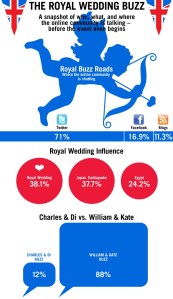
The world has been very well informed about the Royal Wedding and its events – thanks to social media. Royal wedding social-network chatter has surpassed that for the Japanese earthquake and tsunami and the people’s uprising in Egypt. According to Webtrends, which gathers data on social media, 911,000 wedding-related tweets were tracked in the past 30 days, which accounts for 71% of all social media tracked by the company.

Kate Middleton & Prince William

Television networks are also taking advantage of social media platforms, sharing minute-by-minute news, giving wedding followers various social media outlets to choose from – like the BBC’s royal wedding Facebook page, CNN’s Twitter posts from celebrities, and Today show’s Facebook page and NBC’s Twitter account @royal wedding. Twitter reported a total of 1.7 million tweets by the time Prince William and Kate Middleton had been pronounced husband and wife. That’s 13,000 tweets per minute.

What I found interesting about these numbers is that one would assume that most of this social buzz surrounding the wedding is coming from the UK – think again. About 65% of the tweets, blog posts, and Facebook updates are coming from the U.S. and a mere 20% are coming from the UK. Weird.

It’s truly amazing how fast news travels and how everyone can now send it via social media. I don’t think these statistics just show how important the wedding is; they also demonstrate how prevalent it is in daily life today. It has become such a vital communications tool in the news world that having an account on Facebook and Twitter is a necessity to keep up with today’s current events. Simply turning on your television and watching the news is simply not enough anymore.

Posted by: hannakd | May 2, 2011

The true impact of social media

As my twitter newsfeed filled with tweets regarding the death of Osama Bin Laden, and my Facebook feed filled with patriotic phrases, I really realized how big of an impact social media has had on society over the past decade. Within the first few minutes of the announcement my friends and I had already turned to CNN.  The effect that social media has on society has been something that has come to my attention recently. The devastating tsunami in Japan and the death of Bin Laden I learned about regarding social media, only to call my parents, who do not have a Twitter or Facebook, to relay the news to them.  The day has come when I am the one in the family who is most informed and knows all the breaking news stories. This isn’t because I read the Oregonian or New York Times everyday, but is a result of the online community that has continued to grow over the last few years. Twitter and Facebook are not the only platforms of social media that are being used to acknowledge world events, foursquare is as well. Only moments after the announcement of Osama Bin Laden’s death did people began to “check-in” to a “post Osama Bin Laden world.”

As much as people want to speculate the purposes of Twitter and other forms of social media, the events of May 1st, 2011 can only help to reiterate how important and meaningful social media is in our world.  If it wasn’t for the constant tweets appearing on top left corner of my computer, I may have missed the historic announcement of Bin Laden’s death and the President’s address to the nation.

Over the last two years the presence of social media has forever changed the way many people receive their news, including myself. News is no longer a 24-hour waiting period, or wait-till-morning type of deal. I am so interested to see what the future holds in terms of social media, social awareness, and the online world.

Posted by: Jen J. Ashley | May 2, 2011

Electronics: Bringing Families Together or Apart?

On April 29, 2011 The New York Times posted an interesting article called “Quality Time, Redefined” Bascially the article describes a not-so-out-of-the-ordinary scenario of a family sitting in a living room together and all of them not communicating. All of them were staring at some sort of different screen. In my experience, getting all of my immediate family under one rough is difficult. After accomplishing that task how do you get everyone “unplugged”. Is electronics getting in the way of families?

Some say yes. If a family in a room are all concentrating on what is going on their particular screen, how can they interact? If a child is constantly waiting for a text message how can they actively participate in a conversation? If a little boy is enamored with is video game is he really listening? You can be in a room and not hear anything at all.

On the other hand, some argue that technology has brought families closer together. Speaking from my own personal experience, I would not talk to my family half as much as I do without social media and electronic devices. Most of my family lives on the east coast and without Facebook we would never speak! I now speak to them all monthly. Also if it was not for text messaging my mother and I would communicate about half as much as we do. Without Skype I would have had a difficult time with having a relationship with my boyfriend while he was in Germany. For me personally, electronics have brought me closer to my loved ones.

Should children be relying on technology this much? I personally do not believe so. Part of my love for school when I was younger was because I got to see all my friends. I went home, visited with my family and looked forward to the next day. Having the lack of electronics was important for socializing at school for me. I am torn on the issue that electronics are bad for all ages of family members but both size have reasonable arguments. I guess it is just up to each family to decide for themselves what is right and acceptable in the household.

Posted by: deniseschenasi | May 2, 2011

Employers Plan to Hire More College Grads This Year

As I am finishing up my junior year of college, I have become obsessed lately with figuring out what I am going to be doing this time next year. It doesn’t help that in every single one of my classes my professors are constantly talking about how important it is to have two internships by graduation. I feel like every week I get bombarded with new information on how to interview, how to land an internship, etc. And although all of this information is incredibly helpful, it also has put me in a state of panic as the realization has hit me that one year from now, I will be about to graduate from college and will have started my search for a job. It’s a scary thing to think about, especially because so many people I know have found finding jobs, even with a college degree, increasingly more difficult. So as I was wondering what to blog about for this week, I remembered an interesting article I came across last week from USA Today. According to the article, 2011 college grads are finding a better job market than last years college grads. Why is this? Employees are planning to hire 19.3% more recent graduates. The amount of applicants per job position is decreasing as well — there are about half as many people applying for jobs now than this time last year. In other words, the article noted that in 2010 there was an average of about 41 applicants applying for an open position, while now that number has decreased to about 21 applicants per job.

Although reading this article helped to ease some of the dread I have been feeling over the difficult and scary task of finding a job after graduation, it is still going to be far from easy. Nonetheless, this article is something I wanted to share with my fellow 2011 graduates to help ease some post college job search dread.

Posted by: sarahbrown90 | May 2, 2011

Cloud Girlfriend

Recently I came across a tweet about a new website that was launched called Cloud Girlfriend. I read a few blogs about it and decided to check out the website. The website is to give men the opportunity to have a virtual girlfriend. The relationship is built completely around fantasy. The creater if the website is David Fuhriman. His initial concept behind the website was to have a bunch of women post on men’s walls to display their popularity to all their female friends through social media. According to Fuhriman, it has developed into “a mix between Match.com and Second Life. Users log in through Facebook and create a profile using a selection of headshots of attractive people. They then fill out a profile, which allows one to choose between such options as “Books or Movies”  etc. and there is no sexual preference available. After making a profile of your own you can then browse through other profiles. You then have the opportunity to chat with someone if their profile is appealing to you (remember that the pictures being displayed are not of the actual people).

“We allow people to define their ideal self, find their perfect girlfriend or boyfriend and connect and interact as if that person existed,” Fuhriman says. “It can help in learning how to manage a real relationship, and they then can take it into the real world.”

This concept is extremely odd to me. Why would you want to create a false profile and connect with people you don’t know for pure fantasy purposes? The picture isn’t even of the actual person you are speaking to. For all you know the picture could be of a beautiful 23 year old blond female when in reality you are speaking to an over weight forty five year-old-man. Wouldn’t people rather have real relationships with real people who they can actually spend time with? This website is a great example of how virtual our world is becoming and how we have distanced ourselves from making new relationships in the real world.

Posted by: Dana Nicholson | May 1, 2011

Social Media: The Royal Treatment

Starting at 1 am PDT coverage of the Royal Wedding began, and did not end until after 5 am.  Over 22.8 million viewers tuned in to watch the ultimate modern day fairytale of William and Kate, and that was just in the United States.  The use of social media connected people all over the world to talk about the wedding.  At some point in the coverage  one of the correspondents said that every trending topic on Twitter was related to the Royal Wedding.  More than 911,000 tweets related to the Royal Wedding occurred in 30 days.   According to an article by USA Today 65 percent of all social media related to the wedding has come from the U.S.  By the time the ceremony was over, there were more than 1.7 total tweets counted related to the wedding.  I know I definitely contributed to that number in some small way.

For pretty much two full days it seemed that almost every media outlet was buzzing with news about William and Kate.   It is crazy to think that with all the people in the world so many of them were not only watching the marriage of Prince William and Kate Middleton, but that they were talking about it.  Prior to the wedding Twitter headquarters tweted this picture of how they are preparing for the wedding, and Twitter believed they could handle the wedding overload.  Well, Twitter was mistaken.  With all the millions of people tweeting about the wedding the site was on overload for a little bit.  That just goes to show how many people are connected through social media sites like Twitter. People separated by more than 3,000 miles can all talk about the wedding like they were guests.  It makes the world feel so small and personal, especially when we all share in such a personal event like a wedding.

Posted by: hwsmith | April 28, 2011

A New Way to Organize Web Content Daily

On StumbleUpon I across a new online application called Pearltrees, which offers the tools to capture and organize online information. Pearltrees is a visual format that also reflects the storyline behind the topic being discussed. Pearltress is different from bookmarking sites because it creates a visual mapping of the content that can be dragged and dropped into many different visual trees. According to the site’s FAQ, “Pearltrees is a collaborative network that lets users create, enrich and share the world of their interests. In Pearltrees, everyone creates a world and uses parts of others’ worlds to extend it. By doing so, everyone contributes to the overall project: building the first human organization of the Web.” From my understanding, Pearltree is a visual tree made up of individual pearls, where each pearl represents a link to web content that the user wants to save or organize. The web content wished to be saved or organized can be an article, blog/ blog post, Tweet, video or any link that has a URL.

In order to fully understand Pearltree, I had to watch the YouTube video to simplify the application:

As blogger’s we can now add the word “Pearling” to our social media vocabulary. It will be interesting to see how Pearltrees develops and if people find it to be helpful. I also wonder if the term “Pearling” will become catchy like “Tweeting.”

« Newer Posts - Older Posts »

Categories