Posted by: lmbshepard | April 13, 2012

Crisis is the new black

Over the last couple of weeks I have been thinking about what truly makes a crisis. It seems like everyday there is a new crisis to be consumed, deconstructed and analyzed.  Then I came across an article on The Wall Street Journal online titled the Short Life of a PR Nightmare that discusses the rapid nature of a crisis and how fast it can fade away.  It got me thinking about some of the incidents that are pegged as a “crisis” today. Are they really a crisis or are they something closer to an inconvenience, an embarrassment or a gaffe? Cases like Penn State, the Costa Concorida crash, Toyota’s sticking gas pedal and even Taco Bell’s meatless meat taco should be considered real crises and treated as such.  But should every slip be considered a crisis?

Let consider two recent incidents. Who can forget the short-lived fuss made about President Obama talking about having “more flexibility after the election” into an open microphone? Was this a crisis, a gaffe or an intentional signal being sent from a President who knows his way around a live microphone? We may never know. What we do know is that it wasn’t a crisis. Or, how about Romney Senior Advisor Eric Fehrnstrom’s “Etch A Sketch” moment? This certainly wasn’t a crisis, heck it wasn’t even a crisis in the campaign world but the media treated it like it was.  The public and the media love a crisis and both enjoy making hay out of another’s embarrassing moment for sport and to fulfill our appetite for schadenfreude.  It is almost as if having a crisis has become stylish. Yes, stylish and to prove my point ABC just launched a new show about crisis communicators called Scandal that glamorizes the work.

The problem with labeling everything a crisis is that crisis becomes the norm and we don’t even react to real crises anymore. Soon we’ll find ourselves in a society where we storm, pout and even mourn for five minutes on social media about the crisis of the moment and then we’ll move on.

Oh, wait we are already there. 

Posted by: bahughes13 | April 11, 2012

Facebook Firing

We’ve heard a great deal in the past few weeks about employers demanding job applicants’ Facebook passwords. However, the story of Marci Brabb goes even further. Marci worked at Oregon Natural Market in Ontario, Oregon. She says she was fired – at least partly – because she posted about the bad days she had at work. Although she never named her employer in the posts, at least one report stated that the employer fired her for “slander.” Her boss isn’t doing interviews, but he does admit that he had pages worth of her “private” Facebook page printed out during the termination meeting. He claims she was fired for other reasons.

Regardless of the true reason for the termination, the fact that he felt he had the ethical and legal right to access her private page is troubling. Even MY employer – which makes very clear that I have no right to privacy in any portion of my background – doesn’t ask for Facebook passwords. Maybe because the powers at my agency haven’t caught up with technology? Or maybe because even they recognize there must be a line there somewhere?

What would you do if the job you really really wanted required access to your social media accounts? Would you allow it or walk away?

Posted by: bahughes13 | April 5, 2012

Happy April 4th!

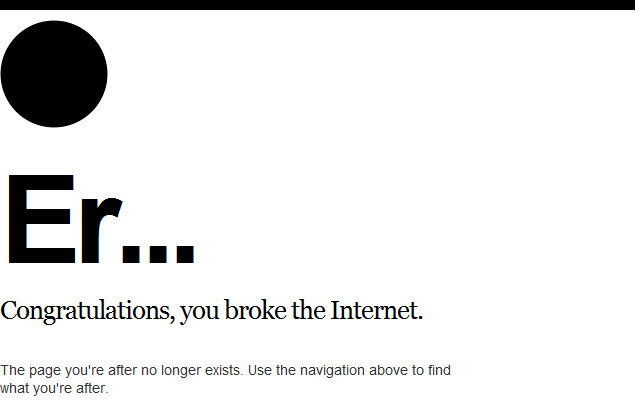
I know we aren’t necessarily posting this week, but I couldn’t pass this up! I had a flashback to SEO when I saw this posting on Mashable about 404 errors. (Who even knew 404’s really were before SEO? OK, maybe lots of people, but not me.)

Regardless, apparently 4/04 is the day to celebrate 404’s! In honor of that, Mashable posted some of the more creative options designed to inspire and humor (or aggravate and annoy) users. My two favorite:  1) Stormtroopers (on the site of a company that makes Star Wars costumes of all things), and 2) Broken Internet (on the site of Digitalmash, which is run by a Facebook product designer.) There are many more at this link:  http://mashable.com/2012/04/04/funny-404-error-messages

Enjoy!


Image

Image

Posted by: lmbshepard | April 3, 2012

Case Studies from PRSA

Case Studies from PRSA

Given our discussion of case studies, I thought you would be interested in this recent post on the PRSA blog about brands recovering from crisis situations.

Laura

Posted by: dandelion4good | March 7, 2012

WHO NEEDS SEO? (Stating the Obvious)

In the Google age, how is possible that any marketers, managers, creative directors, writers, and website developers are not informed, at least about the importance, of Search Engine Optimization? Who does need to understand how to optimize a web site?

In four years of undergraduate study in Public Relations, Media Studies and Writing, SEO didn’t come up. In 2006 we were learning from industry veterans about all the ways they had executed communications plans, not how they would in the years after we graduated. How could they deprive us?!

For my creative, analytical mind… SEO is brain candy. If words like meta-tag and alt-text taste like brussel sprouts to you, hire people who know their SEO.

In five years of public relations work that extended at times into content development, digital communications and ad buying, no one ever asked me about their SEO ranking.

I have never hired a website developer, but the ones I’ve worked with were doing very little to optimize their clients’ websites.

I knew SEO was a thing and left it to the people who knew about it. But not very many people actually know what is meaningful about it or how to effectively manage it. I was one of the many until studying SEO at the University of Oregon’s School of Journalism and Communication at Turnbull in Portland, OR.

Building a website without an optimization strategy is like opening a storefront without a sign or address.  It won’t matter how shiny your salvaged pine floor, how large the front windows or how artful the lighting. No one will know where you are or what you’re selling in there.

Our dependence, as citizens and consumers, on search has become so great that we Google (as a verb) even our favorite web sites over and over again.

Integration of search and social media only muddies the waters, but makes their currents that more powerful.

SEO is an integral part of the communications and marketing mix. Any business owner, manager, communications professional or creative director needs to know it’s importance and essentially, what it is. It allows people to see the sign that tells people who you are and how to get to you.  If you are in business and have a website, you need an SEO strategy and your website developer, manager and content contributors or editors need to know what the strategy is.

Content planners and developers, writers and website developers need to know how to do it, at least in part.

Posted by: Donna Z. Davis, Ph.D. | February 29, 2012

Just the tip of the search engine iceberg!

After three great days of SEM/SEO instruction, it’s clear much was learned and much is yet to be learned!  There seems to be a common theme among you all (among US!) that as fast as we can begin to understand one new technology, another emerges — or a new use of an old one. Before you move on from search engine marketing and optimization, I wanted to remind you about a few great links Ricky Skidmore from Google mentioned.

Here are a few really helpful links regarding Google Analytics:

  1. Google Analytics Help Center 
  2. Google Analytics YouTube Channel 
  3. Google Analytics Blog 

Wishing you all great success in being well optimized in your Internet future!

Posted by: slee3324 | February 25, 2012

Reel ’em in! Customer experience is big for business

What I find most intriguing about SEO is its focus on the customer experience with the brand. Of particular interest, is the “reel ‘em in” strategy where organizations build website content based on what is attractive to the user. This is an important perspective to remember because often times organizations make decisions based on what they want the customer to know, not what the customer actually wants to know.

I found this rule helpful in analyzing my own organization’s website because it made me realize that our content was written for our own organizational interests opposed to that of the customer. We had built content based on what we wanted the customer to know about our product instead of trying to “reel ‘em in” with content they find valuable. Some organizations have found ways to link a good customer experience with increase in loyalty and sales (ROI). I find it especially difficult to do this when the goal is to raise awareness, which is hard to quantify. Quantifiable metrics like purchases would be easier to equate with the customer experience.

Following is a link to an interesting study on relating the customer experience to ROI. While it does not focus on SEO, it is interesting to see how customer experience is big for business, no matter what.

The Business Impact Of Customer Experience by Megan Burns

Posted by: lmbshepard | February 25, 2012

Will work for SEO

When J624 ends tomorrow I will know enough about search engine optimization to integrate some of the concepts and tools into my work. Besides the practical skills and tools I picked up over the last three weeks,  I also picked up an appreciation of how important it is to pay attention when Google rolls out yet another announcement with a cute name like Panda, Fresh or Kitten  (I made that last one up but it is believable).  Advising city staff on effective web content is a struggle under ideal conditions.Hopefully some of the resources and strategies I picked up over the last three weeks will further my ability to get staff to keep content fresh, dynamic and written in terms a regular person would search for.
I found this Guide to SEO Salaries by Market on Mashable that I thought would the class would find of interest. It lists salaries by market and job title.
Posted by: jessica | February 24, 2012

Survival of the Fittest

Working on my presentation for the SEO workshop has me to thinking about the power of a first impression. So I googled it (of course) and this is what I found: “it takes users less than two-tenths of a second to form a first impression, according to recent eye-tracking research conducted at Missouri University of Science and Technology. But it takes a little longer—about 2.6 seconds—for a user’s eyes to land on that area of a website that most influences his first impression”.

So, this made me think about my own web browsing tendencies and yes I am quick to judge you for your website. I am willing to meet you but if you intend on developing a relationship with me, you better make a good first impression in under 15 seconds or I will “bounce” right out of your site. Isn’t it interesting that websites live and die on the same Darwinian principals that govern existence- survival of the fittest?

http://www.ragan.com/Main/Articles/Study_First_impressions_of_a_website_form_in_less_44432.aspx

Posted by: bahughes13 | February 23, 2012

Looking at the next stage of SEO

I think my brain is going to implode. I had heard of Search Engine Optimization before, but I really never had any idea the depths to which one could seed a site to make it more functional and productive. I know that I’m still not getting all of the tools and techniques to the level that they could be utilized, but at least I now know what I don’t know. Better yet, I can recognize when some new concept just might be important enough to try to figure out.

For instance, this article – http://www.mediapost.com/publications/article/168327/yahoo-rallies-for-better-search-metrics.html – shows what we may face in the future. The author’s point is that new mobile technologies are changing the game, and that Yahoo!, Google and others need to stay ahead of the curve. He’s recommending that the major search engines work together to come up with a standardized system to measure search metrics. In addition, he points out that Yahoo! and others are developing SEO technology that can be shared across platforms. One day you may be able to search for a restaurant on your PC, use your phone’s GPS to guide you there, and use your iPad to place your order.

Now if we can just keep up!


« Newer Posts - Older Posts »

Categories