Posted by: pho307 | November 9, 2015

How Do Social Apps Lead Your Life?

Every day I wake up, the first thing I do is to check my phone. I don’t want to see the notification numbers on my phone, but the App store sends me notifications every day.

Here is a video I found in Vimeo. It tells us which apps were popular in 2014.

SOCIAL MEDIA TRENDS 2014 from 2FACTORY Motion Design on Vimeo.

The video identifies Vine, Pheed, Line and Snapchat as some of the new social media apps. You can share 6 seconds video from Vine. Line is a free instant message app. Pheed allows you to share music, videos, photos and posts with your friends. What’s more, you can sell your content to Pheed.

According to the research from Spreadable Media ,“Transnational media content sometimes comes through the front door, distributed by commercial interests seeking to expand markets,”(Jenkins, Ford and Green, P.260). People spend their time on social media because they like quick, easy way to send or share information. Social media apps are designed for people’s demand. That’s why we have these news apps join into the market.

It’s not just about the market, it’s also about politics. Politician use social media filter information and create their own economy. “To be sure, these materials are being filtered according to local cultural norms and interests,” (Jenkins, Ford and Green P.260). During the last election season, President Obama used social media to compete with the other candidates. For example, “Barack Obama’s victory Facebook post was the most liked photo on Facebook with over 4 million likes” (The Huffington Post, 2012). His one post may discussed by many people in his public relation team.

How should our generation educate ourselves to distinguish the filter and get the true information?

 

Posted by: pho307 | November 9, 2015

What is the real news?


Media organizations need to make profit so they can survive in the world. It means, sometimes, media organizations may not represent real news because they speak for their interest group. For long-term thinking, the public need to hear more real news.

What is the real news? As a journalism student, I think about this question every day. Everyone may have their own answers, because we all have our agenda. Every time when you search news online, you already knew where you would go and what kind of news you would read.

According to the authors of , Mediating the Message in the 21st Century, in Chapter 7, “Prominence and importance, conflict and controversy, the unusual, human interest, timeless, proximity”are the defining attributes of news (S&R, p.171). Long run news is one of the examples.

The long news is defined as the news stories that still matter to the public in a long run, according to Kirk Citron, a media expert and the editor of The Long News.

He gives long news example: “People are having trouble feeding 6 billion today. How people is going to feed 9 billion people in the future?” According to the Science Daily, 1.02 billion people hungry.


Posted by: tamgalcook | November 9, 2015

Changes in How We Read

Have Kindles, IPads and tablets replaced paperbacks? While on vacation, I watched sunbathers around the pool reading books, paper books…a majority of the holders of these books were a generation my parent’s age. The younger generation around the pool was reading via their cell phones or tablets and they may have been using social media not necessarily reading a book.

My question is will books be replaced by new technology, like the internet as the main source for reading and information? Research shows the increased use of households with internet access.  In 2007, 19% of the world’s population used the internet. In 2014, there were 2, 925, 249, 355 internet users meaning 40.4% of the world population has acquired internet access.  (Internetlivestats.com)

Additionally, how we approach research is changing as well.  Do we still use printed material? Finding sources online is quick and often a good resource for students and readers. It seems modern technology is more convenient and efficient. I believe that time drives what media choice a person prefers. “…print is now the least used, lagging well behind television, computers and radio.” (Carr)

How do you read?

Posted by: Joe Kuffner | November 9, 2015

Maybe What the Internet is Doing to Our Brains is a Good Thing?

I admit that I find myself more agreeing with the arguments in The Shallows than disagreeing. I too lament many of the changes in the way we consume media in the 21st century. But I can’t help but think of Nicholas Carr’s spiritual predecessors who lamented the advent of telephones, recorded music, radio, television… even writing.

I came to this realization at the end of chapter three, when he discusses the conflict between orality and literacy. You can almost imagine Socrates writing the Ancient Greek edition of The Shallows. That is, if he didn’t believe that “dependence on the technology of the alphabet will alter a person’s mind, and not for the better.”

Carr goes on to reference Walter Ong, who says that writing is “utterly invaluable and indeed essential for the realization of a fuller, interior, human potentials.” That losing oral culture was in fact creative destruction for the human consciousness.

Isn’t it possible that the internet and the way we consume media today could similarly have a cumulative effect that is positive rather than negative? I’m reminded of this interesting essay that pushes back against arguments that say the internet and modern technology cause social isolation.

oldman

Posted by: pho307 | November 9, 2015

Media, medium, medium

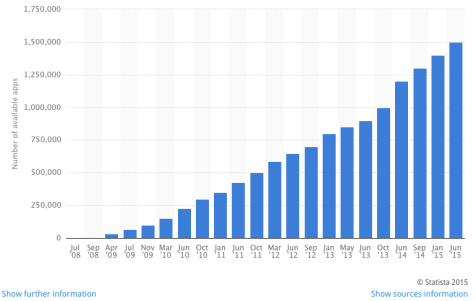
In 60s, McLuhan pointed out “whenever a new medium comes along, people naturally get caught up in the information” (The Shallows, page.2) Now, it’s 2015, McLuhan’s opinion still works. According to the data from The Statista, “the number of available apps in the Apple App Store since July 2008. As of June 2015, 1.5 million mobile apps were available.”

屏幕快照 2015-11-09 上午8.42.26

In Chapter 6, Carr discusses how print books got survive from the digital world. Personally speaking, I’m a print book reader. The reason why I like it because I feel satisfied when I hold a print book. Every time when I pass by Powell Bookstore, I see a lot of people pick up their books.

Here is a video I found in YouTube, which compare and contrast print book and e-book.

E-book changes the way of reading, but paper books are still in there. How e-book sets the agenda for us? What should we do in the digital world? Should we follow the world change ourselves or fight with it? Verify, double check and think twice…

Posted by: John Herman | November 9, 2015

Endurance

Call me an incurable optimist, but I see a future for books. As I was reading chapter 6 and its references to Amazon and e-books, the recent announcement of Amazon’s first physical book store kept coming to mind-a surprising turn around for a company that has been seen as the villain of bookstores. Looking into articles on it, there are a number of opinions on the impact of this. Some writers say it is a good thing, others claim it’s a bad thing. There were also a number of articles that described a resurgence in books and bookstores. One underlying theme in these articles was the question: what does this mean for the future of bookstores and books?

Nicolas Carr writes of the book surviving earlier challenges, yet also states “we have cast our lot with the juggler,” a foreboding prediction about the end of books and the manner in which we read them.

But could there be another outcome?

Radio, film and vinyl were all types of media slated by commentators to fade into obscurity. Yet, today there are locations in Portland where people can still have  camera film developed and recently a company began producing vinyl records.

Does this mean books will survive the Internet? Books changed our culture of reading and how we communicate, such as the use of spaces between words. Users of the Internet continue to use the same words and sentence structure that evolved with the development of the book. Is that not survival?

Posted by: tiannarachellewaite | November 9, 2015

Technology: The Unknown

In Chapter Three of The Shallows: What the Internet is doing to our brains, I was very taken by the idea of determinism versus instrumentalism. Essentially, determinism is the belief that our technology will become so advanced that it will begin to create more sophisticated technology on it’s own, which will render human beings dispensable. This idea is the foundation for many Sci-Fi movies and books, because the thought that this could potentially happen is a fear to many in our ever technology dependent society.

The ideals of instrumentalism is the other side of this argument, with the conservative idea that technology is merely a tool for human beings to use in order to make daily tasks easier—nothing more.

The interesting thing about this particular argument is we honestly don’t know the future of technology. The rapid nature of growth and change is beyond anything the world has ever seen. Even the once thought ridiculous and outlandish pieces of technology in 1980’s Sci-fi films are now a reality. How could we ever really know how technology will unfold and change? The more interesting question: how will we change along side of it?

Posted by: jbeanblossom | November 9, 2015

What we see and what we know

People see what they want to see and believe what they want to believe.

My preschooler’s teacher said the four letters that no parent wants to hear: ADHD.

“He’s four.” My quick reply exposes my feelings on the matter.

She agrees that it’s too early to tell, but wants my wife and I to be aware.

This awareness has morphed into a rabbit-hole of research, including the effects of technology and media consumption on young brains.

Carr’s third chapter of The Shallows explores the evolution of human abstract thinking and its harmful intersection with media consumption. The general stages of child cognitive development is illustrated (no pun intended) in how a child draws a picture of their physical surroundings: “…we progress from drawing what we see to drawing what we know.”

Carr believes that constant exposure to realized imagery and turnkey artistic expression interrupts this development. ABC News’ story aligns with Carr on a number of levels.

I’m not convinced. The experiment where kids’ communication is observed with/without media devices seems superficial. When a child is using a tablet, their observed communication with others is decreased, and without, it increases. Of course that’s the result. Today’s form of media consumption is designed for the user to be in the driver’s seat.

Before we see hard evidence and research on how little brains are impacted by long-term exposure to technology and media devices, I know that my question as a parent should be, how do I encourage healthy consumption habits and make communication happen?

Posted by: governmentdistrust | November 9, 2015

Slaves to Time

“Life was, in the words of the French medievalist Jacques Le Goff, “dominated by agrarian rhythms, free of haste, careless of exactitude, unconcerned by productivity.” (1)  When the Monks took the first steps to measure time they unknowingly built the first link in the chain that binds us today. People in general have become obsessed with speed and saving time. The internet is too slow, the traffic light is too long, and the list goes on. We are always watching the hands of the clock, the clock that we invented. We are slaves to time, and the internet saves us countless hours, but according to Carr there is a price to pay.

According to Carr the price we pay for this Holy Grail of knowledge called the internet is our attention span. The internet is slowly turning into the Holy Grail of information, and people all over the world continue to feed it. “Research that once required days in the stacks or periodical rooms of libraries can now be done in minutes.” (2) To have a wealth of knowledge at our fingertips saves us time and is convienent, but is it worth the cost?

Can we go all day without looking at the time?

1.) “Jacques Le Goff, Time, Work, and Culture in the Middle Ages (Chicago: University of Chicago Press, 1980), 44.”Excerpt From: Nicholas Carr. “The Shallows: What the Internet Is Doing to Our Brains.” iBooks. https://itun.es/us/mmTRw.l

1.) Excerpt From: Nicholas Carr. “The Shallows: What the Internet Is Doing to Our Brains.” iBooks. https://itun.es/us/mmTRw.l

Posted by: nearaquietstream | November 9, 2015

Read more, learn more

This week’s reading of “The Shallows” by Nicholas Carr really makes me sad for our humanity…and for books! I found myself agreeing with the author when he says that one day, books will be rare or obsolete. I love books, and I used to read a lot when I was younger. But these days, I, too, just like the author, have found myself distracted, my attention constantly flitting from one thing to the next; I can no longer sit still long enough to read through a book–or allow myself to be immersed in another world–like I used to.

Carr states in his book that studies have shown that deep reading promotes critical thinking, reflection and contemplation which results in greater comprehension and deep learning. However, “calm attentiveness,” the state we experience while engaged in a book, eludes many of us these days as a result of the amount of multimedia we consume.

In an effort not to lose our ability to think critically and focus deeply (while there are still books around anyway), I thought I’d recommend an article by Ryan Holiday written in 2013: “How to Read More–A Lot More.” This guy reads 5-10 books a month–slowly–and even takes notes for a commonplace book (great idea for ingraining new knowledge into long term memory by the way).

So what’s on your reading list this month (er–I mean after grad school in a couple of years)?

« Newer Posts - Older Posts »

Categories