Posted by: acecasanova | November 7, 2011

“Are you not entertained?”

In the words of Russel Crowe in Gladiator as he throws his victory in the coliseum back at the on-looking public scrutinizing their form of entertainment as something to be mocked and frowned upon.  Is this not similarly applicable to the media we consume.  Our “entertainment,” if you will, has become something of a sham.  Tossed in our face by our “Caesar” which in this case so happens to be the large corporations.  The monopolistic competition being that of the guards and gladiators coming to slaughter their victims in the coliseum.  And who is our Russel Crowe?  Who is our Gladiator, here to show us the corruption hidden beneath the “Caesar’s” form of entertainment, or rather distractions?  That would be McChesney.

As we are raised, we are exposed earlier and earlier to the corporate media messages spoon fed to us by the “Caesar” and we are ruled by this “Caesar” without ever thinking critically about what’s underneath the entertainment he provides us.  What corruption is there that lies within his house?  As McChesney clearly points out on pages 277 and 278, “the key is to reach them before their brand decisions have been made, and before their defenses to advertising are well developed.”    As Mike Searles points out, “…if you own this child at an early age, you can own this child for years to come.”

Once upon a time a friend asked me a question.  “What is the most powerful and evil form of manipulation today?”  His answer, “marketing.”  As someone from a marketing under-grad I find this thought disturbing.  The idea of trying to “own” a child’s mind before he has the ability to decide for himself.  To use distractions in children’s movies and Disney to blind them from the product placements and brainwashing really.

What is your opinion on “getting them while they’re young?”  Is this a disgusting practice, or ingenious?  Has marketing gone too far?

On the other hand, do we not owe corporate greed for funding some of the most amazing improvements in CGI, movies, and television?

Can we be so upset with advertising if we knowingly watch movies under these pretenses, and enjoying what the advertisements have brought to the cinema?
Posted by: lmbshepard | November 7, 2011

If this were an actual emergency we would be screwed

As I’ve prepared for my presentation Monday night on the subject of media serving the democratic process I have thought a great deal about media ownership and how a small handful of corporations decide what we read, watch and listen to. I’ve vacillated on whether McChesney paints an overly dramatic picture of the situation to outrage regarding the state of the media ownership. Just when I thought I found some peace on the subject something happened late last week.

As part of my job, I am helping Gresham’s Emergency Management staff publicize Wednesday’s test of the Emergency Broadcast System. We’ve all seen and heard tests of the Emergency Broadcast System before but Wednesday’s test was to be extraordinary. For the first time all broadcasters, satellite and digital radio and television, cable television and wireline video providers would be participating at the same time for three minutes.  On Thursday, without explanation, FEMA announced the test would be shortened to 30 seconds. From three minutes to 30 seconds? All fired up on McChesney, it didn’t take me long to develop a conspiracy theory about why the test was shortened.

According to FEMA, the “participants provide a critical public service to the nation as the resilient backbone of alert and warning when all other means of communication are unavailable.”  Could it also be that the participants own enough lobbying clout to pressure the government into shortening the test substantially so as not to cut into valuable programming and advertising time ?

In FEMA’s words Wednesday’s test was supposed to  help “identify necessary improvements so that all levels of the system can better serve our communities and deliver critical information that will save lives and property.”I can only hope the change from three minutes to 30 seconds will still provide FEMA and its partners with enough information to test the readiness of the system. Unfortunately, we’ll never know until it is too late.

http://www.fema.gov/eastest/

Posted by: carebear | November 7, 2011

We the People

Something really stuck with me from our latest reading, The Political  Economy of Media by Robert W. McChesney.  In his discussion on social change, McChesney states that it “will be determined by how we, the people, organize, respond, and act.”  A topic of much discussion lately is the Occupy movement sweeping the nation.  Despite his controversial stance on much to do with the media and government, I can’t help but notice he is definitely on to something.  The Occupy movement is being compared by many to the Tea Party.   And, most would agree that the Tea Party has definitely found organization, its voice, and action.

When he wrote this book, the Tea Party had not yet formed, the Arab Spring was in the distant future, the Occupy movement was non-existent, and the consumer voice had not yet created the strength and pressure on major corporations that it has begun to hold today.  What is happening today definitely appears to be the beginning of change, and hopefully for the good.  The formation of an organized Tea Party, the shift in operating strategy of Netflix and the cancellation of the debit card fee by Bank of America, are just a few examples of what is to come.  You can’t ignore us, the people, any longer.  We are finding our voice and it is beginning to work…

In Chapter 9, McChesney discusses the crisis in Public Broadcasting.  What organization and action on behalf of the people needs to occur to ensure the Corporation for Public Broadcasting doesn’t encounter the same predicament as NASA and space travel?

What is the next step for the Occupy movement?  What needs to occur for them to really have an effect on the political environment of this country?

Posted by: carolbcarolb | November 7, 2011

What’s your malfunction…

I echo those of you who said this week’s readings were heavy and left you feeling a bit depressed. It is apparent that just the existence of an advanced media system does not guarantee that it will serve democracy.

Corporate ownership of media is becoming more ubiquitous with more and more First Amendment rights being accorded to corporations. Last week an appellate court reversed the FCC fine against CBS surrounding the Janet Jackson Superbowl “wardrobe malfunction” incident. CBS said that it hoped the decision “will lead the FCC to return to the policy of restrained indecency enforcement it followed for decades.” Duke University law professor Stuart Benjamin, a telecommunications law expert, called the decision “a slap in the face for the FCC.” Lurking behind the case, he said, is a “really big First Amendment issue: Is there really any difference between broadcast and cable, Internet, books, etc.? If we apply the same First Amendment scrutiny to broadcast as we do to other forms of communication, all these broadcast indecency rules are almost certainly unconstitutional.”

***

1.  Does this latest court decision send another message that the corporate media is untouchable and can do no wrong?

2.  Is it right for corporations to be considered “people” and given the same First Amendment rights as you or I? What could the future implications of this look like?

Posted by: jessica | November 7, 2011

The BBC and CBC

“If a society could have either media or government but not both, the sane choice for people is free media.” – Thomas Jefferson

Click to access How_the_BBC_is_run.pdf

While McChesney enlightens us as to the sorry state of our news system, I think it is imperative that we start looking at solutions to the problem.  Frankly, the problem seems so convoluted and hopeless that we need to shed some light on the future.  McChesney suggests that the BBC and CBC are superior to our existing models, therefore why don’t we look at what makes those models successful in comparison.  The government has some hand in regulating and funding those systems, which Thomas Jefferson would warn us against, but is there something to learn from their example?  Obviously our free-market is not producing a news system that upholds the original call to govern our democracy, so what can we learn from other systems in an effort to build our own unique solution to the problem?

How is NPR and PBS different from the BBC and CBC?

Do you think that some form of government regulation and/or funding is the solution?

Posted by: lorihowell | November 6, 2011

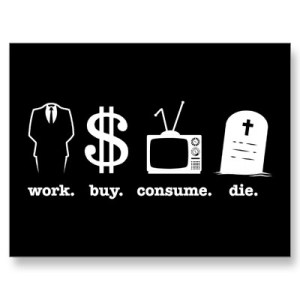
Looking out for #1

work.buy.consume.die

Image thanks to Zazzle.com

I have an opinion about the central question posed for this week’s reading, “Do the media serve the democratic process?”

That’s an easy “no.” The vast majority of media companies in America serve themselves as for-profit endeavors. The public can’t expect companies to rise above that goal in support of democracy.  That’s simply not the charge of business executives.

Even if the media kicked in overdrive today, Americans don’t have an equal say in the decisions that affect their lives. The reasons for this are twofold: 1) our leaders are almost always people who are really good at raising money or already wealthy and 2) people aren’t voting; they’re too busy consuming to try to fill the emptiness in their lives to bother reading voters’ guides.

Consider the Possibilities

Question 1:

Do you think a non-profit media system would help build a healthy democracy—one where most citizens participate—in America?

Question 2:

How could we drive the proceeds from the new non-profit media companies into facilitating democratic processes?

Posted by: bahughes13 | November 6, 2011

Happily Ever After…

I know the politically correct thing to say would be “of course media consolidation is bad” and “massive media corporations are brainwashing us into consumer-driven oblivion.” In fact, McChesney puts it very bluntly when he says “Modern marketing is clearly the greatest concerted attempt at psychological manipulation in all of human history,” (p. 277).

However, I am going to swim against the flow and say up front that I love Disney. I love everything about it. I love the parks, the movies and even the mice (and I’m deathly afraid of rodents). My daughter has three different official Disney princess dresses, at least five Disney princess dolls and countless crowns. I have helped pad the bank account of Disney’s corporate kingdom more times than I care to count. Do I know that Disney is playing me with dreams of “happily ever after?” Yes. Do I care? Not really.

Why not? Probably for the same reasons that most of the rest of the general population doesn’t care about the mega-media business. I have issues that are much more real and important to me. I have to work full-time, raise a family, pay a mortgage and, now, figure out how to go to school on top of it. Add in some random fears about terrorist attacks and earthquakes, and I am filled to the top with worry, conflict and troubles.

Maybe in the years to come I will regret my lack of caring. In the meantime, I could really use some pixie dust.


Discussion Questions:


1. In Chapter 14, McChesney says “commercially viable media content Internet sites remain few and far between — and, today, it would be difficult to find an investor willing to bankroll any additional attempts.” Is this still the case? Aren’t there all sorts of content options now (corporate-controlled such as foxnews.com and user-controlled such as YouTube)?

2.  What would McChesney think of the Twitter-driven revolution in Iran and the social-media driven Arab Spring?

3.  McChesney has definite ideas as to how the 1st Amendment has been adulterated through the years. Does his belief of what the 1st Amendment should be mesh with what was originally intended by the Founding Fathers?

Posted by: bburatti | November 4, 2011

Do the air waves belong to the people?

The Communications Act of 1934, upon which all current broadcast law is still based, stipulates, “The air waves belong to the people.”   In its historical context, this stated philosophy could be interpreted as one small victory the reform movement achieved. McChesney refutes that idea with the progression of actions and regulations that have consistently protected corporate interests over the interests of the people.

The attacks on public broadcasting and NPR demonstrate the deep chasm between free speech of citizens and free speech of politicians and corporate entities. Public broadcasting and NPR are called liberal simply because they report. To present both sides of an issue, to ask probing questions, is now blasted as “liberal bias.”

Speech in advertising is protected.  Corporate owners have free speech rights. Yet insightful reporting is squashed.  Reporters go to jail to protect sources. In this election season, consider that political advertising for federal candidates has a “no censorship” rule.  Stations must air the commercials no matter how offensive, no matter how spurious. What other form of speech has this level of protection?

The progression of the tenet that big business serves the common good led to global consolidation of media.  A mere handful of companies control the outlets for public discussion worldwide. The myth of the “New Economy” additionally fueled this media gold rush and left us with highly leveraged companies.  Debt-laden companies focus on increasing productivity, not innovation.

  1. PBS and NPR are now more reliant on sponsor support than ever before. How do you think that will impact content?
  2. With multiple cable channels with documentary, historical, and science programming, do we still need PBS?
  3. What are the most troubling aspects of global media consolidation?
Posted by: bburatti | October 31, 2011

News consumption and tablets

Here’s a piece the Pew Center just released about the news consumption habits of people who have tablets. Does it give you hope for the future of citizen engagement or reinforce the problem of consumers remaining unwilling to pay for news delivered in a digital format?

http://features.journalism.org/files/2011/10/The-Tablet-Revolution-Graphic-9001.png


Posted by: slee3324 | October 26, 2011

Bad news is bad for business

Last night I had the opportunity to attend a movie premiere of “The Rum Diary,” starring Johnny Depp who returns to the role of Hunter S. Thompson, one he played in Terry Gilliam’s film adaptation of “Fear and Loathing in Las Vegas.” The movie details the 1950s newsroom in Puerto Rico where Depp brings “blasts of rage” against the greedy bastards destroying Puerto Rico.  According to a critque by RottenTomatoes.com, “a growing number of American entrepreneurs are determined to convert Puerto Rico into a capitalist paradise in service of the wealthy. When Kemp (Depp) is recruited to write favorably about his latest unsavory scheme, the journalist is presented with a choice: to use his words for the corrupt businessmen’s financial benefit, or use them to take the bastards down. — (C) FilmDistrict.” Aaron Hillis refers to Thompson as a “novelist in a journalist’s body” (http://www.ifc.com/news/2008/07/alex-gibney-on-gonzo-the-life.php).

The movie comes to theatres this Friday, October 28.  If you get the chance to watch the movie, please post your comments on how you see the curruption and political pressure from this era as relevant to today’s pressures on the news media.  Just thought I would spark some food for thought.

« Newer Posts - Older Posts »

Categories