Posted by: emmajoyce | October 21, 2012

Hey Girl

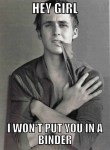
Anyone who’s remotely involved in online social words has most likely seen and/or heard about the Ryan Gosling memes like these:
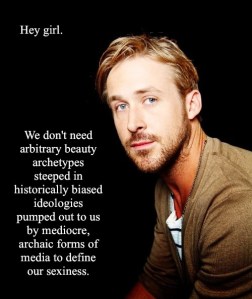
 

It is interesting to analyze this trend on many levels concerning feminism and masculinity. First of all, women are “reclaiming” the title girl…while a girl by definition specifically refers to a prepubescent female, it is used in everyday language to label women.

Our text explains, “Working together, fan identification and media publicity function to mask or bridge the gap between the star and the audience, which also serves an ideological purpose” (p.428). These memes essentially create an ideal man: sensitive, understanding, sexual, and charming. Gosling becomes a blend of the dominant ideal of masculinity: “strength, toughness, attractiveness, heterosexuality, and whiteness” (p.371) and the compassionate companion who females desire to fulfill needs of comfort and love.

This postfeminist view means that women can embrace their sexuality, while not feeling exploited or objectified.

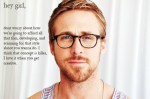
Personally, I think this is a breath of fresh air…a way for women to express things they want to hear in relationships, while at the same time being humorous. Do you think Internet fan creations like these help to address underlying social issues or do they perpetuate false fantasies?
Posted by: delphine criscenzo | October 21, 2012

“And the Winner is …”

As the authors of Media and Society tackle the controversial topics of gender, sexuality, ethnicity and Race this week, I have the feeling that they tried to pack too much in so few chapters. The references and the experts they cite are often one sided and I caught them a few times stereotyping or doing the exact thing they are trying to denounce in these chapters. They claim on page 353 that they are “drawing our attention to the way the media and culture construct these differences for us,” instead I feel that they are becoming part of the system and culture that construct stereotypes and broaden the gap between groups.

In 2011, I got the chance to attend a talk by African American film maker and producer Spike Lee. His talk was just a few days after the Academy Awards and he was upset because he felt that another Award had been given to an African American for a role that perpetuated stereotypes. Indeed, Octavia Spencer won best actress in a supporting role for playing Minny Jackson in “The Help.” Lee explained how Hattie McDaniel had won for her role in “Gone with the Wind,” Denzel Washington received an award for “Training Day” but not for his outstanding performance of “Malcolm X,” Halle Berry for “Monster’s Ball” and more recently Jennifer Hudson for “Dreamgirls” and Mo’Nique for being the mother of “Precious.” Spike Lee comments came to my mind as I was reading our authors explain on page 396 how African Americans were “beginning to gain a foothold in Hollywood from which to represent themselves.” They went on to say in the same paragraph that “this shift is also evident in the acknowledgement of African American film stars at the Academy Awards in recent years.”

When one knows that all the judges for the Academy Awards are white, of European descent, one understands the complexity of still existing stereotypes as identified by Spike Lee and all the work that remains to be done before media representations reflect the complexity of all the individuals within one group.

As journalists, how do we make sure that we are not perpetuating stereotypes?

Posted by: kelliroesch | October 21, 2012

The F-word (not that one, the other one)

Feminism may be one of those  words nice people just don’t say it in  public.   It isn’t a dirty word but it seems as if we should wash our mouths out with soap than to utter the word and acknowledge its power. The power that can make women and men cringe based on how they have personally interpreted it.

Perhaps it is difficult for women today to recognize that they have the privilege to denounce the F-word while also benefiting from the sacrifices of women who blazed trails to deliver incremental changes.  Maybe life is so great there is no need for feminists and there is nothing more to be done.

Perhaps men don’t want to say the F-word because they think it means they’ll get a lecture on equality, become emasculated, or have to examine their own belief system along with the privileges that society has delivered to them through patriarchy.

O’Shaunessy and Stadler remind us, that our current rosy picture of life should not disguise the fact that women are still discriminated against in numerous ways.  These include “unequal pay, violence against women, and general misogynist tendencies.” Why is it so horrible to not want these things? Feminism is merely one framework to address these issues. Both women and men lose when they subscribe to the idea that feminism is a dirty word.

When confronted with the topic of feminism do you ignore the F-word or do  proclaim yourself a feminist? Why or why not?

Posted by: corrinebuchanan | October 21, 2012

What is the media’s role?

This week I listened to a story from the 2009 season of This American Life titled, “Somewhere Out There.” Act two of the episode called, “Tom Girls,” is about two eight year old girls who were both born as boys. They meet one another at a conference and immediately become best friends. In this episode they talk about their likes and their dislikes, their school and their friends. They also talk about how they are viewed as different and are bullied by their peers. One of the girls comments, “I kind of feel really sad that people don’t respect us and nobody really likes to be my friend.”

When interviewing the parents, one of the moms mentions how it was the neighbors and the parents that were concerned and were calling the school, spreading rumors, and were at times the initiators of the harassment.

There is a significant lack of representation of transgender people or people that differ from societies norm in the media. This absence breads unawareness, misunderstandings and fear. I also believe it has a direct affect on the prevalence of bullying in our community. Do you believe that the media plays a role in bullying? How would an increase in transgender representation change our society?

Here is an excerpt from the episode.

 G1 – I just think of myself a lot of the times as a regular kid.

 G2 – As a boy or a girl?

 G1 – No a lot of the time I just think of myself as a regular person. Regular. Just any regular person because I don’t feel like I’m different.

You can listen to whole episode at http://www.thisamericanlife.org/radio-archives/episode/374/somewhere-out-there?act=2

Posted by: chrissypurcell | October 20, 2012

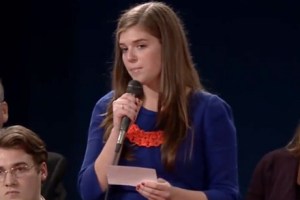
If you watched Tuesday’s presidential debate, you may remember Katherine Fenton, a young woman who posed a straightforward question to the candidates: “In what new ways do you intend to rectify the inequalities in the workplace? Specifically regarding females making only 72 percent of what their male counterparts earn.”

Well folks, big shocker: Katherine Fenton is already under attack from the conservative Washington Free Beacon for being a “feminazi” and a “party girl” (read: a slut and a drunk). Check out the full story as reported by the Huffington Post here.

When interviewed about her question and the backlash that has followed, Katherine has expressed that she is an undecided voter who is “absolutely not” a feminist (for that story, click here).

There are so many layers to this story that I hardly know where to begin.

I’m saddened that we’ve made such little progress in these postfeminist years that we’re still publicly shaming women for questioning the status quo. But what is perhaps more disappointing to me is the fact that the idea of feminism is still so divisive that a young woman who believes in gender equality is uncomfortable calling herself a feminist. Will the word “feminism” ever lose the negative connotation and be recognized for its potential as an ideology that promotes equal treatment for everyone? 

I love the Dale Spender quote in the introduction to Chapter 20 of our text: “If someone says, ‘Oh, I’m not a feminist’, I ask, ‘Why? What’s your problem?'” (O’Shaughnessy & Stadler, 2012, p. 349).

Posted by: itslikethatweb | October 20, 2012

Boys In Frocks

If there’s one thing I love to talk about, read about, think about, and write about, it is gender. Gender is such a fascinating concept, and in my opinion, definitely a social construction. I like to tell people that when they get irked about using the bathroom of the opposite sex, even when it’s a single room with a door that locks – it gets some laughs on the West Coast, but definitely did not fly in the South.

A truly fantastic example of differing opinions on appropriate gender boundaries was published on mommy blog Nerdy Apple a couple years back when the author’s 5-year-old son, Boo, dressed up as a female character from Scooby Doo for Halloween (many of you probably have already heard of this, it got a lot of media attention). Here’s Boo:

Image


A tiny deconstructionist in action. You can check out the full article here, but to give you a quick summary, Boo asked to be Daphne for Halloween, and his mom bought him the costume without a second thought. When they got to school, several parents of Boo’s classmates had a total cow, imposing their biological essentialist bullcrap on his mom and causing her to write this post. One of the most compelling points she makes is this:

If my daughter had dressed as Batman, no one would have thought twice about it. No one.

That one really echoed in my head. I’ve spent a lot of time considering what limitations we place on little girls as far as what is and is not acceptable for them to wear, do, be, etc. But little boys face plenty of their own limitations. My question is this: why is it that a girl dressing as a boy is more socially permissible than a boy dressing as a girl?

There were approximately a million ideas for a blog post that occurred to me on gender issues alone as I did this week’s reading. There’s the increase in coverage through blogs and traditional news about young boys who want to wear ‘girl clothes’ and play with ‘girl toys.’ It seems pretty clear that it’s adults who are struggling to accept this more than the children themselves. There’s the phenomenon that men who have characteristics patriarchy calls feminine must be gay (check out the coverage on the 5,000 year-old remains of a man buried with household jugs).

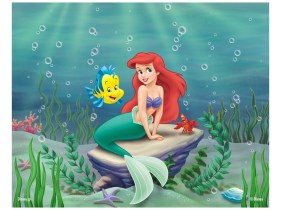
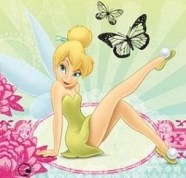
But I’m going with the sexual objectification of women, but not men, in the epitome of all Western media aimed at children: Disney movies. Below are two Disney heroines. Consider how little clothing they are wearing and the sexual ways that they are posed, especially when compared to their male counterparts below them.


In researching more about this topic, I stumbled upon the artist David Kawena on another blog who creates portraits of Disney heroes that sexually objectify them. What would happen if Disney depicted heroes more like they are shown in Kawena’s images? As much as we advance on gender equality, why is it still normal to bombard our children with sexual images of girls and women while sexually objectifying images of men and boys are inappropriate?

Posted by: karlcd | October 19, 2012

Your Body is Your Business

My favorite team super hero movie this summer was Magic Mike.  It had everything a high budget comic book, super hero, action thriller movie needs.  Our hero’s super power is driving the ladies (and men) wild.  His kryptonite is turning 35.  All the big action scenes take place on a stage or in the bedroom, and when the going gets tough  our hero works hard and does the right thing.  He hangs up his thong, follows his dream and gets the girl!

Youth is fleeting and why not make the most of your physical attributes to cash in?  Whether you are using your body to make touchdowns, sell Victoria’s Secret, or hike the Pacific Crest Trail.  Your body can be your business.  Yes, someone else will also make a profit off you, the NFL, Limited Brands Inc. or Alfred A. Knopf.  But there is no company where revenue equals profits.

Anyone who has ever wanted to start their own business knows it takes a lot of hard work and a majority of business don’t make it.  It does not matter if your business is a food cart or singing or acting.  Starting a business takes luck, knowing the right people, selling yourself,  and lots of hard work.

Do beautiful actors work hard?

Are you envious of entrepreneurs, working for themselves?

Concussions affect the quality of football players lives are they fairly compensated?

The message on Nike’s website was short and pointed: “Due to the seemingly insurmountable evidence that Lance Armstrong participated in doping and misled Nike for more than a decade, it is with great sadness that we have terminated our contract with him. Nike does not condone the use of illegal performance enhancing drugs in any manner. Nike plans to continue support of the Livestrong initiatives created to unite, inspire and empower people affected by cancer.”

The sign guy at Nike campus must be very busy these days. After recently taking down the Joe Paterno Childcare Center signs he now has to redirect people from the former Lance Armstrong Center.

If stars embody social and ideological values (O’Shaughnessy & Stadler, 2012, p. 421), then Armstrong certainly rode away with our hopes and dreams. After his against-all-odds comeback from testicular cancer to win the Tour de France seven times, and his advocacy for cancer survivors through his foundation, Armstrong embodied qualities we find irresistible: courage, perseverance, athletic prowess, helping others. Add his romance with singer Cheryl Crow and his friendship with actor Matthew McConaughey – well, it was enough to get me to fundraise, sweat through 75 miles of Washington County on a bike and wear that yellow wristband for months (oh and buy his book.)

Soon after the Nike announcement, and another that he was stepping down from the foundation, donations went up. Will Lance Armstrong’s social currency remain strong enough to continue to benefit (or at least do no harm) to Livestrong and what does that say about the limits or excesses of stars who embody our social and ideological values?

Posted by: ARNoack | October 17, 2012

Gender-Neutral Language Makes Gender Androgynous

As I reached the end of the chapter entitled “Feminism, Postfeminism, and ideologies of Femininity,” it saddened me that, according to Cameron, some women feel the need to become more like men in an effort to get ahead in their occupational or political careers. Women should be accepted for who they are regardless of their masculine or feminine traits because both men and women have valuable experiences, ideas, skills and perspectives to bring to any situation. I think the recent emphasis on gender-neutral language, in particular, attempts to elevate equality at the expense of diversity. 

“Actors” and “actresses” are now both “actors.” “Stewards” and “stewardesses” are now “flight attendants.” And “anchormen” and “anchorwomen” are simply “news anchors.” What this communicates to me is that men and women no longer have unique identities and perspectives: they’re interchangeable. I agree with the intended purpose of gender-neutral language: to avoid perpetuating the belief that one gender is more suited to one particular social or occupational role over another. But, in my experience, men and women are wonderfully, uniquely different and that should be celebrated, not mitigated. Perhaps this relates to the different perspectives on gender, biological essentialism (nature), that biology defines the essence of a person, and social constructionism (nurture), that society defines the essence of a person. I’d say nature and nurture both come into play. Overall, there’s one thing I’m certain of: I wouldn’t be the man I am today without the women in my life.

How does the concept of gender-neutral language affect the discourse on gender? Do you see gender from a biological essentialist or social constructionist viewpoint? Why?

« Newer Posts - Older Posts »

Categories