Posted by: nallen123 | April 18, 2013

In a Good Light

A few weeks ago I joined an architectural photographer as he shot a recently completed community college building designed by my firm. We spent nine hours on-site for a shoot that yielded 24 photos–roughly two and a half photos per hour. Given just one hour, anyone with a point-and-shoot camera could have captured over 100 photos of the building, but they would likely depict a very different building than the professional photos do. Our photographer took so much time to set up his shots because he was framing each photo to tell a very specific story about the architecture. By waiting for just the right lighting, cropping the “EXIT” sign out of view, or catching a city bus as it passed to craft an elegant, “urban” smear across the image, the photographer created images of a structure that in many ways appear more impressive than the real thing. By contrast, careless snapshots of the same building don’t do it justice–the light may be flat, the lens too narrow, or the carefully planned proportions not entirely visible yielding awkward looking volumes.

In the same way that a photographer frames his shots, researchers, the media, and even we in our everyday communication as friends, spouses, co-workers or parents frame messaging. The context around a message – other words, tonal inflection, inclusions, and omissions – influence the way the message is received. Given the events of the past few days, I’m taking this as a reminder to wear a smile more often.

Posted by: chrissypurcell | April 17, 2013

War/Peace Framing in Today’s News: Boston

As I read Neumann & Fahmy’s article on war/peace framing, I couldn’t help but think about the ways that we see war and peace frames shape our everyday news coverage. Specifically, I thought of the recent bombing at the Boston marathon. While there is no doubt that this unfortunate event deserves and requires news coverage examining the brutal reality of what happened, I have been heartened by an emerging sentiment re-framing the event as a testament to the good in people. In the face of this brutal act, everyday people came to each other’s rescue to help heal wounds and find loved ones.

This re-framing has emerged in the public forum through unlikely spokespeople like comedian Patton Oswalt. In his commentary on the bombing, Oswalt reminds us, “when you spot violence, or bigotry, or intolerance or fear or just garden-variety misogyny, hatred or ignorance, just look it in the eye and think, ‘the good outnumber you, and we always will.’”

As consumers grow ever skeptical of commercial news outlets and take increased ownership of news through blogs and social media outlets, I wonder if we will see more and more re-framed news from individuals who seek a peace frame approach to our world. We may not be able to control the events around us, but we can take a moment to consider how we frame them. 

Posted by: ellenpayne2012 | April 17, 2013

Clyde Common tears up menu rules

The June 2008 article in Esquire starts out provocatively, “Hotel bars are sad places. The anodyne, Cheers-like décor, the conversation-crushing TVs, the grudging service, the uninspired drinks, make you wish you’d taken the red eye.”  And then this, “Clyde Common – in the Ace Hotel in the middle of downtown – breaks the mold.” When I read “Menus as Marketing Tools: Developing a Resort Hotel Restaurant Menu Typology,” by Mohammed Baiomy, et al., Journal of Tourism Restaurant Hospitality 2013, Vol. 2 ─ I couldn’t help but think of Clyde Common’s menu. This restaurant’s picture-less, simple, readable, engaging menu captures their unique offerings and Portland’s zeitgeist effortlessly. The restaurant’s branding was created by a hometown firm, Official Mfg. Co. and much of the marketing swims upstream against “best practices,” like putting photos on menus. Clyde Common, snuggled into the Ace Hotel, exemplifies tactical marketing ─ though probably not in the way the authors imagined. This hotel and restaurant put their own twist on the floor stands, bulletin boards, posters, tent cards and the menu clip ons proposed in the article. Descriptions do highlight organic local products, reflect a sense of place, and cater to the local provenance; like “Chicken, potato latkes, date purée, Catalonian chicories, wild mushrooms, fiddlehead ferns.” Sign me up! But Clyde Common bellies up to the bar in such a unique way, it’s hard to really compare. I guess we’re spoiled. Greetings from one of the hippest towns on earth!

Posted by: kararc | April 16, 2013

The Power of Photographs in Framing

I was intrigued by Neumann & Fahmy’s framing analysis of the visual coverage of the Sri Lankan Civil War (2012). They explore news photographs and their framing as part of either war or peace journalism, and use their findings as a platform to discuss the gatekeeping role these images play in how we view global events.

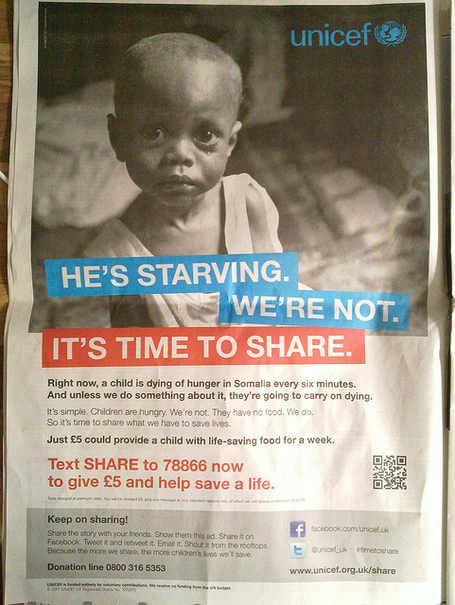
The study brought to mind a visual framing issue that I recently explored in depth. In the non-profit world, well-written and well-designed fundraising appeals are critical to fundraising success. Several recent studies have tackled the issue of visual images in fundraising appeals and how their framing as either happy or sad influences donor intention.

In a 2009 study, Small and Verrochi found that sad images generate the most sympathy, and also the most donations. A 2010 study by Chang and Lee agreed and went even further to find that the framing of the text of an appeal must match the included images to be most effective. In other words, a sad image with a happy, upbeat textual message won’t work as well as an appeal featuring either all sad elements or all happy elements.

In their discussion of visual framing of news events, Neumann and Fahmy discuss the overwhelming “power of photographs” to determine how a news event is thought of by the public. Images are just as potent when it comes to fundraising appeals: they speak volumes.

Is it ever effective to include multiple opposing frames in a single communications piece?

unicef

Posted by: bburatti | April 15, 2013

Finding the patterns in communication


Language and visual communication can be effectively analyzed in crisis communication, news coverage and marketing.  Each is a distinct platform yet accepted research methods identify patterns useful in developing best practices. Scholarly research increases awareness of how news gathering choices impact the perception of global conflicts.

The detailed descriptions of methodology in each of the readings pointed out the importance of the researcher having extensive knowledge of the topic and prior research to develop distinct research questions and create the frames and themes.  Bias is thwarted by the use of independent coders, a vital component when analyzing partisan or controversial topics.

In the analysis of the BP press releases I found it interesting that within the parameters of the study the researchers declared BP’s press release communication a success. Throughout the disaster the ongoing poor performance of CEO Tony Hayward, the man who in the midst of loss of life and calamity complained, “I’d like my life back,” would lead many to judge BP’s total communication during that time a failure.  Communication pieces don’t stand alone.  This study showed the importance of recognizing the limitations of each research project and acknowledging what additional research would form further connections.

Posted by: kelliroesch | April 15, 2013

Framing a crisis; does time heal all wounds?

BPburning-oil-rig-explosion-fire-photo11

 On April 20, 2010 a British Petroleum (BP) drilling platform exploded, instantly killing 11 workers and spilling 18 million gallons of crude oil in the Gulf of Mexico in 87 days.

While reading “A Content Analysis of BP’s press Releases Dealing With Crisis” by Jingbong Choi, I attempted to remember the event. The news featured the daily saga, BP’s Chief Tony Hayward’s attempts to respond publicly fell flat and he was fired, and oil kept pumping into BP oil_spill_birds_01the ocean.

During the crisis BP communicated to the public through 93 press releases Choi labeled as, informational, philanthropic, social responsibility, defensive, and official BP updates.Choi believes BP succeeded in minimizing further damage to their reputation by coupling social responsibility and philanthropic frames to accept responsibility of the disaster.

Today BP tourism commercials encourage us to visit the Gulf because the water, weather, and seafood is great. http://www.youtube.com/user/BPplc?v=0FidIIQO6ZY

Despite the passing of time and the positive framing, skeptics comment on the videos; they haven’t forgotten the spill or its effects. Time has changed nothing for them. Yet there are those who like the videos and say so. They’ve moved on, it seems.

What is your framing of the BP disaster then and now?

William J. Brennan, Jr. “We look to the history of the time of framing and to the intervening history of interpretation. But the ultimate question must be, what do the words of the text mean in our time.”

Posted by: chrissypurcell | April 11, 2013

Qualitative Research vs. Market Research in the Online World

Like Nicole, our reading from Eysenbach and Till got me thinking a lot about online privacy. Yesterday, Facebook announced that they are rolling out a new tool for advertisers and expanding their ability to tap into a user’s personal information from outside of the social network’s walls. This means that Facebook isn’t just pulling information from your profile, but also from your online shopping, browsing history, online public records, and more, to provide advertisers with increasingly targeted data. For a detailed explanation, take a look at the WSJ article here.

Image

As a Facebook user, I implicitly condone this practice through my participation in the social network, despite the fact that I do not know what companies are mining my personal data as part of a large-scale marketing effort. Yet, if I were a member of an online forum and discovered a “lurking” researcher observing my behavior there, I have a feeling I would be peeved to say the least.

What is it about these two scenarios that feel so different? Is the qualitative researcher held to a (necessarily) higher standard than the quantitative market researcher? Is there a fundamental difference in feel between being observed for qualitative purposes, versus being observed for quantitative purposes?

Posted by: nallen123 | April 10, 2013

Is “Online Privacy” an Oxymoron?

Eysenbach and Till’s 2001 article “Ethical issues in qualitative research on internet communities” raises a critical question for qualitative researchers and participants of online forums alike: where is the line between “public” and “private” community spaces on the internet?

Consciously living in a cyber-saturated world, I have learned that online content can never truly be deleted (as ensured by The Wayback Machine), and as such, nothing one posts online can truly be private. But this viewpoint, while perhaps technically accurate, does not accommodate the very private – and very real – spaces where confidential support groups regularly deal with highly sensitive, personal issues like addiction, depression or terminal illness.

For researchers, observing online support groups like these could easily seem akin to watching a group of people interact in a public place – since it can be argued that the internet is a sort of public place. However, the difference lies simply in whether the group being observed is aware of the researcher’s listening ear. In the case of in-person interactions, it is obvious where the line between observing and eavesdropping exists. While experientially that line seems blurrier online than in person, in reality it is not. As Eysenbach and Till point out, participants of subscription-based discussion groups are likely to regard the group as a “private place” and trust that anyone in the “room” is open to a similar level of vulnerability. It is the ethical obligation of the researcher to respect individuals’ privacy online in the same way they would face-to-face. 

Posted by: pcordell | November 26, 2012

News and Fear of Crime

Last week I blogged about the idea that the internet might be changing how we feel as well as how our brains work.  I asked whether we might be the most medicated generation precisely because we are the ‘victims’ of our latest technology. Researchers are becoming aware of a higher level of stress and anxiety in our society due to too little ‘down time.’

My research project has supported and even furthered this concept:  We are being driven to distraction by our technology.  Not only are we unable to read deeply and for sustained periods according to research published by Nicholas Carr (The Shallows, 2010), but we are becoming more anxious in general.  According to research findings in Fear of Terrorism (Nellis & Savage, Crime & Delinquency 2012 58: 765):

In this study, we found that perceived risk is associated with fear and that exposure to TV news is associated with perceived risk. Among the variables that were significantly associated with perceived risk in this study, exposure to TV news is the only one amenable to control by policy makers, so if they desire to manipulate the public’s fear, it would be tempting to manipulate news about terrorism.

To paraphrase a further conclusion by Nellis and Savage (p.765), do we want to be buffeted “by the conflicting interests of the media, who, in the United States, make a greater profit when people watch the news, and the government, who have reasons for wanting to maintain fear but also to reduce it?”

Posted by: Shekhah | November 26, 2012

the new media in a changing world

I have learned many media concepts from The Media and Society book. It made me understand media better. It is interesting to see how the media work from a different prospective and most importantly when compared to media in the Middle East where many of these concepts don’t exist.

Studying the author usage of movies, TV shows and images to explain the media and society around us, I realized that these visual media have a great impact on our life and was able to change our world in the past years regardless of where we live.

When comparing this book to the Shallows, or in another word :What do media do to us vs. what the internet is doing to our brain? I reached a conclusion that a new media is introduced. Both confirmed to me that the internet and the visual media forms are the new books and the new media.

In addition, I realized that many mass communication issues become global. The difficulty in reading books, defining media role and meeting the audience expectation are international phenomenons.  However, the audience basic needs is the same: an interesting and compelling story.  Mastering  a storytelling technique and choose the right narrative  is all what it take regardless of what new forms of media we have.

Finally, as we are now living in this global village with a collective identity, that McLuhan has predicted in the 60s, we have to act locally and think globally.   Now I strongly believe  the new media is our new form of communication that makes our life better.

« Newer Posts - Older Posts »

Categories