Posted by: karlcd | May 23, 2013

The Low Cost of QR Codes

http___makeagif.com_media_5-23-2013_3i27Gb

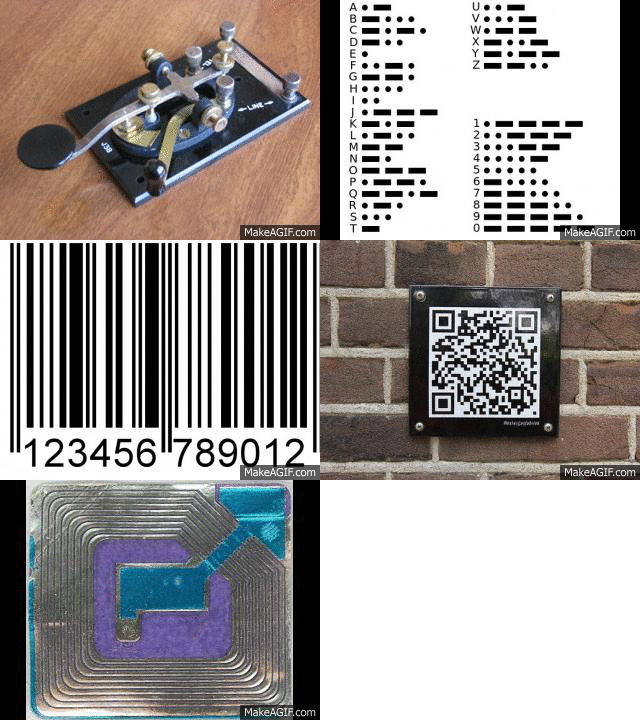
Mores Code, Bar Codes and QR codes and RFID are all communication tools. They use X and O to communicate, but with any language it takes time to learn and adjust a new communication language. For me QR codes are too complicated and clunky to be worth my time. I can Google something faster and have trust I will find what i am looking for rather than using a QR code to tell me where to go. QR code are useful as short cuts to get to the web, but only if the audience knows where it is going.

What makes QR codes great is that anyone can make one or read one. Already QR codes are being replaced by RFID chips which send out a radio wave and are found in library books, student ID’s and smart phones and can be use to open doors, check out a library book or share a link. While RFID are easy to use they are hard to make and that is why QR codes will still be around in the future. QR codes are limited by their technology but as long as the price is free people will continue to use them.

Posted by: chrissypurcell | May 23, 2013

QR Codes: An Opportunity? Or Obsolete?

Corrine, Anthony and I are looking forward to presenting our readings on Web & Mobile Analytics. Since we have a lot of ground to cover, I thought I would use this blog post as an opportunity to discuss QR codes. To be honest, I was surprised to find a reading on QR codes because I assumed they were already on their way to obsolescence. As I looked for additional research on QR codes to support our readings, I kept coming across articles with titles like, “The Death of QR Codes” and “9 Reasons QR Codes are Bad for your Brand.” My office actually started putting QR codes on the back of our business cards about a year ago so that students could easily connect with our Facebook page – and I truly can’t stand it! Our Technology team used a free QR code generator that scans to a third-party-link, rather than going directly to our page – and in my opinion this does our organization a disservice. I’m curious to find out what other people’s experiences have been with QR codes, good and bad.  And we’re looking forward to hearing your thoughts in class! 

Posted by: matisseelliott | May 23, 2013

Google’s secret sauce

I really enjoyed learning more this week about web analytics and web search results.  In particular, I’ve always been fascinated by the Googlebot and the methodology behind the process.  While Google gives some basic insight into how the bot crawls, indexes, and serves the web, there are still many mysteries behind how it actually works and how webmasters and site owners can improve their performance.

Perhaps an even greater mystery is how the Googlebot and search side of the business is kept separate from the AdWords side of the business.  Having been in large corporations in a marketing capacity for over 20 years, I find it very difficult to imagine how these two sides of the Google company are kept completely separate with no influence back and forth. 

With search results determined by “over 200 factors” I would love to learn more about how this is regulated – is the search results methodology self-regulated by Google or does an outside body also monitor and evaluate the process?  And in terms of keeping the search and ad sales sides of the business separate, how does the technology team avoid getting pumped for information by the AdWords and sales teams?  Lastly, for the developers that work on the search side of the Google business, it seems like just a matter of time before one of them leaves and spills some of the beans on some parts of the search algorithm that are kept secret.      

Too bad I didn’t read the interview section of Lindlof and Taylor’s book Qualitative Communication Research Methods  and Terry Gross’ intro to All I Did Was Ask several weeks ago. The 13 interviews I did were for Nurses Week and the goal was to honor them on Facebook with a photo and their backstory. I would have taken a more research-oriented tack and added much needed personality; instead I routinely plunged in.  What could have gone better:

1. I failed to ask one nurse when she decided to become one. She asked me, “Don’t you want to know?” It was a fun story of when she was 9 and it made all the difference in her life.

2. I mixed up two nurses when I posted their pictures and profiles because I failed to extract something, anything, that seemed interesting enough to make me remember them.  Instead of becoming engrossed in the person and their story, I was interested in completing the task.

3. I didn’t ask for compelling stories. Instead I requested a gender, age, and experience differentiators. It’s the stories that make people interesting though, not where they went to school and how long they’ve been on the job.

Interviewing is an art and a science and interviewers can grow from each experience, thus subsequent interviews can be better. Next time I’ll do a little more research and ask more compelling questions so that when the vignettes are posted, the nurse are truly honored for their contribution to the patient care.

Posted by: Nathan Dinsdale | May 16, 2013

When Interviews Go Bad

Interview rapport is a fascinating thing to me. In many cases, an interview effectively involves two people trying to have a natural conversation in decidedly unnatural circumstances. Yet most interviews go well enough. Some are great. Some mediocre. But out of the hundreds of interviews I’ve done during my career (first in journalism, now in marketing), it’s usually the flame-outs that I remember most.

Lindlof & Taylor are dead-on when they talk about the fact that you can have rapport between an interviewer and an interviewee even when the two have almost nothing else in common except the fact they happen to be talking to one another at that moment. It’s relatively rare when you come across an interview subject that sabotages the interview either consciously or unconsciously. In the case Donna cited earlier in the term, Grace Slick interviewing Frank Zappa, it was a combination of “dumb questions” (as the Shel Israel reading might suggest) on Slick’s behalf but also some sly gamesmanship by Zappa. 

On occasion, the interviewer simply isn’t prepared or nimble enough to avoid pulling a Chris Farley Show. But it’s often the best interviewers (like Terry Gross and Gene Simmons or 60 MinutesMike Wallace and, well, pretty much everybody) who are able to take difficult questions, subjects and (especially) interviewees head-on and be the one left standing with fresh insight and perspective for the rest of us to enjoy.  

Posted by: nallen123 | May 16, 2013

A Breath of Fresh Air

I have another confession: The idea of conducting an interview scares me. My “fear” stems not from a concern that anything truly bad will happen to me or the interviewee, but rather from concern that I will be unable to keep the dialogue on track or fail to earn the trust of my interviewee – or even worse, cause them to feel defensive. It was a breath of fresh air (pun intended) when I read Terry Gross’ introduction to her book All I Did Was Ask and learned that a seasoned professional deals with these very issues. Terry presents examples of each of my fears come to life: discussing the run-on interview with Georgi Arbatov, explaining the uncomfortable interview with Chiwetel Ejiofor in which it became obvious that she’d tread on a sensitive personal topic and inspired reluctance in her guest to share, and in cases of Gene Simmons and Bill O’Reilly that resulted in angry exchanges.

While I would like to live in a world where being a “professional” means the realities of human nature melt away when one goes to work, it is comforting to know that each of us is a person on the inside – equal parts vulnerability, fallibility and inspiration all at the same time. The important thing is not to lose sight of that reality — especially when you’re asking a fellow human to share their thoughts, opinions and feelings. 

Posted by: matisseelliott | May 16, 2013

Avoiding the “walk of shame” the next morning

I often conduct several interviews a week at work for a variety of reasons including interviewing potential job candidates, probing the business needs of peers and other business stakeholders, and for research with customers or key stakeholders.  It is really challenging to conduct a great interview, especially when preparation time is limited and the  interview itself is scheduled right after another meeting with no ramp up time to switch gears and get into “interview mode.” 

I found the Hermanowicz article, The Great Interview: 25 Strategies for Studying People in Bed, particularly helpful as a guide for conducting great interviews.  While the 25 strategies were mostly based on common sense and may seem obvious on the surface, it’s easy to forget that nurturing interpersonal dynamics is crucial in order to get the most meaningful information.  When conducting an interview in the midst of a busy day, it’s tempting to fall into a mechanical, driving mode in order to get the information and get to the end of the interview.

The strategies were immensely insightful guides to conducting great interviews.  Of particular interest to me personally were the strategies around listening and probing as well as the strategies that dealt with the flow, or how best to “sequence your moves.”  A great interview will leave the interviewer with deep insights and unexpected information, and will leave the interviewee feeling respected and fulfilled the next morning.      

Posted by: corrinebuchanan | May 16, 2013

The Art of Interviewing

For the past two years I have been doing research for my job through interviews on a daily basis. The topics of our interviews are incredibly specialized and at times very technical. This is challenge when someone like me, who is not a very technical person, is the one asking the questions. I have found that it is not so much about being an expert of the topic, as it is about being able to discover the nuggets of valuable information that are being said and knowing how to ask the right follow up questions.

When reading the excerpt from Terry Gross’s book, I was surprised when she mentioned that she was more comfortable doing the interviews via telephone. Each interview I conduct is by phone and it is something that I continually struggle with. I find that it is harder to establish a relationship by phone than it is in person. I also find that interviews are the most successful when the conversations seem natural and easy, which can be a challenge when people are talking over one another, unfamiliar with one another and unable to gauge one another’s actions of the phone. There is truly an art to interviewing, and even though it is something I do everyday, I am not even close to mastering it.

Posted by: kararc | May 16, 2013

A Lesson in Interview Rapport from Terry Gross

In the introduction to All I Did Was Ask, Terry Gross mentions interviewing Gene Simmons of KISS for Fresh Air. It was an interview she expected to be fun, but instead it was, Gross says, “confrontational.” I just finished listening to the interview and confrontational is indeed how I would describe it, along with offensive.

But it got me thinking about the reading we did this week about the need to establish rapport in interviews. I would argue that, given what she had to work with, Gross did a mostly excellent job.

One minute in, Simmons uses sexual innuendo at Gross’ expense, but she continues with her questions about his stage makeup. When it’s clear this is leading nowhere, she moves on, and eventually gets him to speak without being quite so horrible about his childhood in Israel and then in a yeshiva in the U.S. She even manages to get a poignant moment when he describes seeing exciting aspects of American culture on TV and wishing he was part of that world instead of the very religious world he felt stuck in.

Gross does call Simmons out on his “obnoxious” attitude — repeatedly. It’s a reminder that an interview is a two-way street and that both parties ought to feel respected. Either party could have quit at a number of different moments, but neither did. This begs the question: how much disrespect is too much? At what point is the potential poignant moment no longer worth it?

undercover boss imagesUndercover Boss is a show that gives viewers a peek at what employees do while unknowingly working with the CEO. It uses video to get a glimpse of their daily operations and interactions. While the show may not be considered ethnographic fieldwork, components mimic what Lindoff/Taylor share in Chapter 5 of Qualitative Communication Research Methods and can provide insight on employee behavior otherwise not visible to the general public.

Undercover Boss CEOs are what Lindoff/Taylor call “complete participants” in observing employees because the CEOs are in disguise but are being filmed and trained on the workers daily tasks. According to Lindoff/Taylor “the complete participants role thus positions us to use our empathetic and sense making capabilities to understand social action as it “naturally occurs in a setting”(p.145). The presence of the camera is not acknowledged.

Occasionally CEOs make spontaneous decisions to fire an employee or temporarily close a business. They do this when egregious situations arise, and often, they come out of disguise to immediately stop the inappropriate actions of an employee.

Lindoff/Taylor argue that contemporary fieldworkers do not embrace the role of complete participant for four reasons; lack of freedom of movement in the scene, worry about blowing their cover, losing analytic detachment, and it is an ethical challenge. On Undercover Boss Lindoff/Taylor’s concerns are part of what makes the show interesting, although the ethical challenge isn’t addressed and it isn’t considered scientific research. Ultimately, the CEOs and the employees are changed due to the information collected during the show.

« Newer Posts - Older Posts »

Categories