
Posted by: kelliroesch | June 1, 2013

Help Wanted: Must Love Data and Be Able to Explain It

help wanted 2The need for people who can crunch numbers and explain them is growing. Well, more like exploding and it’s doing  so at such a rate that the McKinsey Global Institute predicts a shortage of 190,000 data scientists within five years.

According to the New York Times, data scientists “crunch the data, use mathematical models to analyze it and create narratives or visualizations to explain it, then suggest how to use the information to make decisions” (Miller). Forbes suggests that data science is in essence, the “coupling of the mature discipline of statistics with a very young one–computer science.” The Harvard Business Review went so far as to call data science “the sexiest job in the 21st century.  (That might be a stretch.)

Corporations can’t get enough data scientists to handle the volume of big data they want to manage and academia are just beginning to define it and develop the curriculum. Those institutions that already have analytic degrees or certificate programs are finding their graduates are being snapped up by companies offering an average salary of $89,000, to upwards of $100,000 for those with experience.

The next logical question might be what does this mean for communicators? PRNews says “If you’re a up-and-coming communications pro with a penchant for math, statistics and science, a data-science focus sounds like a winning career path. ” Yes it does. However, those who are not “number crunchers” naturally can still be highly successful if they are taught to think strategically about analyzing, interpreting, and reporting data.

2013 State of the Union Word Cloud http://www.politico.com

In the 2012 election I noticed that word clouds were used to analyze many candidate’s speeches.  These info-graphics count the number of times a word was used and then represent that word a particular size. The larger the word, the more times that word was used in the speech.  Word clouds do a great job at telling which words were used the most but they also give the reader a false understanding of the material.

Word clouds have two major problems: first they do not include a legend and second, the software used to analyze the text is unknown.  Even with these two faults, I love world clouds.   They give me the raw data and allow me to analyze it myself.  Word clouds make me feel smarter.  I can look at a word cloud and make my own interpretation  because all context of the words has been removed.

The above word cloud of the 2013 State of the Union speech shows me that the words  jobs, America, new, families, congress and energy used most often, but it leaves me to fill in all the adjectives.  Regardless of which adjectives President Obama used, I still think believe I know what he was talking about.

Posted by: ARNoack | May 30, 2013

Nate Silver: More Data, More Problems

I recently learned something about big data: more data doesn’t always lead to more reliable results. Just ask Nate Silver. As we all know, Nate Silver is the number-crunching guru who most recently predicted the outcome of the 2012 presidential election for all 50 states without error. He told Fast Company that, “‘the flood of data means more noise (i.e. useless information) but not necessarily more signal (i.e. truth).‘” According to Google chairman Eric Schmidt, every day we create more information than all of history created before 2003. Silver’s point is that all that data is useless unless you know what to do with it. You have to ask the right questions, write the correct algorithms, and utilize the best statistical methods. Computers are powerful, logical tools, but, without human creativity, they cannot make sense of the complex, illogical world we live in. This creativity, “finding ways to approach and solve problems,” as he explains it, is what makes Nate Silver so good at what he does. And it’s also what makes his blog (FiveThirtyEight.com), and everything else he does, so interesting. By creatively intertwining math, prose, and infographics, he makes boring masses of data fascinating to the masses.

Posted by: acecasanova | May 30, 2013

Manual Vs. CAQDAS

So as you all know from the readings last night, CAQDAS stand for “computer-assisted qualitative data analysis software” (try saying that 10 times fast). CAQDAS in particular caught my eye as I began to weigh the cost vs. benefits of doing a manual method of analysis vs. a computer-mediated method. Me being the all about tech guy that I am (though not as much as Karl admittedly), naturally the CAQDAS is what primarily caught my eye. The ease of use and amount of time saved in analysis and coding seems all the more worth the investment.

Yet it would seem many would argue for the manual method as a preference, due to the more intimate and intricate nature of “cut and paste” and turning your floor into a giant corkboard. Surprisingly, as I considered my options of anxiety-ridden analysis, I come to a shocking conclusion that though I am a fan of computer software, I would likely end up using manual myself.

Despite my shocking revelation, the part of this reading that really stuck me was the fact they have been using CASDAQ since the late 70s! I thought computers still filled whole rooms in the late 70s. I couldn’t even fathom what word-processing software and programming looked like at that period in history. So I decided to look it up, and alas, my search and efforts were found wonton. So I found other popular current software instead to share with the group and some intro videos.

Miner 2.0

QSR International (NVivo)

Atlas.ti

Posted by: matisseelliott | May 30, 2013

Writing up and then presenting your qualitative research

Writing up and then presenting your qualitative research results can be two of the most difficult challenges you face as a researcher.  For writing, there is the constant threat of writer’s block.  In addition, the process of writing can be an isolating and even lonely period.  Qualitative research writing requires a high degree of creativity in order to tell a compelling story.  But the creativity must always be balanced with careful examination and reflexivity around what you’re saying, why you’re saying it, and how.  The process can be truly exhausting, and the one certainty is that you will be editing and revising your text over and over again.


If you doing research for work, be prepared to face criticism from your audience.  The purpose of the research was probably to inform a key business decision, which usually involves a significant investment of time and/or money, and you may find your audience very skeptical of the research findings simply because the stakes are high.  In order to best prepare for the presentation day, try and anticipate what questions and doubts each of your stakeholders may have.  In addition, bringing the research results to life by illustrating key themes with video clips or sound bytes often really helps. Lastly, have fun and be confident – you are representing and reporting out what you heard – you are bringing the voice of the customer to the table, whether or not the business decision makers like what the customer has to say or not. 

Posted by: corrinebuchanan | May 30, 2013

Big Data – Playing Your Cards Right

You probably realized that every time you rate a movie on Netflix , the information is stored and used to make Netflix a better program. But did you realize that every time you hit play, pause, rewind or fast-forward, that information is captured and considered valuable consumer information? Though this might seem a little intrusive, in the end it is what ensures all of the movies under the category “Period Drama with a Strong Female Lead” are ones that you can’t wait to watch.

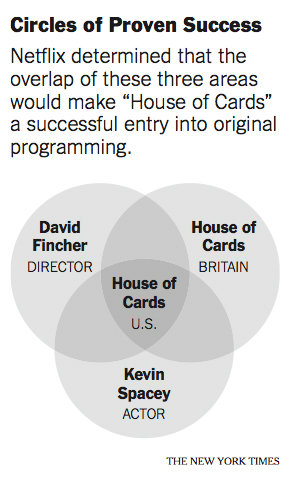
A recent article in the New York Times titled, “Giving Viewers What They Want” explored how Netflix used “Big Data” to determine that their original show “House of Cards” would not only be watched, but would be a huge success (see infographic). Jonathan Friedland, Netflix’s chief communications officer, said, “Because we have a direct relationship with consumers, we know what people like to watch and that helps us understand how big the interest is going to be for a given show. It gave us some confidence that we could find an audience for a show like ‘House of Cards.’ ” According to the article, “House of Cards” is now the most streamed content in the United States.

carr-graphic-popup-1

I don’t know about you, but I am beginning to become more and more unnerved knowing my every move on the web is being recorded. As a customer do you see yourself becoming more private in what you do or don’t do on the internet or is this just going to become second nature to all of us?

Posted by: ellenpayne2012 | May 23, 2013

RFID tags: now tracking you!

In our reading for tonight’s class, “Linking Consumers to Your Cause with QR Codes,” by Waters, and MacDonald from the book Cause Marketing for Dummies, we learn that QR codes, which use RFID tags to operate, are a great way to get information about a cause. QR codes use RFID tags to work. Just take a picture of those abstract art-like-squares and they’ll magically redirect you to a web page, calendar event or gelocation.

These RFID tags are becoming ubiquitous in our lives. Already, says the site How stuff works, “Outside the realm of retail merchandise, RFID tags are tracking vehicles, airline passengers, Alzheimer’s patients and pets. Soon, they may even track your preference for chunky or creamy peanut butter.”

There are advantages. I’d love to install one on my keys and my work badge. In fact, I just used the Find my iPhone app today before I rushed off to work.

But this Orwellian advancement can have some unintended consequences, as everyone from Homeland Security to the State Department begins using them. This recalls something Intel Futurist, David Johnson, who spoke at the PRSA conference said a few weeks ago. Technology is neutral. It doesn’t care whether you turn it on or off, so don’t be afraid of it. But do have those conversations around the best use of it. A question: How do we use technology to better our lives without surrendering ourselves to it?

Posted by: ARNoack | May 23, 2013

QR Code, Meet your Replacement: The VR Code

QR Codes are seemingly everywhere: in magazines, in television commercials, on business cards, and even on websites. When the technology first came out, people were very enthusiastic about the prospect of integrating the real world with online content. However, the design limitations inherent to ugly, pixelated QR Code images forced marketers to use other physical content linking methods. Television advertisers have started including onscreen prompts to open mobile apps, such as Shazaam or SoundHound, which decipher embedded audible cues to link users to additional content on their mobile devices. Still, this isn’t the most elegant solution. 

The most recent issue of Fast Company features 2013’s 100 Most Creative People in Business. Number 85 on the list is Grace Woo, founder of Pixels.IO, the company responsible for engineering the Video Response (VR) Code. VR Codes embedded in the invisible flickering of digital screens direct viewers to additional content. Programmers and designers can incorporate VR Codes into digital content, such as live TV shows and tablet magazine articles, without obtrusive icons or imagery. Until the technology catches on, content creators will have to clearly indicate their use of VR Codes, but Woo hopes that one day these new codes will be seamlessly incorporated into all digital media. 

Posted by: robertheinz | May 23, 2013

Welcome the golden age of open data

Big data has officially heralded the golden age for marketers and communicators around the globe. As The Economist reports in its latest issue, on May 9th Barack Obama ordered that all data created or collected by America’s federal government must be made available free to the public, unless this would violate privacy, confidentiality or security. In addition to the information that is provided to today’s communicators through analytic tools, like those mentioned in this weeks reading assignments, a large scale release of government data is sure to reshape business models again, mainly because such information hasn’t been (easily and legally) accessible for most professionals.

The Economist refers to the impact GPS and weather data have had on business around the world, once the data was made accessible for them. The president himself sees the future default of government information as “open [to everyone] and machine-readable”, that includes your voter registration information, your phone number, pollution data of the neighborhood you life in, or official sanitation ratings of your favorite restaurant. This new wave of big data allows for an even more granular targeting mechanism for marketers, but also shifts even more power towards the consumer and away from businesses. What specific impacts open public data will have remains to be seen, but also Ronald Reagan never guessed that future drivers would obey robot voices telling them to turn left, when he made GPS available to the world.

Posted by: acecasanova | May 23, 2013

BabyBoom

So the other day I was watching this movie “Baby Boom” with Diane Keaton. In this movie, Diane is a big city girl that moves to a small town. Long story short, she hates it, wants to move back, so she begins her own business making organic baby food. This is the 80s, remember that sort of thing didn’t exist then. So the business takes off and she runs into a perceivably common issue as a small, booming business. How do you get the word out about your product and onto store shelves? So naturally, being a child of the technology era I’m thinking to myself the whole time, “Why doesn’t she build a website and do online distribution and marketing?” You can imagine how silly I felt when I realized this wasn’t possible in the 80’s.

Brushing up on my SEO basics post “Baby Boomers” I’ve realized how drastically the face of business has changed over the last 20 or so years. How business people used to have to go town to town to give free samples of their product to spread WoM. These days, spreading by word of mouth equates to being on the front page of Google. Without even having a product with an entirely successful history, with the proper SEO strategy you could increase your sales. Not only can you increase your sales online, but you can track your traffic and where it’s coming from. That’s crazy!

This was just a basic reflection, so I’ll leave you with this, SEOMoz’s “Beginner’s guide to SEO”. Perhaps one of the most intelligent and comprehensive introductions to SEO I have ever read.

Image

« Newer Posts - Older Posts »

Categories