Posted by: itslikethatweb | October 29, 2012

In Defense of Nice-Guy Politics

Emma’s well-stated question was thrumming through my mind as I read “The Lie Factory,” as well. A certain moment towards the end jumped out at me, when Carey McWilliams wrote a story about Baxter and Whitaker for The Nation in a way that shocked both strategic pioneers: he was fair. As Lepore writes:

“He hadn’t been simple. He hadn’t attacked them. He had taken time to explain. He hadn’t invented an enemy. He hadn’t taken remarks out of context. He hadn’t made anything up. He hadn’t lied.”

Even more shocking? McWilliams’ article actually had an impact. It inspired many doctors to resign from the A.M.A., and the A.M.A. later fired Whitaker and Baxter in an effort not to “compromise its nonpartisan status.” This flicker of hope in a generally spirit-dampening story makes one wonder if, in the end, the old adage is true: cheaters never prosper. Campaign, Inc., set a precedent for outright war among candidates, highlighting the ugly human hunger for victory and obscuring the fact that elected leaders exist to represent and protect their constituency. One wonders if America can ever bounce back from how deeply it’s been steeped in a game of political tug-o-war.

Can we conjure up real-life examples of “nice guy” politics, similar to those imagined by Leibovich in “Feel the Loathing”? What, if anything, can candidates and political parties do to reverse the cycle established by Campaign, Inc.?
Posted by: kelliroesch | October 29, 2012

No news is good news! (Actually, that’s not true.)

The old saying, “no news is good news” refers to the idea that some people believe if they have not heard about a situation, then nothing bad has happened.  In reality, news keeps us informed as citizens, no matter if it’s good or bad.  

The Pew Research Center released a ten-year study in late September that pointed to specific transformations in news consumption.  Alarmingly, Pew reported that a sizeable minority of young people less than 25 years old said they got no news at all yesterday! Despite the variety of news sources available, whether traditional news sources or digital news platforms, a full 29% are newsless, said Pew. That’s right, almost a third of those less than 25 may not know what is happening in the world around them. Further, those younger than 30 that did get news yesterday, most spent considerably less time (an average of 45 minutes) consuming it than older age groups, said Pew. 

Based on these and other findings, the conclusion may be  “no news is bad news” if you consider that the public derives the majority of their knowledge of politics and current events from print, television, radio or digital news sources and a growing number are not getting any news at all.

Why do you think there is a growing number of young people who do not get the news? Should our education system require  classes to dissect and analyse current events? What is the value of news to you?


Posted by: emmajoyce | October 29, 2012

Attack, keep it simple, and create opposition.

The New Yorker article “The Lie Factory” by Jill Lepore explores with great insight a rather frightening history of American political campaigning in relation to advertising, consulting, and lobbying. It should be deemed frightening because of the manipulation, distortion, and conceit that have been woven into campaigns, with due credit to Clem Whitaker and Leone Baxter of Campaigns, Inc.

Looking through this historical lens and at the present-day election afoot, it is easy to see how binary oppositions have made it extremely difficult for a third party to legitimately contend. People understand things in terms of good vs. bad, us vs. them, me vs. he.

In order to execute this juxtaposition, Campaigns Inc. identified these effective strategies:

Make it personal: candidates are easier to sell than issues.

Keep it simple. Rhyming’s good.

Never explain anything.

Say the same thing over and over again.

Put on a show.

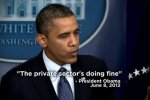
Take a look at these two ads in which one of Obama’s sentences has been extracted and its meaning manipulated by Americans For Prosperity and the super PAC Restore Our Future.

Think about Romney’s “binders” and “Big Bird” social media craze.

If instant communication reduces campaigns to slogans, people to icons, and words to soundbites, how can journalists who want to bring authenticity, ethics, and accountability to reporting compete with the flashy show of modern media?

Posted by: ARNoack | October 28, 2012

Jalopnik: Crowdsourced Journalism Meets Car Culture

“…A recurring theme that emerges from talking to those involved in these [crowdsourced journalism] projects is that the crowd contributes because it has sufficient passion or interest in an issue, or perhaps, adequate stake in it. ‘They have an interest to do it because they are passionate. These folks take great pride in volunteering and lending their very specific expertise,’ Wells says of…Team Watchdog.” Reading this passage in Muthukumaraswamy’s article “When the media meet crowds of wisdom” reminded me of my favorite automotive blog/news site Jalopnik.com, part of the Gawker network.

Jalopnik is a car enthusiast site “obsessed with the cult of cars” that covers car culture, motorsport and the automobile industry. Staff writers on the site are former car magazines writers, car company employees and bloggers with great enthusiasm for everything automotive. However, much of the content on Jalopnik originates from reader tips and comments. The crowd that contributes to Jalopnik is passionate with very specific expertise – car knowledge, in this case. One example of how readers share their expertise is a regular feature on the site, called “Question of the Day”, that asks a car-related question. The following day, “Answers of the Day” features the ten best reader submitted responses. The site is so popular among car enthusiasts that automotive manufacturers beg Jalopnik to review their cars, which the writers often do. Unlike most car magazines, Jalopnik is not supported by advertising revenue and will unceremoniously pan a new car if it’s warranted.

How are crowdsourced journalism and online discussion platforms like the Gawker network joining forces to alter the ways we create and consume news?

Posted by: chrissypurcell | October 28, 2012

Trust in our Democracy

As I read The Lie Factory, I was fascinated by our ability to pinpoint a moment in time when modern-day political consulting was born at Campaign, Inc., and how easy the leap is from Whitaker & Baxter’s strategies to the strategies that our PACs and politicians employ today. Our democratic system is now so infused with partisan pocket book funding, and our politicians’ stances are so carefully designed by consultants, that it’s hard to know who to trust in politics.

I recently watched a Ted Talk by political scientist Ivan Krastev that raises some interesting questions regarding the state of our modern democracy.  You can watch the talk here and if you’re pressed for time, I recommend starting at minute 8:30. Krastev notes that in the internet age there is a new demand for transparency in politics and in the media. Although this is a good thing, Krastev also reminds us that this emphasis on transparency points to an underlying foundation of mistrust; if we could trust our politicians and our media outlets in the first place, there would be no need to demand transparency.

Can real democracy exist without trust?  What would our democracy look like if we could trust that the most capable, intelligent and honorable people in our society were the same people running for office?  Can we picture that day in our future?

Posted by: lee E. | October 28, 2012

When Media Meets Crowds of Dummies

According to Muthukumaraswamy’s When the Media Meet Crowds of Wisdom, a disadvantage of crowdsourcing “is the unreliability of the news obtained…However, such projects are transparent in what they deliver because the audience is aware of what it is getting.” (p. 51)

This assertion comes in stark contrast to the premise of Whitaker and Baxter’s winning formula in Lepore’s The Lie Factory, where “Never explain anything” is key to swaying public opinion.

Lepore quotes Nixon adviser William Gavin to say “Voters are basically lazy…uninterested in making an effort to understand…Reason pushes the viewer back…impression can envelop him…without making an intellectual demand.”

With this in mind,  I think Muthukumaraswamy is overly optimistic in assuming that the average viewer has the energy (or training) to filter its information (Note the May survey that found that viewers who consume ZERO news are better informed than those who watch FOX).   Likewise, I think Muthukumaraswamy is being naive when she worries solely that amateur reporters “are not sufficiently trained in rules that govern traditional media.” (p.59)  Not only are they not “trained,” but in today’s climate they also have nothing to lose (and are, to the contrary, commonly rewarded) by spouting nonsense.

How, in this age, do we normalize a source that the average viewer can trust to be reliably neutral?  And if people are as stupid as campaigns rely on them to be, why in the world do we want them “reporting” anything (except maybe gas prices (when the tank is on “E”)) to us?

Posted by: delphine criscenzo | October 28, 2012

“This is what Democracy sounds like!”

This election season, only one news outlet helped me make an educated decision on which candidate best reflected my beliefs. Democracy Now! streaming live on weekdays and podcasting at www.democracynow.org aired 4 “Expanding the Debate” specials, one for each presidential and vice-presidential debates. The concept is pretty simple, but genius! They played the presidential debates live but paused after Obama and Romney answered the questions and gave third party candidates present in their studio the same amount of time to answer the same questions. As Amy Goodman, host of the show, often says “this is what Democracy sounds like.”

The reading for this week only reminded me of why I do not open a newspaper or watch mainstream news outlet during election time. I often feel frustrated like Mark Leibovich about the discourses coming from both main parties. I am also shocked at the open endorsement of candidates by newspapers which Joel Connelly denounced as well. In a post “Citizens United” era, I was not even surprised to hear from the Pew Center that “journalists are a shrinking source in shaping the candidate narratives.” Though Jill Lepore provided more background information on how the campaign process became a business, I did not learn anything new about the way political messages are being controlled and often distorted to the advantage of one candidate over the other.

But what about the other candidates? How about the four third party candidates on the ballot this November? It appears that the choice has been made for us, that the media and lobbying companies have predefined what our choices are. This does not sound democratic!

How, as journalists, do we work to foster democracy?

Posted by: ellenpayne2012 | October 28, 2012

Creepy calls from the campaign trail

Whitaker and Baxter in founding Campaigns, Inc. in the ’30s may have been the first people to make “politics a business” (The New Yorker, The Lie Factory, Sept. 24, 2012) but as the article notes, political strategists are alive and well. An Oct. 14, Oregonian article reports that strategists in both the Obama and Romney camps have access to information about our personal lives on a scale never before imagined.

Millions of voters will be receiving calls from campaign volunteers who identify themselves as “friends of friends.” Then, with script in hand culled from $13 million dollars worth of data mined from your online habits (yes, they know if you visited porn or prefer Michelob Lite over Corona) will ask you how you will spend election day (as studies show just asking such questions will increase voter turnout.)

That same hapless target might then see a Facebook post calling out those who do not plan to vote in a “public shaming” ploy. One Romney campaigner says, “You don’t want your analytical efforts be obvious because voters get creeped out.” Well, I don’t know about you, but I am, and it’s got nothing to do with Halloween! Another New York Times article that same day reported on a full court press by advertisers to disable the “Do Not Track” mechanisms now available on many browsers.

Question: Will this creepy following of our online habits, from political strategists to advertisers, backfire at some point? Or is this now the new normal? 

In Feel the Loathing on the Campaign Trail, Mark Leibovich daydreams about the candidates getting together for hot dogs as a way to temper the “fauxness permeat[ing] everything this year.” His daydream is fascinating. The fact that we can only dream about political leaders getting together shows how big the wedge between Democrats and Republicans has become. I’m with Leibovich that the negativity this year is disturbingly high — another article shows this all too well.

But I’m more disturbed by what Leibovich terms “fauxness.” George Packer describes it best in a 2003 Mother Jones article: “The more confusing and contradictory reality becomes, the more we cling to our fantasies of how things should be; facts, it turns out, can be far less stubborn things than opinions.” The fauxness of this election comes from an instinct to cling to beliefs and opinions, no matter the facts. It’s telling that a politician who changes an opinion is seen negatively, as a flip-flopper.

It’s disturbing that we ignore or misconstrue facts that don’t support our opinions because we end up living in a warped reality. Consider Indiana Senate candidate Richard Mourdock whose attempt to justify his opinion led him to state that rape, something virtually all Americans see as criminal, is the will of God.

Why is changing an opinion a sign of weakness? How did we get to this point where changing our minds is more difficult than warping and ignoring facts? Why do politicians have to pretend they never change their minds?

Posted by: miralbessed | October 27, 2012

Thank Whitaker and Baxter for todays never ending campaign ads.

While it might be slightly unfair to blame Whitaker and Baxter for all the annoying political ads we are forced to watch and hear today, I can’t help but to attribute some of this craziness to them.  In The Newyorker.com’s article, The Lie Factory,  Jill Lepore lists the resources and tools that were utilized in a typical campaign during the 40’s. As our resources have expanded exponentially these days, so have the number and methods of political ads. Between pamphlets, TV and radio commercials, internet ads/pop ups and finally ground efforts, the 2012 political campaigns for both presidential candidates have now surpassed 500 million dollars according to MSNBC’s Nightly News. Mit Romney campaign has reportedly spent $273 million, $205 million of which came from his outside resource AKA the Super PACs (Political Action Committee). President Obama is not trailing far back. His campaign has so far spent $239 million dollars $33 million of which comes from the Super PACs supporting him.

The above figures paint an ugly and unfortunate picture about todays politics. It no longer is about the issues facing the nation but rather about the depth of a candidate’s and his suporters’ pocket books. As we clearly observe this massive shift in spending and strategy from the good old days of Whitaker and Baxter’s Campaign Inc. to the present day freak show, what can be expected of future political campaigns to come and what role will  the Super PACs play in the speculated change?

« Newer Posts - Older Posts »

Categories