Posted by: Rachel B. | October 8, 2014

Too Independent?

To celebrate “National News Engagement Day”, I donated to what has steadily become my favorite news source in the past six months: the national and independent daily news program Democracy Now!. After hearing about DN! from a friend, I quickly fell in love with Amy Goodman’s raspy voiced reporting and the generous coverage given to topics I had never seen addressed in the mainstream media.
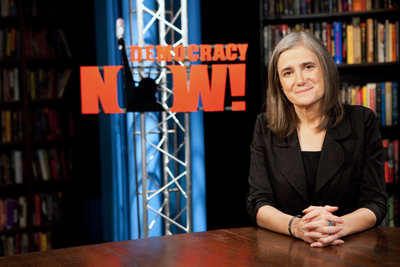
13_-_Amy_in_studio


I began to really get into DN! after they devoted an entire broadcast to an interview with George Takei. Soon I wasn’t just watching the hour-long segment. I even went so far as to pick up books mentioned in my favorite interviews, or research topics that interested me within DN!’s online archives. I felt empowered and informed. There was only one problem. I liked DN! so much, I didn’t watch anything else.

As Shoemaker and Reese point out, the cultural value of individualism in our country has a pervasive effect on not only how we consume media, but also how we perceive the effects of such media on society, as well as the resulting study of those effects.

How then has the value of individualism translated into the consumption of news? If I self-select DN! and patronize only that program, is that the result of larger cultural norms favoring independent thought? And if so, how can we, as a culture, reconcile our need to be independent from the likely negative consequences of a “mirror-me” news consumption habit like my own?

 

Posted by: Donna Z. Davis, Ph.D. | October 8, 2014

Vote for your favorite week one blog HERE!

Posted by: alansylvestre | October 6, 2014

Communication as a linear or circular approach

Throughout history, many people have thought of the communication field as a linear model, i.e. where journalist and communication professionals gather information and disseminate that information to the public. But I think that given the advent of modern technology and the digital era, communication is becoming a circular, or two-way, method of information gathering. In the days of purely print journalism, reporters and editors did not have large interactions with the public as news progressed throughout the day. They had to wait for letters to the editors to gauge the reception of their material by their respective audiences.

Given the advent of Facebook, Twitter, and other minute-by-minute ways of syndicating information to the public, I believe communication is transforming into a cyclical environment, where journalists give share information with the public, and can instantly see how they react; therefore altering their approach to storytelling to tailor it around the needs and wants of the public. The way in which the public receives their news can now be measured easily through analytics and comment sections, therefore transforming the communication platform among professionals to a point-to-mass-to-point model, replacing the traditional point-to-mass method of communication and placing emphasis on civic engagement.

I’m curious to see what your thoughts are on this. Is the traditional method of communication changing as technology changes?

Posted by: Emily Priebe | May 29, 2014

The Surprising Qualitative Side of Web Analytics

Google Analytics is one of my secret weapons when it comes to creating content. Given that the platform is heavily numbers based, this may seem surprising. However, there are a wealth of qualitative opportunities available. One of the best avenues available is the list of keywords that Google keeps track of. This list displays terms that people have searched on to find your site, helping give you a better idea of what kinds of information people are really looking for.

When planning out content, I like to pull this list and look for patterns. Is there a question in here that site visitors are hoping is answered by the content on your site? Is there an opportunity to create content to answer that question? From that list you can start to really identify the strenghs, opportunities and weaknesses of your own content. There are even tools that can help you identify which terms your competitors are performing well on or aren’t addressing at all.

It isn’t a perfect science by any means, but it’s an easy way to perform a content assessment that can help you target your offerings to site visitors.

Posted by: B. Scott Anderson | May 22, 2014

The finer points in qualitative research

Lindlof and Taylor (2011) went over the nuts and bolts of note taking, writing and researching in qualitative research in Chapter 8. I’m not sure about anyone else in the cohort, but since I have never done an official qualitative research project, I didn’t have a real grasp of the finer points of everything that went into coding, interviewing and note taking. I had, of course, read several qualitative research studies and read in the methods section about how the researcher conducted their study. What really stood out to me was how much of the tone of what subjects said was recorded and thought about. One question I kept thinking that wasn’t addressed was the objectivity of the researcher’s notes (and perhaps coding). For instance, if all of the notes were handed to an uninvolved qualitative researcher, would they come up with the same results or interpretations as the original researcher?

Another question I had related to external validity. It would seem that having a stranger come into your workplace or home to conduct interviews or to observe a subject may entice that subject to give socially desirable answers or to act differently than they normally would. As a researcher, how do you make sure the subjects are giving you legitimate, valid answers to interview questions?

At the end of their chapter Sensemaking, Lindlof and Taylor introduce a relatively new qualitative approach called crystallization. Posed as an alternative to triangulation, which uses a combination of multiple sources, methods, and even researchers to articulate a truth or a statement about a research object, crystallization takes almost precisely the opposite tack. It incorporates “artistic and scientific sensibilities” (Lindlof & Taylor, 2011) into an edifice whose purposeful incompleteness practically coerces the interpreter into accepting that all the evidence it contains is relational, contingent and historical, not absolute, essential and enduring.


It is an interesting theory, to be sure, and it certainly provides a solution, or at least a handy escape clause, for qualitative researchers vexed by the continually elusive nature of an objective reality. But is it good practice? I cannot say for certain, not having seen an actual sample, but my instinct is to proceed with caution. The goal of scientific inquiry should be to advance knowledge, not obscure it, and crystallization, with its Rashomon-like use of multiple perspectives, seems to belong more the sphere of performance art than to actual research. For a discipline that has already largely abandoned the concept of reliability and gleefully embraced self-reflexivity (Lindlof & Taylor, 2011), the adoption of such a practice could further call into question the legitimacy of certain social science studies. What do you think? Can researchers use crystallization to say something useful about a subject, or is it a practice best reserved for art exhibitions?

Posted by: Emily Priebe | May 22, 2014

Visualizing Qualitative Data

Visual displays provide a multidimensional space to organize data and show connections between different pieces of relevant data. (Verdinelli & Scagnoli 2013)

Creating visual representations is intrinsic to building theories and creating textual meaning. (Clarke, 2005)

While Joel and I will cover this topic in more detail during our presentation tonight, I wanted to briefly touch on it on our course blog. Many of the tools created for visually representing data are created for quantitative data sets (bar graphs, pie charts, etc.). But how do you visually represent qualitative data? What format does the data take in visual form? Is it even important to have “word” data represented in a different form? I would argue, yes. As communicators and writers, it can be easy to get wrapped up in describing our data, but there are many rich opportunities available to enhance our qualitative findings. By visually representing qualitative data, there is a larger opportunity to make connections, visualize relationships, and build theories.

An examination of qualitative data visualizations by Verdinelli and Scagnoli (2013) outlined the following best practices:

  1. A visual display should be as uncomplicated as possible.
  2. There should be the right balance of important information and minimum detail.
  3. Off-topic content or information should be avoided because irrelevant data creates visual noise.

Above all “a visual display should eliminate any barrier to the goal of presenting information in a clear and accessible way but yet seek to be engaging and appealing.”

Posted by: lorihowell | May 20, 2014

Interviewing Amanda Marshall, U.S. Attorney

Sitting face-to-face with Amanda Marshall in her 6th floor office in the U.S. Courthouse building, you’d never know that she is the top federal prosecutor in the state of Oregon, appointed by President Obama. If you’d heard Amanda’s stories about her crossroads in childhood, you wouldn’t suspect that she’d just shaken hands with Jimmy Carter. 

Amanda was very trusting during our interview about leadership. She openly told me stories about leaders that she admired in college and how they helped steer her career to places she otherwise might have overlooked. 

Our interview had clear objectives, but it felt more like a conversation.  Amanda was generous about storytelling and really seemed to appreciate the opportunity to reflect on topics and dig into the details. 

I’d like to be able say that I was able to gather all of this information because I’m a talented researcher who possess amazing interview skills. The truth, however, is that Amanda is a very open person and also a good friend. 

In the case where you don’t know the person your interviewing and they aren’t familiar with your work, I wonder how you build trust. Do you have any tips for getting people to open up?

Image

Amanda Marshall, U.S. Attorney, Oregon

Posted by: Emily Priebe | May 15, 2014

The Importance of Prepping the Right Questions

Like many others in this class, my job involves trying to craft the right questions. The importance of that was never more apparent than at conference that I just helped run in Orlando. Before each conference we gather insight from a number of people who will be attending the event using the interview technique. The interviews help us identify what would be most valuable for the attendees to hear at the conferences. It’s only through those interviews that we can really glean the topics that are the most salient to the group.

When we go onsite, we also have to be prepared with a contingency plan, which usually involves pulling together a panel with several of the executives that have been involved in the planning process. Typically, we never have to use these plans, but in this case we had a last minute speaker cancellation that prompted a race to fill the session with content. We knew attendees wanted to hear about developing critical skills in the industry. We were then able to pull together a panel with three powerhouse female executives about that topic, which had all three of them asking each other questions and throwing questions out to the audience.

Though the session was thrown together at the last minute, having prepped the right way led to the session being one of the most highly rated presentations of the day. It was the perfect convergence of circumstances that wouldn’t have happened without the right questions.

Lindlof and Taylor’s chapter on qualitative interviewing offered a lot of food for thought. I was especially struck by their discussion of the process of transcription. As a journalist, and even in my current role as a communications specialist, I’ve struggled with how far I should go in “cleaning up” ungrammatical and extraneous speech. Sometimes such editing can smooth out distinctive characteristics in the subject’s speech. Lindlof and Taylor provocatively state that “the kindest interpretation of this sort of editing is that we are trying to make the content of their speech more accessible. Less charitably—and more truthfully—we are performing unlicensed surgery on the participants’ identity” (2011, p. 215).

I believe researchers and journalists have a duty to transcribe their interviews as close to verbatim as possible. But as a communications specialist for OSEA, the interviews I conduct with our union members receive more aggressive “cleaning up” because my goal is to ensure that our members are shown in the best light possible, which hopefully also means helping further the interest of the union. But at the same time I do not want the members to appear inauthentic, which is why agree with Lindlof and Taylor that capturing distinctive speech is an “ethically and politically uncertain art” (2011, p. 215). I’m curious how many of us have participated in such “unlicensed surgery.”

« Newer Posts - Older Posts »

Categories