Posted by: reddingrob | October 30, 2014

To post or not to post?

Producerly text allows for new text to be created from it (p.201). Material that fills in every blank limits audience interpretation, thus hurting its spreadability. To John Fiske, a producerly text leaves enough of an opening for people to add their own take or experience to the text. “Content spreads when it acts as fodder for conversations that audiences are already having (p.199).”

Corporations hurt the value of their content when they close it off from circulation. They can try to block access, but a creative audience will find a way to put their spin on a text anyway.  The organization will be seen in a better light when it allows viewers to use its material freely. John Oliver just did this when his team created of dogs dressed in court robes representing  supreme court justices. He invited his audience to use the footage to reenact supreme court cases and post them online.

Content is more likely to spread when it’s available on demand. The Netflix model of releasing a whole season at once is a savvy move in our right now culture.  Audiences want to be able to show the latest Jimmy Fallon clip to their friend by handing them their  iPhone.  How do you decide what to post?
Posted by: eldrickbone | October 30, 2014

How Axe body spray won me over in 2003

As I was reading Spreadable Media, I could not help but laugh as I read about marketing techniques and shared fantasy. I began to reminisce.

In 2003, I was 12 years old and the boys’ locker room was smelling funky as it naturally should. I would see other boys putting on deodorant after P.E. class and then going about their business. I, embarrassingly, was still using my father’s deodorant in the morning’s before school. I thought it was time for this boy to become a man and have his own smell. Axe deodorant came to mind.

The commercials were always the same: man puts on body spray and instantly becomes irresistible to women, another desire I had at that age. I went to the store by my house before school, bought a can, sprayed it on after P.E. and found the first girl in my line of sight and said “smell me.” She took a whiff followed by a befuddled look. I shared the same look, but for a different reason. I did not understand why she wasn’t immediately all over me. The verdict, Axe doesn’t work.

This story is not about how Axe should stop claiming it has a bewildering effect on females. It is about how their marketing team used my need and my fantasies for their profit. They stereotyped men, what they should want as men and us, the prepubescent boys in the locker room, fork over our money. Well played Axe, well played.

Posted by: Rachel B. | October 30, 2014

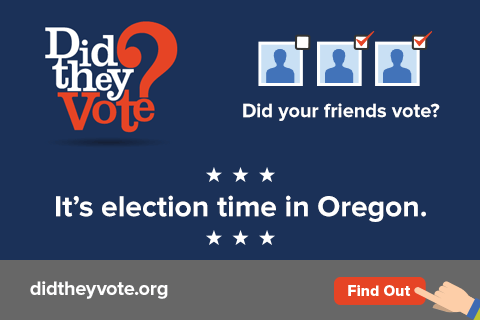
Did You Vote?!

I was scrolling through my Facebook newsfeed today when I noticed something a little strange. A friend had declared that they knew exactly who did and didn’t vote amongst all their friends on Facebook. And they’d used a simple new app to find out.

didtheyvote_480x320

The app, called “Did They Vote?”, is an excellent example of civic media. What better way to spur millennials to engage civically than to incite their worst fear… being judged and publicly shamed over Facebook!

Did They Vote? uses public voting records to access voter participation information to match up individuals on your friend list that haven’t yet submitted their ballots. It then prompts you with a “message” feature, where you can send a helpful reminder to your tardy/absent minded companions urging them to exercise their democratic right.

The website has all the hallmarks of a truly spreadable medium. There’s a page dedicated just to spreading, ingeniously titled “Promote This”, where you can find links to embed a video explaining the app, as well as images of the app’s brand logo to download and spread via email, social media, or elsewhere online.

There’s also a leaderboard displaying the most prolific app users and spreaders, a device undoubtedly added to motivate users to message as many friends as possible.

I’m curious about how this app will impact voter turnout. Millennials are notorious for opting out of elections, but I think that this crafty blend of social media verve and activism will help change those statistics.

Posted by: JenLuecht | October 30, 2014

Are these the 12 types of Millennials?

millennial-12-types-hed-2014

This week I’ve been thinking a lot about perceived social value and the idea that we share things as a way to define ourselves. What do you think: if you looked at the content you’ve shared via social media, would it be an accurate depiction of yourself?

We are not just the audience – if we share things as a way to define ourselves via social appraisals, aren’t we essentially embodying the media we choose to push forward under our name? Too many cat videos?

In a recent attempt to get more specific about Gen Y, AdWeek asks: are these the 12 types of Millennials? Now don’t zone out yet – technically Gen Y does not have precise dates when the generation starts and ends, but it typically represents birth years from the early 1980s to the early 2000s. That’s not all of us, but it definitely is a lot of us. According to AdWeek, “if there’s one thing every millennial hates, it’s an overly broad generalization about what every millennial thinks.” But, if we’re all posting, reading, and reposting the same content as digital natives, can millennials – and most everyone actively using social media – be boiled down to a handful of broad assumptions? In this case, a researcher who analyzed over 4 million millennials using their online data, did just that.

If someone – a friend, coworker, future employer or potential date – was to base her entire judgment of you off of the media you choose to spread, what would she say?

Posted by: katieaoreilly | October 29, 2014

You think that’s funny?

For years, I have been convinced that I once heard an ad for a product whose tagline rang “You bet your sweet Aspercreme.” I only heard it once, but I loved it. I told my brothers about it, but the ad was so quickly updated with a new tagline, neither of them ever saw it, and believed I was making it up. Well:

It was real! I hadn’t thought about this particular campaign for years, until reading Spreadable Media, in which humor was discussed as a potential connector of audiences. Tapping into a shared sense of humor can endear one to the audience, but missing the mark can be disastrous (204).

To the correct audience, this tagline is gold. It’s funny, unexpected, and not only caught my attention but stayed with me. Unfortunately, the ad ran during daytime TV and the audience rejected it. Aspercreme quickly pulled the ad, keeping the original pitch of the tagline, but changing the words to “You bet if it’s Aspercreme.” The public outcry and subsequent retraction of the tagline made me assume the brand was harmed by the ads, but further research shows sales of Aspercreme increased 53% in the quarter the ad ran. Coincidence?

Today, the only evidence of this tagline’s existence comes courtesy of the collaborative culture of the internet, where others like me can seek it. The company clearly had the right idea, but the wrong audience. Had the ad aired in a different time-slot, would the tagline have required a change?

Posted by: stephanieessin | October 29, 2014

Meanwhile in North Korea…

On October 28th, 2014 Vice reported that Korean leader Kim Jun-un recently executed 10 officials for watching South Korean soap operas. I followed the link to the South Korea’s state news agency, Yonhap. Their article said that according to the South Korean spy agency “North Korea forbids its 24 million people from watching foreign broadcasts and any other foreign video content out of fear that the influx of outside influences could pose a threat to its leader.”

Chapter 7, Thinking Transnationally, takes a shot at focusing on the transnational side to the spread of media content. Upfront, it is implied that they are using “transnational” and not “global” because they recognize that there is an uneven flow of media globally. The purpose of this post is the bring attention to areas of the world where people are “not yet able to actively participate in these exchanges” (pg. 260). The word “able” used in this context is a little concerning to me because it discounts a much larger population that is cut off to media my means far more serious than accessibility. Being “able” to access the media is one thing. What I feel the Chapter didn’t touch on are the countries that are not allowed to consume media transnationally.

Under “The World is Not Flat” section in the Chapter, the authors state that “access to transnational communication can foster curiosity about other cultures and may motivate further investigation” (pg. 289). In the context of transnational media, what are N. Koreans loosing out on when it comes to consuming media? If they are denied curiosity outside of their borders, and are cut off from outside information, how does that manifest itself in damaging ways?

"Naejoui Yeowang" (Queen of Housewives) is a South Korean Romantic Comedy

Naejoui Yeowang (Queen of Housewives). Popular South Korean Romantic Comedy on MBC.

Posted by: bburk2014 | October 29, 2014

A New Kind of Exchange

“I think we’ve been obsessed with the wrong question, which is, ‘How do we make people pay for music?’ What if we started asking, ‘How do we let people pay for music?'”

So asks performance artist and musician Amanda Palmer in her TED Talk (video above). I was reminded of her presentation while reading the “Courting Supporters for Independent Media” chapter of Spreadable Media. Palmer’s practice of “giving away” her music pays homage to her background as a street performer, where she depended on her audiences paying for her performances voluntarily. Though today she allows her fans to access her music for free, Palmer finds that her band survives on the generosity of its fan base through donations of money or in-kind services, and that her public is grateful for the opportunity to give something back.

It’s counterintuitive to assume that people will pay for things when they don’t have to. And perhaps the less personally-connected one feels to an enterprise, the less likely one is to pay (ask me how to get around the New York Times’ paywall, for example). But when the content is independently produced by artist or artisan, its consumers seem likely to open their wallets to express their gratitude for what was freely given.

At a time when publics feel as alienated from big corporations as ever, the spreadability and connectivity that the internet allows create opportunities for a new kind of economy, one based on mutual respect, gratitude and trust.

Posted by: jstrieder | October 29, 2014

Is Online Vitriol a Given in a Participatory Culture?

An October 26 article on Forbes.com called “Hashtags and Harassment: Is Participatory Culture in Trouble?” tackles the hot-button challenge facing analysts of participatory culture this year: What happens when these opportunities are used to spread vitriol against individuals instead of merely content without consent?

Henry Jenkins and his team do not address this issue in “Spreadable Media.” But Jenkins DID address it in a white paper published in 2005 called “Confronting the Challenges of Participatory Culture: Media Education for the 21st Century.” He proposed teaching young users how to participate in ways the mainstream considers appropriate: “A central goal of this report is to shift the focus of the conversation about the digital divide from questions of digital access to those of opportunities to participate and to develop the cultural competencies and social skills need for full involvement.” (4) Of course, as we’ve seen since then, cultural competencies and social skills are not needed for full involvement. In fact, the circumvention of boundaries is a central tenet of spreadable culture. A cat can look at a king, and the proverbial unemployed guy in his mom’s basement can debate a nationally known female journalist on terms not constrained by class or education … or decency.

The last sentence of “Spreadable Media” anticipates forging a media environment that is “more inclusive, more dynamic, and more participatory than ever before.” (305) By definition, it will include more people who for whatever reason are poorly socialized by mainstream standards. Some of them will be racist, homophobic or sexist.

Posted by: alansylvestre | October 28, 2014

The “Virality” of online content

An infographic about how easy it is for content to spread through the Internet

An info graphic about how easy it is for content to spread through the Internet

In today’s journalism structure, it’s important to think about the “spread-ability” of your content. No longer do that days of simply putting your story in the paper exist. In today’s journalism industry, content has the capability to go viral in a matter of mere minutes, thanks to popular social media outlets like Facebook and Twitter.

In Spreadable Media: Creating Value and Meaning in a Networked Culture, they discuss how easy content can spread throughout the Internet. They say,” …entertainment companies have long used models of overproduction and formatting to address this uncertainty.” (Jenkins, 197).

The concept of “virality” is one that entertainment industries have been interested in long before media companies. But, with the transformation media outlets are in as we speak, shifting to website first content, they must consider the ways in which their content if going to be used. YouTube trends manager Kevin Allocca did a Ted Talk in which he discussed how easy a video can go viral in today’s society.

The answer is that media companies are learning the concept of creating content for the web; designing with the idea of “spread-ability.” I’m employed with Oregon Public Broadcasting, and one of the things we discuss weekly is how our content is going to get used on the Internet. Because of the advent of the Internet, the question we think of on a daily basis is no longer, “How are we going to construct a story for our audience?” The question has become, “How are we going to interact with our audience?”

I think when journalists think with this mentality, they’re able to make more educated decisions about how to create stories for an online audience.

Posted by: listonjoe | October 25, 2014

The Avengers and User Engagement

I had been thinking about our previous reading assignment in “Spreadable Media,” in particular the complicated ‘Web 2.0’ relationship between corporate properties and engaged users who creatively remix videos and trailers. Then, like a bolt of lightning from Thor’s hammer, this romantically remixed ‘Avengers: Age of Ultron’ trailer blasted onto my screen.

How will Marvel/Disney react to this? Will they allow it to remain online? How will Celine Dion’s record company, Epic/Sony react, if at all. Perhaps they will realize that it will “…increase emotional investment in properties through respecting and recognizing the contributions fans make to the value of stories.” (Spreadable Media, page 61).

Personally, I think that media companies should embrace the audiences that spend the time to help them promote their properties. Yes, I understand that an Avengers movie hardly needs additional promotion, but it’s a win-win all around. You have users passionate about your ‘media text’ who are marketing for you. While it is possible that a youtube user can see some minor payback depending on how popular the video is, for example, it likely dwarfs the profits you’ll see as a corporation.

« Newer Posts - Older Posts »

Categories