Posted by: listonjoe | November 6, 2014

Molding the Clay of Our Minds

“We become, neurologically, what we think.” This sentence, found on page 33 of Nicholas Carr’s ‘The Shallows,’ is the key to understanding how powerful effective communication can be. It also highlights the power effective communicators have at their fingertips.

The ability to craft messages that make people think, or as the Elaboration Likelihood Model states, allows a viewer to process information along a central route which actively re-wires them neurologically. Whether it is relatively innocent, like crafting an advertisement that convinces someone they need that new Honda, or strong arguments that dictators and politicians use to nudge your neurons into falling in line with their beliefs, or to fan the flames of motivation. One of the most famous, inspirational speeches was made by Winston Churchill during World War 2. These words inspired those who lost their lives defending Britain.

It’s important that we, as professional communicators, those who plan and create these messages, realize that we need to craft communication carefully. We must do our best to understand the effects of communication on our audiences. Because, as we’ve read it’s not just simply attitudes that can change..but the physiology of the brain itself.

Effective communication are the hands that mold the clay of our minds.

Posted by: reddingrob | November 6, 2014

It’s Tool Time.

In chapter three of The Shallows, Nicholas Carr states that our technology falls into four categories. There’s the plow and the fighter jet which extends our physical strength; the microscope and amplifier which the rang or sensitivity of our senses; reservoirs and genetically modified plants reshape nature to better suit us; and clocks and maps which extend our mental abilities.

While we use technologies like the refrigerator and the light bulb everyday, Carr argues that intellectual technologies like your smart phone or laptop are the most important to us because it’s through these tools that we express ourselves. On pg.45 Carr writes, “the tools we use to write, read, and otherwise manipulate information work on our minds even as our minds work on them.”  How have your electronic tools affected your behavior?

There  are two schools of thought in the debate about how technology has helped create civilization. Technological determinist believe that technological progress is an autonomous force outside of mankind’s control and is the primary factor influencing history (p.46).  Instrumentalist believe that tools are neutral and do only what the user tells it to.

I disagree with Carr when he says we don’t choose to use certain technologies. I’m not required to have a smartphone, my flip phone serves its purpose.  I could still use a film based camera if I could find a place to develop it, and vinyl records are making a come back because of their sound quality.

Posted by: lindsaym88 | November 6, 2014

This is Your Brain; This is your Brain… On the Internet!

Nicholas Carr, in The Shallows, argues that he has transformed from an English Major who found comfort in libraries and books to a middle aged man who finds it difficult to concentrate on a long-form news article. He states that all this on-demand succinct information, courtesy of the internet, has transformed the wiring of his brain to require that on-demand nature of all content consumed. He quotes disparaging lit professor who can’t get her students to read full books anymore.

Two things. First, since when have students ever read everything cover to cover? Yes, Wikipedia and Spark Notes have made it easier to avoid the work. No arguments here. But it’s a Hallmark of students everywhere to do as little work as possible to yield the most results. Second, I found myself frustrated Carr’s assertions. As an English major myself, I spent an inordinate amount of time studying diction and craft, poetry and fiction. That’s not to suggest I’m never guilty of occasional skimming (like I said, it’s a Hallmark, plus I’m a notoriously slow reader), but I like words. I like taking time to process what I’m reading. I appreciate a tight, gorgeous sentence. (How you doin’, Shakespeare?)

Concentrating can require work. Generally, I need to have classical music playing to drown out distractions so I can dive in, and once I do, I can get properly lost in what I’m reading. Of course, now I have to wonder if I’m just the exception to the rule.

Posted by: chrisforde915 | November 6, 2014

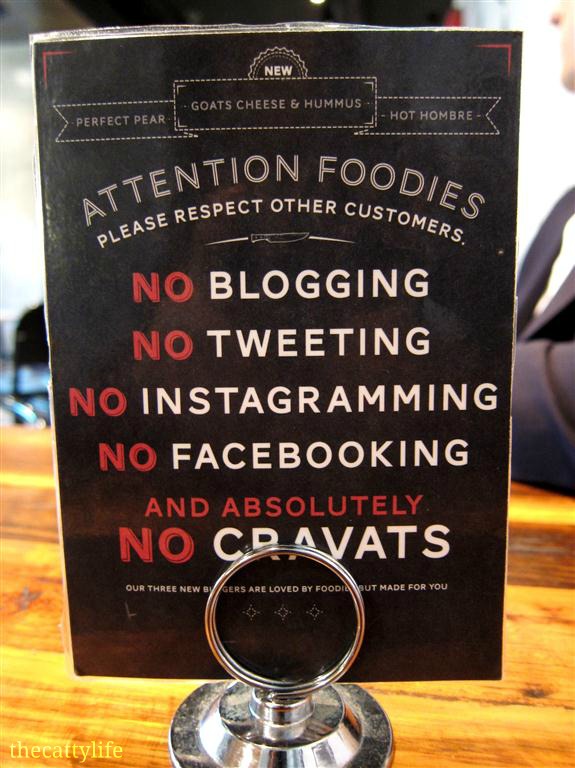
Are smart phones ruining the restaurant experience?

Nicholas Carr briefly described the effect of the internet on the way we experience actual performances as well as the recordings of those performances (Carr, 96). Since the introduction of the internet, and most recently the growth of social networking platforms there has been a cultural shift on how we engage and communicate. Media companies, businesses and organizations are continuing to adapt and cater to new expectations. However some businesses are going against the grain and standing up to consumers.

A New York restaurant is claiming that cell phones are slowing down service. Wait times have doubled because customers are too busy taking pictures of their meal, posting it on Facebook, Twitter and Instagram. This prompted some restaurants such as Bucato to ban cell phone usage in the dining area. Other restaurants such as Sneaky’s Chicken are proposing a different strategy. Customers who willingly surrender their phones receive a 10% discount on the bill on select evenings.

???????????????????????????????

The internet has begun to alter the way we experience every day activities. Nicholas Carr recognized the impact, and I wholeheartedly agree. In a world where technology is rapidly advancing, and affects so much of our daily routine, do you think banning cell phones is a good idea? Are we too far removed from the days of connecting with one another, and having meaningful conversations and interactions without being distracted by the internet? Where do we draw the line?

Posted by: Rachel B. | November 6, 2014

iBrain 6

Am I using my iPhone, or is my iPhone using me?

iphone drug

Nicholas Carr argues in The Shallows that the instantly gratifying, one swipe away, 24/7 access to media via new technology like iPhones is messing with our brains. As we upload, Instagram, and surf, we’re creating new neural networks accustomed to swift, and often scattered information intake.

But at what cost? Carr believes our shiny new techie tools are making it harder for us to concentrate. As someone who bounces back and forth from my Gmail account, to Facebook, and back to Gmail again in a matter of seconds, I can’t say I disagree.

However, judging by Carr’s reverence in tone for the long lost days of deep book reading, I get the impression that the newness of the technology might be biasing him to its effects.

caveman-and-computer

Much like the ancients who deplored the change from oral transmission of information into the written word, I think Carr might be too quick to label our Apple products as harmful. There are limitless possibilities for the advancement of human debate, for example, when the facts no longer need to be memorized. They can be Googled instead, thus freeing the creative thinker to build on applied logic, inserting facts and statistics where relevant.

Just imagine how ridiculous it sounds to us living in 2014 that at one point, people scoffed at the very idea of writing. I applaud Carr’s tale of caution, but nothing could get me to trade in my iPhone for a Post-It note or Sumerian clay tablet.

Posted by: eldrickbone | November 6, 2014

The Shallows is unbearable to read and Nicholas Carr knows it

Trying to read through the six chapters required in this week’s reading for our course had me fidgety, frustrated and upset. I kept trying to talk myself into continuing forward and not sacrificing a week of obligatory blogging for the term. I just wished I could press Ctrl+F on a keyboard and find the point he was trying to make by describing the history of brain and nervous system tests on monkeys or letting me know how old he was when he saw Star Wars: A New Hope in theaters for the first time. I found myself saying “get to the point” several times at 3 am., surely passing my annoyance on to a housemate or neighbor.

Living in this digital-driven era (especially as millennials), we absorb media ad nauseam, which means a constant state of learning, but we have, seemingly, the freedom to find exactly what information we want and then stop or move on to the next thing, creating short attention span and tolerance for irrelevance.

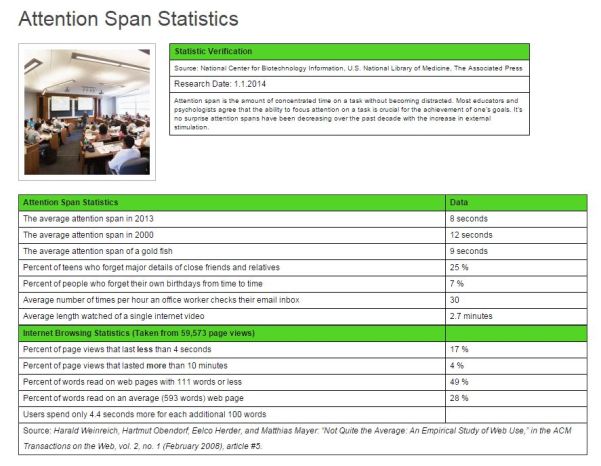
An article on Psychminds.com described a Pew Internet Study in the U.S. that cited “attention span and in depth analysis is being diminished by instant access to computers and online platforms.” A point that Carr makes throughout his book in a long, drawn out manner. Rationally speaking, he has an easy-to-read style of writing that takes forever to get to the point. Just like me!

Attention Span

Posted by: JenLuecht | November 6, 2014

A Swift Recovery: Storytelling by Means of…

This week we read a lot about the effects of having a “juggler’s brain,” an addiction to fast-paced constantly changing content, and an anxiety about being continually connected and involved with social groups via media. We live in a world where technology exists and where we must constantly adapt to survive. But is it really just survival? Doesn’t the widening of the way stories are told also allow for more creative storytelling?

The Shallows describes that in 2000, Japanese women began composing stories on their mobile phones and uploading them to a website. The stories were soon read and commented on, quickly becoming serialized “cell phone novels” and eventually printed books (Carr, 104). Not only were these changes in reading style, new stories were being told. A perfect example of how we can adapt our storytelling to open new channels of communication, thus affecting how the message is received.

While navigating a long-standing battle with iTunes and in the midst of a tricky PR situation, Spotify recently posted an entertaining response to Taylor Swift, after the singer decided to remove her music from the popular app.

Screen Shot 2014-11-05 at 9.12.45 PM

Their sadness is told (very appropriately) through the songs themselves. This unique response not only incorporates what Spotify should know best – music – it sings a sincere tune to Swift on behalf of the company, in a honest and transparent voice.

Humans are adaptive and creative – we are movers and shakers. Why leave things the way they have always been? Push the envelope.

Posted by: craigmetke | November 6, 2014

Never on Time

The Internet and the digital mechanics it is built on has messed up our perception of time.

Consider our predecessors: individuals would wait weeks or months for telegrams to be delivered, only to then wait an equal amount of time for a response; and this was acceptable. There was no sense of urgency in the minutes or hours after sending a message. Contrast that with your own frustration when you have to wait two or more hours for a response to a text message; the agony!

I attribute this level if immediacy not entirely on a social desire for instant gratification, but more so on our learned understanding of digital mechanics and system operations.

Click a link and a web-page is displayed in five seconds. Query Google and infinite results are returned in even less. Select a source of entertainment and visuals are streamed instantly.

We have become conditioned to interact with a response system where input and output are instantaneous; a system of immediate response to our query. Our measurement of time has narrowed because we’ve been trained to interact with highly flexible algorithms designed to respond to our every wish command.

We are susceptible in blurring the lines between human – systems interaction and human – human interaction. We have tools at our disposal which eliminate the waiting room; we show up to the doctor’s office and are admitted the moment we walk through the door. And when we do have to wait in uncomfortable chairs with months-old issues of People magazine, minutes turn into eternity.

Posted by: Donna Z. Davis, Ph.D. | November 6, 2014

Vote for best week 6 post here!

Posted by: katieaoreilly | November 5, 2014

Don’t judge a book by its movie

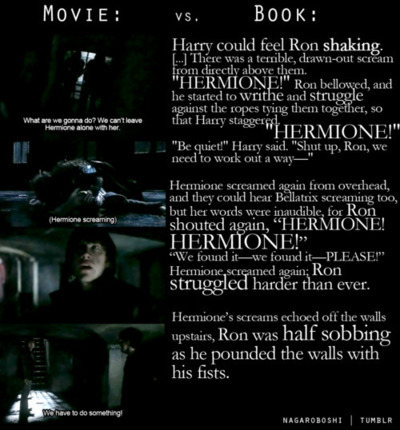
How many times have you left a movie theater and said to your friends, “The book was better?” You can spend hours upon hours getting attached to characters and story lines while you read, only to have your favorite aspects of a story changed or removed entirely when the book hits the big screen. If you don’t read the book ahead of time, you miss out on a much deeper level of involvement.

Movie-vs-Book-harry-potter-19872342-400-430

Yes, I’m referencing Harry Potter again.

Nicholas Carr talks a great deal about the effect the web has had on books, both through the distribution of ebooks and the decreased attention spans humans are developing due to web use. I wonder though if the more serious threat to readers is the constant creation of film adaptations. If the movie comes out next month, why bother reading it now?

According to the New York Times (2012), reading narrative text evokes strong neural reactions that trigger the parts of the brain associated with all five senses. Written description leaves more room for the brain to work creatively, as it attempts to construct for itself the the world being described on the page. But as Carr says, our attention spans are getting shorter, which could be what makes film adaptations more palatable. On that same note, it seems as though authors, especially those in the young adult fiction genre, are writing books with the big screen in mind. What does this mean for literary content in the future?

« Newer Posts - Older Posts »

Categories