In the second chapter of Spreadable Media: Creating Value and Meaning in A Networked Culture, there is discussion on how YouTube audiences consumed content in the last few years. One area of consumption that was noted, which I would like to expand on, is the use of YouTube in the classroom. I have been in college for the past eight years consecutively, and I have noticed a trend of using YouTube as a teaching and learning tool in the college courses I have taken—across all disciplines.
Personally, I appreciate this trend. I believe this spices up the ordinary classroom discussion and allows for more perspective on different topics.
At the graduate level, the requirements for students to teach fundamental principles to their classmates—in the student-led curriculum style—I find myself also turning to YouTube to help explain different ideas. Multimedia style videos grab attention far better than I ever could, which allows for the information to permeate in ways I could never manage on my own.
YouTube can be used as a tool in the learning environment in an effective way, however, just as in any type of media, it’s always important to check the validity of the source.
What could be some downsides to using YouTube as a teaching tool? Can teachers use this tool too much?
After our in-class discussion that touched on media framing last week, I would like to take a moment to provide the parts of Lamar Odom’s history that many entertainment driven media outlets missed. There is more to the man than the headlines. If you want to understand why people in the sports community care so much about an NBA/reality star, proper context is required. Odom’s story is among the saddest in professional sports. Fair warning: We’re going deep.
Odom grew up in South Jamaica, Queens, NYC with his mother. His father, struggling with heroin addiction, was largely absent from his life. When Odom was 12 years old, his mother died of colon cancer and he was sent to live with his grandmother. She was his emotional support through the hardest part of his childhood.
Three years later, Odom befriended soon-to-be NBA star Kobe Bryant at the 1995 Adidas ABCD Camp. The two would both go pro in their own time. On June 29, 2003, Odom’s grandmother died. Odom, 22 at the time, needed a new support system. He found one when he was traded to the Los Angeles Lakers the following year, rejoining Bryant.
In 2005, Odom fathered his third child (Jayden) with then girlfriend Liza Morales. It seemed as if the reaper that shadowed him through his youth had let him be to enjoy his family. This was not the case. Odom was shaken when six-month-old Jayden died of Sudden Infant Death Syndrome on the third anniversary of his grandmother’s passing.
Odom began writing the names of his dearly departed on his shoes as a pregame ritual: Cathy (mother), Mildred (grandmother), Jayden (son). Throughout his NBA career, he was widely known for being a warm and sensitive person. In 2009 and 2010, the Lakers won back-to-back championships. In 2011, Odom was voted NBA Sixth Man of the Year, but was traded to the Dallas Mavericks after the Lakers failed to 3-peat; a move that Bryant publicly criticized.
That July, Odom received word that his cousin, with whom he was close, had been murdered in Queens. He returned home for the funeral. The following day, Odom was involved in a traffic fatality when his chauffer struck a motorcyclist that knocked a 15-year-old boy off his scooter. The boy lay dying in the street, unaided as distracted bystanders requested Odom’s autograph.
Overcome by grief once more, and without any semblance of a support system, the once dominant forward struggled to perform at even a passable level in Dallas. He and the Mavericks mutually agreed to part ways before the completion of one full season. In 2012, he signed with the Los Angeles Clippers, only to struggle even more. It would be his last season in the NBA.
By 2013, Odom was pervasively rumored to be abusing cocaine as he spiraled into depression. He would attempt a number of NBA comebacks to no avail. He would also attempt to get clean with limited success. Spending life surrounded by death takes its toll, and it wasn’t done taking.
On June 14, 2015, Odom was devastated by the sudden death of best friend Jamie Sangouthai, who died of a heroin overdose. Odom barely had time to arrange the funeral before their mutual friend, Bobby Heyward, overdosed six days later. Without his family, his friends, his teammates, or his estranged wife, Odom hit rock bottom. It was a long, torturous trip to present day.
The events of the past few weeks are deeply saddening for many. Entertainment news coverage paints the picture of a coked up reality star that simply partied too hard, but the pattern of depression and self-destructive coping has been longstanding for Odom. His story is one that the basketball community has followed very closely for several years, hoping for a happy resolution, not the mockery brothel deathbed he narrowly escaped.
While fending off personal demons in the face of repeated loss is not a struggle unique to Odom, it is one that should be understood, and not trivialized. The man needs help just to live his life, as do others who are antithetically fortunate to evade the public eye. Behind the sexy headlines is a son without his mother, a father without his son, a husband without his wife, a friend without his comrades, and a champion without his dignity.
Spreadable Media‘s section discussing the value of “cult” audiences really resonated with me. One of my favorite movies is Scott Pilgrim vs. The World. I was a huge fan of the comic books and found the movie to be one of the best adaptations I’ve ever seen. I felt like I was living every fan’s dream of seeing the pages come to life on the big screen. Even though it wasn’t a huge box office draw, my friends and I tirelessly promoted the movie’s virtues. Therein lies the power of the cult audience – word-of-mouth and avid fandom. Especially considering the powerful effects of social media, cult audiences can influence many, as seen in it’s top-selling Blu-Ray status on Amazon.com.
Cult audiences can also bring back shows that have been cancelled, like Community and The Mindy Project. This was largely due to fan outcry and support. Another example is Hannibal (think Red Dragon and Silence of the Lambs). Despite relatively low viewing numbers, NBC kept it around for three seasons. Incredible acting and a unique visual style led the show to critical acclaim, and several awards and nominations. By many accounts, this show led to increased credibility in NBC’s programming. Hannibal was cancelled this year, but the fact that it lasted three seasons was a testament to the effect of “cult” audiences and their unique ability to influence the value of media. If you haven’t seen an episode of Hannibal, I highly recommend it.
Last week Drake, a popular Canadian-born rapper, posted to YouTube the music video for his current hit song, “Hotline Bling.” The video features Drake dancing as if no one is watching in front of a plain background that is constantly changing colors. Speaking of the video, John Caramanica of the NYT writes,”No celebrity understands the mechanisms of Internet obsession better than Drake. Online fandom isn’t merely an act of receiving–it’s one of interaction, recontextualization, disputed ownership and cheek. For the celebrity it’s about letting…the hive take control. For Fans, it’s about applying personalization to the object of adoration.”
So, how does this relate? Well, if “‘Stickiness’ broadly refers to the need to create content that attracts audience attention and engagement,” and “spreadability” refers to the “technical resources” like YouTube, Vine, and other social media sites that “allow people to share links quickly and efficiently,” then Drake fully encapsulates both of these ideas. Almost overnight there were dozens of spin off videos, gifs, and memes stemming from “Hotline Bling.” Realizing his fans would do more to “spread” him across the internet than he could do on his own, Drake put together a video with tons of negative space, corny dance moves, a slow, catchy beat, and offered himself up to the Internet. Folks ran wild with it, and almost overnight there were dozens of spin offs edited to produce comical reactions, and further “spreadability.” Does Drake know what “stickiness” and “spreadability” are? Looks like it to me.
In this week’s reading of Spreadable Media, the authors state, “This shift from distribution to circulation signals a movement toward a more participatory model of culture, one which sees the public not as simply consumers of preconstructed messages but as people who are shaping, sharing, reframing, and remixing media content in ways which might not have been previously imagined.”
Henry Jenkins, one of the authors, talks about Transmedia Branding and cites the video above as an example on his blog.
The video is a great example of content that is shaped by participatory model of culture. Originally created by Chipotle, the Chipotle Scarecrow video was re-edited by Funny or Die, an Emmy-award winning video and film production company, to demonstrate a different truth from the one originally produced by the multinational corporation.
Funny or Die doesn’t stop there. It invites viewers to watch and vote, fostering a participatory culture where viewers have an opportunity to affect how that content is shared and circulated.
In case you wanted to see the original Chipotle video, it is, unfortunately, “unavailable.”
The amount of shows that are illegally downloaded for personal use ever increases, to the dismay of innumerable production companies. However, as was explained in Chapter 3 of The Spreadable Media, the shows’ creators do not necessarily share those companies’ disdain for the law-breaking individuals characterized as pirates. These creators maintain that the current nature of the television industry is too dependent upon “sticky” advertising slots, meaning that audience measurement is determined by the amount of viewers who tune in at a particular time, for a particular broadcast; and those who tune in for the broadcast are not the only ones who view the show. How then, these creators wonder, can the television industry adapt to become more “spreadable?”
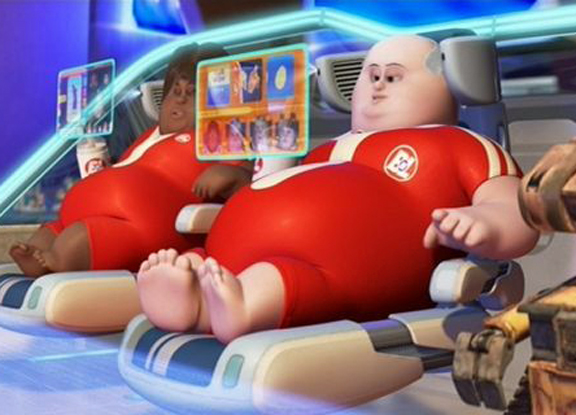
It seems to me that such a shift is already in progress, considering that many shows now are released by the season, to be watched at the consumer’s leisure through applications like Netflix and Hulu. It also seems that this encourages “binge watching,” and I can’t help but wonder how this trend could affect our social realities, especially if it becomes the new norm for how we consume media. Whereas broadcast schedules used to moderate our consumption, we are now left to moderate it ourselves. Maybe that’s progress, but still it’s worth asking: when should the consumption of media (entertainment media especially) be considered overconsumption? Is too much media consumption really such a bad thing?
The effects of overconsumption, as depicted by Pixar’s 2008 movie, Wall-E.
It is striking how audiences and corporations impact each other. Just last Wednesday was “Back to the Future Day,” a media event celebrating a successful film franchise from the 1980s. Historically such celebrations for films or television series were started by fans and usually focused on the day that it was first aired.
This day was actually the anniversary of a date in the plot of the movie, demonstrating what the authors called “transmedia engagement.” The amount and diversity of public and corporate participation truly impressed me. Companies like Nike, Pepsi and USA Today released products based upon the ones shown in the movie, which was re-released in select theaters. Michael J. Fox and Christopher Lloyd literally drove a DeLorean onto the “Jimmy Kimmel Live” show.
Many of these organizations likely used this event as a form of advertising, to highlight their goodwill and brand. However, without the existing fan devotion and interest in this franchise and the subsequent influence they exercise, such involvement by these organizations would have most likely not occurred.
From Prime Ministers to fans dressing up it was an interesting phenomenon where consumers, businesses and leaders were influencing each other simultaneously in a participatory culture. The question to ask now is whether this is a onetime thing or is such commercial interaction to become the norm? Is it a good thing or does it weaken the authenticity of grassroots movements?
As I’ve been reading chapters 1 to 5 in Spreadable Media, I have been thinking about the concepts of media power and of framing, as they relate to stories currently dominating the news, such as the upcoming Presidential election. In all honesty, although I do not agree with many of Donald Trump’s positions nor think that he is a positive or strong candidate, having these ideas in mind makes me think that much of the coverage of him by the media has been unfair, and has involved framing often in a negative or biased way. Ideally, it is the media’s job to be a middle entity or mediator between us, the public, and newsworthy events. It should be their job and their goal to present events and facts objectively, and without any spin. But as I think about it, I feel that they often have no hesitation or reluctance of portraying Donald Trump as an unfit or ridiculous candidate, and of conveying their own opinions regarding him. Ultimately, it is for the public to decide on our own and the media should not be actively asserting opinions or trying to influence these decisions.
In the Introduction of Spreadable Media, the authors state “Audiences are making their presences felt by actively shaping media flows.” The video below and the context in which it was “spread” demonstrate this idea in several ways. I found this on a Reddit thread, where users share and vote for links posted from other sources. The video itself is posted on a YouTube channel named Harmful Opinions, which appears to be managed by a self-appointed media critic. The channel gathers headlines and news stories to critique them, albeit in a rather unprofessional and Anonymous-influenced way.
This video critiques the way news organizations covered a Facebook post written by Chris Mintz, a hero of the Roseburg, Oregon, shooting who was shot multiple times while trying to help others. Mintz is clearly a standout human being, and it’s great that he has gotten more attention than the shooter in many stories, such as this profile from the Washington Post. Thankfully, Mintz is recovering in the hospital. He recently wrote a lengthy Facebook post about his experience, and said that he wanted to make his statement on Facebook because he didn’t “want any media outlet to alter it in any way,” which is a pretty great example of a savvy news consumer trying to control their own story.
But the video illustrates that the media did reinterpret his statement to fit their pre-existing narratives and focused on the phrase “like he was playing a video game.” How much influence can the audience really exert on what the mainstream media produces?
In Chapter Four of Mediating the Message in the 21st Century: A Media Sociology Perspectivethere is discussion of how information is often controlled during time of war. I found this passage particularly fascinating, as I was a information gatekeeper while in Afghanistan during my combat tour. From the outside perspective, as viewed in our book, it appears the keeping of information during war is some sort of censorship directed at reducing the knowledge of the public on the doings of the military, when in actuality, that is not the intent.
This sparked interest in researching a little more on the subject and how journalists in the field feel about this information protection. It turns out, many journalist feel similar sentiments when it comes to the reporting of both the Iraq and Afghanistan wars. The attached video is a perfect example of what I found during my research.
Now, let’s get to my military background in Army Public Affairs and the comprehension I have gleaned from my service. I believe:
Information=Knowledge.
Knowledge=Power.
Photographs and videos of the effectiveness of the Taliban would jeopardize the safety of the men and women fighting in Afghanistan. Just imagine what could happen if the Taliban could start determining our military’s shortcomings by merely watching our news. It could be disastrous.
The fact of the matter is this: news stories have a global reach—meaning, everything our intended audience gets, the Taliban gets as well. This information is protected for service members’ safety, not censored as a malicious attack on American Citizens.
What do you find more important– safeguarding information on behalf of the safety of our service members or providing all combat information to the American public?

 Strategically Communicating