Interesting timing…
In case you missed this in Willamette Week:
http://www.wweek.com/2015/11/12/instagram-wont-stop-deleting-cannabis-dispensarys-accounts/
Interesting timing…
In case you missed this in Willamette Week:
http://www.wweek.com/2015/11/12/instagram-wont-stop-deleting-cannabis-dispensarys-accounts/
Posted in Uncategorized
As students, we have more freedom when using media for projects and presentations. We are covered under a set of rules. https://copyright.lib.utexas.edu/ccmcguid.html
When we step out from underneath the education umbrella, we are slapped by the reality that the line that divides legal and illegal is very large and very gray. Just ask “The Content Factory”, they were slapped with an $8,000 copyright infringement penalties. http://www.contentfac.com/copyright-infringement-penalties-are-scary/
“Current Fair Use image copyright laws say that you’re financially liable for posting copyrighted images, even if:
After reading through the material and personal experiences, it seems like lawyers are looking at copy right infringements as the new gold rush. This can make someone very hesitant once they step out from under the education umbrella.
How comfortable do you feel about fair use knowing that there are lawyers scouring the web?

^ Image copywrong: Kari DePhillips. Others are free to steal or “borrow” this graphic.
Posted in Uncategorized
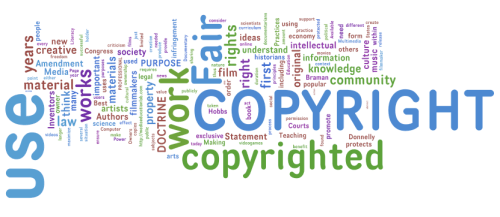
Archives, letters, diaries, manuscripts, reports, or any work that the owner may publish in the future can be considered as unpublished works. However, when talking about copyright, we most likely would refer to published books, papers, photographs, etc. So is it OK to use unpublished work without permission? No.
Copyright of an unpublished work lasts for the life of the author plus 70 years. If the author (or the author’s death date) or the author is unknown or if the author is a corporation or organization, then the term is 120 years from the creation date for the work. After that duration, all works will be moved to the public domain.
Therefore, Shakespeare’s work is free to use for everyone, while Hemingway’s, as well as many other archived works, still have a few decades to go before they land in the public domain
Apparently an unpublished work is protected by copyright, but I also wonder, should the way in which the unpublished material is used affect the scope of protection? For example, if the unpublished work is a letter, does the copyright belong to the person who wrote the letter, as the creator of the original work, or the recipient who actually “owns” the original letter own the copyright?
Posted in Uncategorized
During this week’s reading in Center of Media & Social Impact on “How Journalists Think about Fair Use,” I stumbled onto this phrase:
“One mainstream reporter referred to bloggers as ‘these rogue players who have no formal journalistic training. Everyone can have a blog now.’”
This sentence reminded me of the hostility between journalists and bloggers, which not many people see the similarities as much as they see the differences between them.
I graduated with a broadcast degree, worked at a news station as a reporter, but I also love blogging and sharing my thoughts and writings with the world. Does this make it better for me to blog ? Does every blogger have to prove themselves as a journalist before they start a blog?
I would say in cases like Crystal Cox, there should be some journalistic background.
“Blogger Crystal Cox is No Journalist, Must Pay $2.5M in Damages, Says Judge,” is
Cox called herself an ‘investigative blogger.’ She blogged about Mr. Kevin Padrick, saying that he acted illegally as a trustee in a federal bankruptcy proceeding with Summit Accommodators. Mr. Padrick then sued her for defamation.
This case caused me to pause and stare at my screen for a while, first due to the fact that Cox calls herself an ‘investigator’ and secondly I wondered if bloggers like Cox are the reason there are some hostility.
Do you think there could be ‘investigative bloggers? Also, why do you think there is such hostility between journalists and bloggers?
Posted in Uncategorized
The research topic this week is the communication theory of gatekeeping, or agenda-setting. Gatekeeping is basically the power to filter, and in essence (at its most extreme) is or can be censorship.
Are there fewer conventional “gate-keepers” now because of the Internet? Let’s think about Edward Snowden, as an example. In the past, a figure like him with direct, classified information would have had to go to a conventional and probably large media outlet and would likely be turned away. However, in this day and age, he was able to publish his information directly for anybody in theory to see.
An example of gate-keeping that is currently being talked about is related to the recent terrorist attack in Paris. Some people have been upset at what they feel is a stark inequality between coverage of the incident in Paris, versus very similar events elsewhere, such as one in Beirut, Lebanon.
While a number of people there have died in terrorist attacks in the past week, we must admit that we know a lot less about those events than the one in Paris. Why?
I think that this is a fair and important topic to bring up. Here are some people’s posts focused on the difference between coverage of the Paris incident and similar ones in other parts of the world.
Billie Joe Armstrong, lead singer of Green Day, on Instagram

A friend’s Facebook post
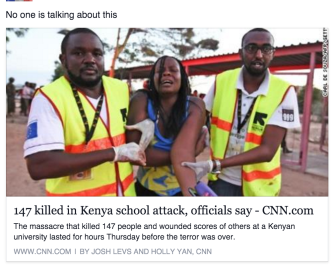
New York Times (Nov. 15) – Beirut, Also the Site of Deadly Attacks, Feels Forgotten : http://www.nytimes.com/2015/11/16/world/middleeast/beirut-lebanon-attacks-paris.html
Posted in Uncategorized
I appreciated the readings from CMSI on the code of best practices for fair use. I think fair use is one of the most important and misunderstood ideas for creators today, as illustrated in the CMSI article on how journalists think about fair use. Unfortunately, I think the fear of corporate litigation has scared many creators into erring on the “safe” side, and their final products suffer unnecessarily as a result.
For several years, I worked as a live VJ, remixing found footage and psychedelic effects in real time on projection screens at clubs and concert halls. My interpretation of fair use in that setting was quite liberal, and I think rightfully so. My VJ work was highly transformative of the source material, and fit squarely under number 6 on the CMSI code of best practices: “a new work that depends for its meaning on (often unlikely) relationships between the elements.”
On the other hand, when a museum commissioned me to create a video homage to the ways that human flight (both fictional and factual) has been portrayed throughout the history of pop culture, there was a rigorous examination of our fair use rights by the museum’s curators. It was decided that our piece fell under numbers 1 and 2 on the CMSI code: “Commenting on or critiquing of copyrighted material” and “Using copyrighted material for illustration or example.” We were also careful to credit all our sources. What do you think, is this video fair use or copyright infringement?
Posted in Uncategorized
When reading about copyright and fair use this week, one question kept coming to my mind—where is the boundary for copyright and fair use infringement? How can one truly determine a violation?
One of the easiest examples to help explain my question is within the music realm. There is a finite amount of ways to put together musical notes to create nice melodies; therefore, it’s only a matter of time before one song begins to sound like another song. Because of this challenge within musical copyrights, there are recent examples in which music artists feel as though their music had been copied.

In early 2015, a jury granted the verdict of copyright infringement based on musical plagiarism against Pharrell Williams and Robin Thicke. The accusation was that the two song-writer/singers plagiarized Marvin Gaye’s 1977 hit Got to Give it up with their 2013 hit single Blurred Lines. This ruling may forever change the landscape of music and using other songs for inspiration.
But the question remains, how do courts decide what is considered infringement and what is not? Most pop songs are constructed with the same four chords, so to make this distinction is very challenging. The video below demonstrates the similarities in many pop songs throughout the past two decades.
Which songs in the video do you think would fall into the infringement category? Which do you feel are merely inspired by other pop songs?
Posted in Uncategorized
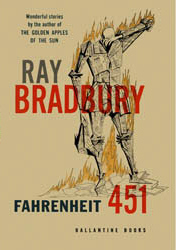
All this reading and talk about our fickle attention spans, the advent of various technologies, the power of the internet, the Church of Google, and the inefficiency of memorization nowadays, well, it all got me to thinking about Fahrenheit 451. For those of you who haven’t read it (or don’t remember it well, heh) Fahrenheit 451 is Ray Bradbury’s 1953 dystopian future work about a time when books are outlawed and “firemen” burn all books they find. The main character, Guy Montag, is a fireman, and befriends a young girl named Clarisse who is a subversive in her embrace of nature vs. technology, and asking “why” instead of “how” to the chagrin of her peers and teachers in school. Quite the opposite, Mildred, Montag’s wife, is portrayed as being under a spell that characterizes the society at the time: She’s addicted to sleeping pills as well as the shallow dramas that she watches on television, and the feed she regularly listens to through her earbuds. Two major themes stand out: resistance to conformity, and control of individuals via mass media and technology.
I think of Fahrenheit 451 in the context of Don Tapscott’s quote in The Shallows: “Memorizing long passages or historical facts is obsolete” because it’s all a click away on Google. We all live out this reality, especially now as students, and the realization of this actually worries me. As powerhouses of technology like Google expand their reach and benefit exponentially from our usage (read: dependence), who is actually in control of the information that is said to be ours collectively? Are we as a society becoming Mildred? Is journalism going the way of Mildred’s form of entertainment? Or are there still Clarisses and Guy Montags (Journalists doing journalism? Snowden?) out there, or are they becoming a minority?
Posted in Uncategorized

We take selfies in our daily life, so one might believe that if you post a selfie on your Instagram account that it would not be a big deal. But what if Katy Perry posts a selfie with 2016 Democratic presidential candidate Hillary Clinton?
Media use their power to frame and spread information to the public, targeting specific audiences and telling them what they should watch and how they should think. But is it framing when celebrities are the center of the story? When Katy Perry sings for the Iowa Democratic Party dinner you need to know she is supporting a political party. It’s not Katy Perry’s solo concert.
If you are big fan of Katy Perry, when you see a picture like that, what are you going to do? Vote for Hillary Clinton?
In 2012, Craig Garthwaite and Timothy Moore write a paper to explain how celebrities make a difference at the polls. Garthwaite said:”If endorsements affect all kinds of behavior, why would we think that they wouldn’t affect voting behavior?” It’s hard to measure the impact of an endorsement.
Katy Perry has the power to affect at the polls, but it does’t mean all of her fans will vote for Hillary Clinton.
Posted in Uncategorized
 Strategically Communicating