Posted in Uncategorized

With all the media coverage of Syria in recent months, I was pleased to see an npr.org article that took the time to answer 5 Key Questions About Aleppo. I shared the article with four people in my community: a stay at home parent, a mid-career professional, a tenured professor, and a college freshman.
Because of their varying degrees of interest in current events, I focused on what value the article might bring to each of them. For the stay at home mom, it was context for some of the policy questions in the presidential debates she’s been watching. For the mid-career professional, it was interesting talking points for his next networking event. For the professor, it was ideas for how to explain the conflict to others. Finally, for the college freshman, it would make her smarter than a 3rd party presidential candidate.
Ok, that last one was a cheap shot, but it piqued her interest enough to read the article.
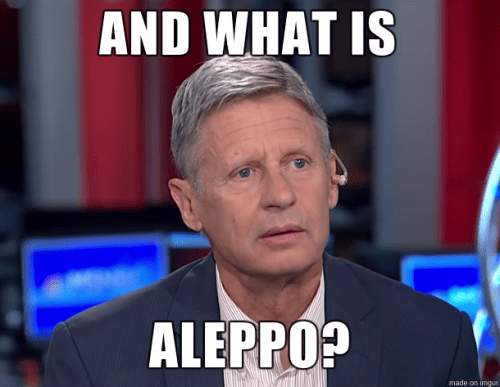
If I were sharing this article with all four of these individuals at once, I would start with the cautionary tale of Gary Johnson being thoroughly lambasted for not knowing what Aleppo was, and then focus on the common value of being prepared to discuss this important topic with anyone. I would share it via Facebook (where all of these generations still converge at the time this post was written), so they could respond to and engage with the article and with each other.
Posted in Uncategorized

On October 4th, BBC News published an article about England’s low percentage of male teachers. It cited a serious need for diverse backgrounds in the classroom and positive, male role models for many children who do not have them at home. According to the UK’s Department of Education, only 26 % of teachers are male. In the US, that number is 24%, according to the National Center for Education Statistics. This article stood out to me because I work in an educational setting and have many friends and colleagues who are teachers.
I shared this article with a friend who is a high school teacher in Portland, a former classmate who is a doctoral candidate in Sociology in Chicago, a former professor, and a friend who is a single mother. The high school teacher and professor were able to relate to the issue (being male teachers themselves), and to refer me to similar articles. For them, print and web articles are perfect. My sociologist friend, being in graduate school, cited theories and reasons for the gender disparity. Jen, the single mother, really resonated with the article’s focus on the need for strong male role models. She gets most of her news via Facebook links.
BBC News did a good job of framing this article in a way that spoke to me and to my network on different levels. The subject was compelling, the statistics confirmed what my educator friends already knew, and the social impact spoke to my sociologist and single mother friends.
Posted in Uncategorized

Throughout this election season, Nate Silver’s polling aggregate and political analysis website FiveThirtyEight has been a regular fixture in my daily reading. I’m not exactly alone in my readership, either – the site had 10.7 million unique visitors in February. Presumably that number has only gone up as the campaign season starts to enter its final stretch.
Yet despite that impressive level of readership, it’s undeniable that the statistics found on FiveThirtyEight are intended for the wonkishly inclined. As a result, stories like this one might not be of interest to the general public, despite shedding some potentially telling light on some of the failings of our democratic process.
I explained the story linked above to four people who hadn’t seen it. I also asked what would help them both find and understand it. Brief summaries of their responses below:
Interestingly, all four felt an essential part of the story being successful was an expert explaining the topic’s relevance. Good news, traditional journalists: looks like there’s a place for us after all.
Posted in Blogs
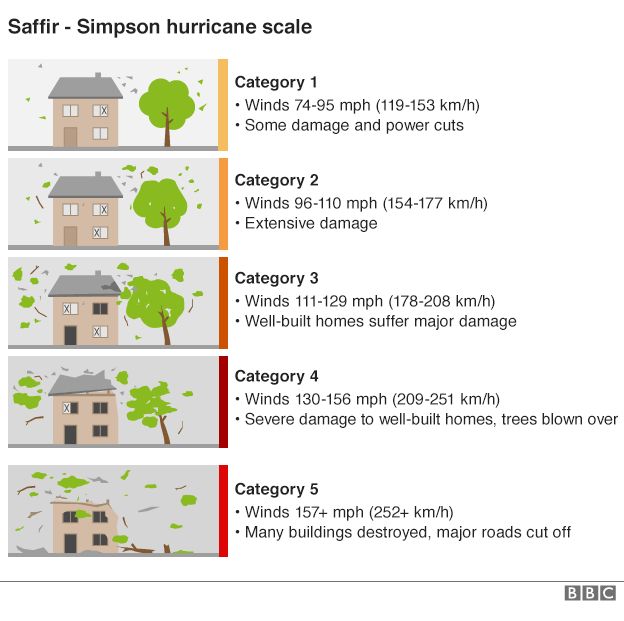
While reading the news on the News Engagement Day, I picked a story about hurricane Matthew to share with my friends and family in Ukraine. According to BBC, Matthew was the strongest hurricane to hit the Caribbean in a decade. The hurricane caused huge destruction in Haiti, where hundreds of people died and tens of thousands of homes were destroyed.
I told the story to my father, my sister, my friends, and my colleague, who is a journalist. First, I shared the news with my dad (48) on Skype, and he immediately started looking for more. He used to consume news mostly from TV, radio and newspapers, but after becoming more familiar with computer, he prefers online media. So, when I first asked him if he heard anything about the hurricane, he answered – “I will google it now.”
When I thought how to make the story relevant to my 12-year old sister, I decided to tell her what happened in general terms, using a map to show where the disaster happened, and pictures to explain its scale.
Most of my friends and my colleague were already aware to some extend of what happened from social media. Nevertheless, I sent them articles with detailed explanations, photos and videos.
This particular story made me think how to get people to listen and sympathize with something that happened far away. I decided to use pictures, numbers and personal stories. I also considered age, background, education and media preferences of the audience.
Posted in Blogs

North Carolina’s HB2 legislation (AKA the Bathroom Bill) has sparked heated debate this year. The bill, among other things, allows businesses to discriminate based on sexual orientation. Despite pressures applied to the state to revoke the law, it remains.
Comedy to the rescue?
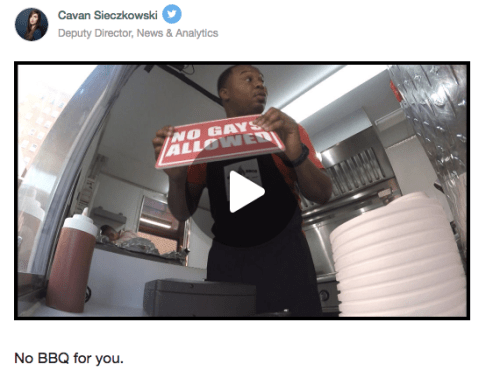
On Oct. 4 The Huffington Post shared The Daily Show segment in which a food truck set up shop and refused to serve people they thought might be gay, to see how they’d react. Bone Brother’s Flamin’ BBQ customers, and those in my network whom I shared the story with, were, not surprisingly, shocked and angry. We also all agreed that the video effectively illustrates the absurdity and arbitrariness of the law, and that this format is an effective attention-getting tool.
I relayed this story verbally to a parent and a colleague, following up with the video link in an email. To my brother and another colleague, I sent the article with video link directly, and followed up with conversation. My point of view and introduction to the story was fairly uniform across all four, and certainly held personal bias. In one case I also had a more in depth conversation about The Daily Show itself, because that person was not familiar with the show.
If I were to rewrite this story, I’d mirror the approach taken by Huff Po; keep the story brief and let the video speak for itself since this proved effective with multiple audiences.
Who’s hungry for BBQ?
Posted in Uncategorized

When mum and dad are actually your aunt and uncle is an online magazine article that explores the experiences of three individuals who discovered their bonds to family were through what’s commonly known as informal adoption within the Asian community living in the UK. Human interest pieces like this engage the audience by helping to show an experience through the eyes of another. The best pieces take challenging subjects and create a framework and context for discussion.
I shared the story with a male colleague, a close friend who’s a mother, her seven-year-old son, and my own mom. In three of the four cases, I was able to easily relay experiences of the subjects at a high level. General remarks among the adults indicated the topic was interesting. To make the story relatable and create a dialogue I asked this question: if it were your family, would you keep it a secret? In the case of the seven-year-old, after conferring with his mother, we chose to bring up the topic by asking him if he understood what adoption was, and whether he knew anyone who actually was adopted.
In approaching such a piece, which in this case is culturally sensitive, I would look to social media or online forums as an outlet for the audience to react and share experiences. Interactive media can offer a way to shape and inform the actions of families and individuals.
Posted in Uncategorized
The story that caught my attention on News Engagement Day was a tweet from the Associated Press: “Venezuela’s health crisis: How a banged knee nearly killed 3-year-old Ashley”. On October 4th Ashley’s story was shaped around Venezuela’s medical shortage and a family’s quest to find proper antibiotics.

I shared the story with my mom initially over Facebook, which instantly led to a phone call. Over the phone, I retold the story from the perspective of Ashley’s father, who tirelessly searched for antibiotics, rather than focusing on the facts about Venezuela’s current crisis. My mom deeply sympathized with Ashley’s parents, who were unable to help their child immediately, because resources were unavailable. She described, “I can feel what they are going through – every parent wants to help their child.” The content had a deeper impact on my mom, brother, friend and co-worker after I retold the story from the father’s perspective.
The original story concluded with Ashley’s father leaving the clinic at 1:30 in the morning to buy antibiotics. On October 7th I revisited the article and learned that Ashley survived and her parents sold the left over medication to mothers in the hospital. The story is captivating because it addresses a larger cultural and societal issue as well as touches the hearts of those who can empathize with the family. This family narrative was nevertheless, universally understood.
Posted in Uncategorized

Potential future college athlete & Florida Gator, drawing by nephew Jack McEntire, 2011
Back in 2009, college athlete Ed O’Bannon sued the NCAA and Collegiate Licensing Company for compensation for using his image for commercial purposes and seven years later, the case made its way to the Supreme Court. As the New York Times reported, the Ninth Circuit’s ruling will stand and more cases are on its heels as the NCAA could be found in violation of anti-trust laws.
After discussing with many, including explaining it to my 10-year-old nephew, the ramifications of the ruling and the potential changing state of college athletics is far more compelling to consider than the legal process. Therefore, leading the story with the big questions that arise from considering the upside and the fall-out of paying college athletes could be a stronger story angle.
The people I emailed and talked with were in agreement that college athletes should get some form of compensation for their image to be used for commercial use. Now whether that is tied to academics, how to compensate for the commercialization of a hyped team or individual and how to preserve an athlete’s amateur status is all up for debate. In addition, there are also some other big challenges with Title IX rules and taxing scholarships that further complicate a complicated landscape. There is big money on all sides of the issue, so no doubt that this is far from over.
Posted in Uncategorized