Posted by: Keegan Clements-Housser | October 24, 2016

Propaganda Ascendant

In Chapter 4 of “Mediating the Message: Theories of Influences on Mass Media Content,” attention is drawn to the Propaganda Model, a concept proposed by Edward S. Herman and Noam Chomsky in their text “Manufacturing Consent.” The model proposes that media can easily become propaganda for societal elites, even in the absence of more stereotypical heavy-handed state control.

Their premise, though not without its detractors, is worth thinking about. They posit that most successful news organizations are not only owned by large corporations with vested interests in promoting particular types coverage, but are also generally heavily reliant on governmental agencies and corporate PR offices as authoritative sources. These sources often heavily doctor the information they provide to journalists, helping to reinforce a perception of society that favors the elites, and is often not representative of the average citizen. Coupled with the need to not offend advertisers who pay the bills, this creates for a dangerous erosion in factual and unbiased reporting.

In an ideal world, of course, journalists would specifically seek out independent sources to corroborate information provided to them by governments or corporations. Unfortunately, as the industry continues to contract and newsroom layoffs become the norm, many newsrooms simply lack the manpower to do much digging into the information provided to them by society “elites,” as Herman and Chomsky would describe them. The implications for the future of traditional journalism are grim – unchecked, this trend could  see news become propaganda without a single censor office in sight.

Posted by: laurahaneyjackson | October 24, 2016

The Art of What is Desirable

streaming

After reading chapter 3, The Value of Media Engagement, I’m eager to see what Henry Jenkins has to add to the next edition, as much of the landscape has changed since Spreadable Media was published in 2013. For example, the addition of original series created by and exclusively distributed through Netflix, Hulu, and Amazon, make it apparent that media companies have embraced the idea that capitalism is about the art of what is desirable.

Surveying the Originals lineup on Netflix, there is a clear effort to appeal to genres that are considered a transmedia success. The series Jessica Jones and Daredevil are both Marvel spinoffs that have had success in online forums, comics, and various fan fiction sites. The inclusion of the series in Netflix creates a venue for fans to engage and support, while sponsors and content creators at Marvel reap the benefits of having enhanced and measurable user stats.

True crime is another genre that has thrived as an original series. The Making of a Murderer, the story of Steven Avery, has created a social outcry. The format of the series taps into the expanded cognitive abilities of the viewer. Super sleuths have created online forums to discuss evidence, which resulted in a revisiting of the case and the overturning of the conviction of Brendan Dassey.

It’s clear that Netflix and its competitors are changing the approach to media engagement, and have only just begun to create content that will appeal to and engage audiences.

Posted by: whitneygomes | October 20, 2016

“If it doesn’t spread, it’s dead.”

Henry Jenkins, media scholar and renowned co-author of Spreadable Media: Creating Value and Meaning in a Networked Culture, first coined the term participatory culture in 1992. Today, we live in a convergence culture that is participatory: Jenkins claims that we are no longer passive consumers of media, but are now strong contributors to the media we consume.

Jenkins, Ford, and Green use the term Spreadability to describe increasingly omnipresent forms of media circulation. Spreadability measures and describes the potential, in technical and cultural/social terms, for audiences to share content for their own purposes. It refers to the technical resources that make it easier to circulate certain types of content over others.

jenkins

In contrast, they explain the term Stickiness as describing media content that stimulate deep audience engagement––potentially motivating them to share (or post, tweet, or insta) what they learned with others. These terms provide a framework for us journalists (and communicators abroad) to consider––keeping in mind the prevalence of Web 2.0 power players like YouTube.

If spreadability describes “the how” and stickiness describes “the what”, it seems we cannot measure one without the other. That said, how does one measure the potential for audiences to share content? Can we reach a quantifiable outcome? Doubtful, but it is important to understand that some media are sticky––”post me,” “share me,” “retweet me”––while its ability to reach other audiences for purposes of sharing (self-satisfying, economically inclined or otherwise) is a vital part of the Web 2.0 discourse.


Posted by: Donna Z. Davis, Ph.D. | October 18, 2016

Talk about truths…

After our class discussion last night, this video landed in my Facebook feed this morning! It speaks to the issue of “bigger truths” and why folks believe what they do. Important perspectives…


Posted by: victoriahaiboniuk | October 17, 2016

(Under)mediating reality: Standing Rock protests

Lately I’ve come across news on NPR about protests against the Dakota oil Access Pipeline near the Standing Rock Sioux reservation in North Dakota: protesters worry that the pipeline which is to be constructed across four states can disturb sacred places and pollute the Missouri River.

Although those protests (that began in April) represent the largest mobilization of Native American activists in more than 40 years and a fight for environmental justice, they had not been covered by any major American broadcast media before journalist Amy Goodman went there and reported about violence against protesters. To date, during the protests at least ninety people have been arrested including Goodman and another journalist.

In this context, there is a clear gap between social and media reality. Why were those protests The Guardian named “new civil rights movement where environmental and human rights meet,” and The New Yorker called “new movement for Native-American rights” outcast by media? Why didn’t influential outlets such as CNN, NPR, CBS, or NBC send their reporters to cover Dakota Access Pipeline controversies? Was it gatekeeping?

And finally, all of it led me to a question – as journalists and strategic communicators, where should we start when analyzing such complicated issues? When applying theoretical framework of hierarchy of influences to this particular case, should we focus on how ideological forces shape and influence media content, or simply on routine practices?

14606379_883990831737211_6692318810125157008_n

Image is from Native American World Facebook page

Posted by: estutesman | October 17, 2016

The Prevalence of Bad News

Screen shot 2016-10-16 at 9.27.21 PM.png

In chapter three of Mediating the Message in the 21st Century, the authors discuss the pervasiveness of “bad” news in the media, such as crime and natural disasters. While reading, I thought about how I have noticed that monitoring the news can give me anxiety. For example, if I see a celebrity’s name trending on Facebook, often my first assumption is that something terrible has happened to that person.

I decided to conduct a simple experiment by scanning a couple of news sites to determine if their stories were “good” or “bad.” The lead story on Oregon Live focused on the storm this past weekend: “128 houses damaged, one-third of trees destroyed: Manzanita grateful, but long cleanup ahead,” while a less noticeable headline in the right sidebar states, “Portland streets open, safe after days of rain and wind.”

On CNN, I counted five main stories that if not inherently “bad,” would definitely fall into the stressful category—all focused on the election, specifically Trump’s misdeeds. Finally, after scanning a few other sources, I realized that I was unsure of what a “good” news headline would even state, until I finally found one, “Conjoined Twins Separated, Both out of Surgery.”

For those reading, do you feel that the constant stream of negative news impacts you? For instance, I personally feel fatigued by this election cycle- Any mention of either candidate wears me out, and when I realized that I would be unable to watch the next debate, I felt relieved.

Posted by: ladyelayna | October 16, 2016

Mediated Reality

Mediated Reality was a theme in chapter three of Shoemaker and Reese’s “Mediating the Message in the 21st Century”.  As someone who has traveled extensively in the developing world and worked with people from many cultures, I am disheartened when I see the media depict entire cultures, countries, or even continents, through the most negative, biased lenses.

And while this can happen with the best of intentions, perhaps in an effort to gain public sympathy, build awareness, or raise funds to help people in need, it plays into stereotypes and does not paint a full picture.

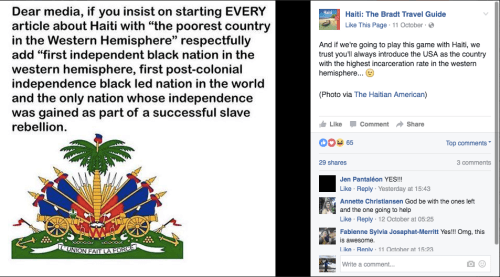
Here’s a Facebook post from this week, in the form of a “Dear Media” letter, that beautifully illustrates how significantly the choices made by the media can shape perception:

screen-shot-2016-10-14-at-6-38-52-pm

Yes, Haiti is a poor country and has more than its share of problems. However, there are some very important facts about Haiti and its history that tell a vital part of the story. And shine a much more positive light. Most Americans don’t know these things about Haiti because they rarely make an appearance in the story.

Imagine for a moment, As Bradt Travel suggests in their comment above, if we turned the tables and journalists started every story about the U.S. with the qualification that the U.S. has the highest incarceration rate of any country in the western hemisphere. Does that shift reality? Does it help illuminate how much power the media has – to modify reality with the information they choose to emphasize or omit from a story?

Posted by: Closed Account | October 10, 2016

This is news?

I found my story of choice while scrolling through Twitter, one that covered a topic less known among colleagues- celebrity gossip.

The story

Demi Lovato critiques Taylor Swift’s squad’s body type in Glamour magazine: “It’s kind of this false image of what people should look like…it’s not real.” Read: Taylor Swift’s tall, slender, and long-legged crew is not realistic.

Fans backed Swift and admonished Lovato’s attempt to radiate feminism. Lovato ends up vowing that she’s “not meant for this business and the media” and will be “stepping back” in 2017.

Sharing

My mom (NPR and CNN app user) was utterly uninterested this ‘Facebook fodder’ constituted news and abruptly changed subjects to the VP debate. My male colleague (follower of all things gossip) later commented he read a blogger trying to fan the flame. My friend (social media, new media user) wanted to see more author speculation and commentary around “feminist” views when choosing to discuss women’s bodies, no matter the type. My 10 year-old cousin proved most difficult, because I realized she was an age that this story could influence negatively. So I started by the story by setting some (admittedly one-sided) context, and asking her what a “normal body” is (“I don’t know!”) and asking if she thought it would ever be okay to criticize other people’s looks (“no way!”).

I know… l broke the rules, but hey- I never said I was unbiased.

Posted by: akabigmo | October 10, 2016

Fox News Goes to Chinatown

After the first round of the 2016 presidential debates, China was forcefully brought to the forefront of American politics. Jesse Watters, Fox News correspondent, went to New York City’s Chinatown to gauge Chinese political opinion. Watters’ segment in Chinatown aired Oct. 3, so I thought it would be perfect for News Engagement Day.

In an attempt to get a diverse range of perspectives I spoke to people from several different communities.

Pon was the most tolerable of the video, and suggested the best course of action would be to ignore the content and publisher.

“Small mind small talk a chance of Small fun,” she said. “Be confident and take the high road.”

While she didn’t dismiss Watters’ report, her position of tolerance was admirable.

The rest of the people I spoke to were a little less forgiving, with responses ranging from “unprofessional” to “simply not funny.”

I had a hard time finding someone who supported the segment, and those I usually go to for far-right opinion said they hadn’t seen it, and didn’t want to participate.

It’s likely their response is due to either my delivery or perceived bias, though I suspect it may be the latter, because I intentionally focused on the fact that Watters went to Chinatown to gauge Chinese political opinion.

Another possibility may be that the segment’s popularity and increasing response made it a difficult subject to comment on, due to expected responses to their opinion, despite offering anonymity.  

Posted by: jillkillsit | October 10, 2016

In Search of a Buzz

Fact: arctic bumblebees are dwindling in population in the Alaskan wilderness, signaling a concern about the effects of climate change. This is the news story I chose to share with four people in my life.

To my 3-year-old daughter, the written word is insignificant. Instead, visual aids become key. After showing her pictures of the subject bumblebee and then referencing heat and ice melting like how it does in a hot drink, she was able to somewhat grasp the nature of the piece. Basically, I had to make the story smaller for her. It had to fit into her life, be relevant to her frame of reference.

For my 70+ dad, I simply sent an email with the link to the story. He read it at his discretion. My 66-year-old mom required a phone call, because she hasn’t quite mastered technology.

The best way to get my husband’s focused attention is to grab a moment of his time and tell him verbally about the story. I pulled up the article on my phone so that I could read a few choice quotes for him, knowing that he likes direct-from-the-source citations. We then discussed the article.

It would be difficult to find a way to mediate this story for all 4 people. Perhaps a photo layout of the story so that my daughter could understand it too? Even then, this is an example of why mediating news across different realities has so many complications.


« Newer Posts - Older Posts »

Categories