Posted by: Keegan Clements-Housser | June 5, 2017

Qualitative Tales: Pulling it All Together

Note: This post is on Exercise 12.1, which focuses on identifying appropriate writing strategies for different types of qualitative essays. The topic of my research is bridging participatory media and professional media; the answers are written with this topic in mind.

I’m planning on a mixed method approach to my qualitative research. Specifically, I intend to conduct interviews of media professionals already using a hybrid participatory/professional content approach, as well as doing some focus group testing of hybrid content. With the level of complexity that a mixed method approach brings, the “themes/topics” strategy seems to be the most appropriate choice for identifying problems and explaining my data.  The clear logical flow inherent to this strategy will help make sense of both sets of data, as well as highlight statistical and thematic convergences in the data sets.

However, when it comes to connecting with my key readers and audiences, the themes/topics strategy may not be the best choice. While I am conducting much of this research with my future academic career in mind, I’m also very specifically trying to contribute to the professional field of journalism. Ideally, my research will be useful not just to me and my own projects, but also to journalists and other media professionals outside of academia. With this audience in mind, it may be more beneficial to adopt the “separated text” strategy. This strategy’s use of distinct analytical/theoretical and descriptive story sections could help non-academic readers get a more personal sense of what the research is about and how it can relate and apply to their situation than a more purely academically-oriented strategy might.

As an added bonus, the separated text strategy is one I’m most familiar and comfortable with as a writer, if perhaps not as an academic (as an academic I’ve only ever used the themes/topics strategy). The familiarity comes from the fact that the strategy is actually very similar to a journalistic technique known as the “ladder” method. In this method, the journalist switches back and forth from a narrative-heavy first- or close third-person account of a scene to a “big picture” overview/theoretical look at the topic – “climbing up and down the ladder.” The method uses the narrative thread to help the reader find the human element and not get lost in the weeds of policy, hard numbers, geography, etc. The fact that journalists, myself included, are already familiar with this approach further reinforces the separated text strategy as being ideal for journalists in my audience.

That said, as I mentioned above, the themes/topics strategy is the one I’m most familiar with in an academic setting. This complicates the question of which one would have the most potential for achieving my study’s goals; after all, if I go for the separated text approach, I’ll be stepping outside of my comfort zone by quite a bit. Honestly, I probably won’t know which one to use until I’m further along in my research.
Posted by: sweadickblog | June 5, 2017

Themes/Topics: A Winning Strategy for CEO Communication

Exercise 12.1 in the text, Qualitative Research Methods (Tracy, 2013) looks at writing strategies for qualitative reports and when to employ the different strategies based on the research approach.

My research plan involves personal interviews around a topic, the people involved in the decision-making, and the approach and projected outcome on internal and external communications. For this research, the best approach for identifying problems and explaining the data in a report will be the themes/topics strategy. This is the most common writing strategy (Tracy, 2013, p. 262) and for good reason; it gives the final paper a clear logic flow, readers can understand the topic of discussion, and dive into the individual themes that emerge through the research.

The research I will be pursuing involves one-on-one interviews learning about the reasons why corporations chose to get B Corporation classification. The scope of the research will involve learning about the decision makers, the anticipated implications of the classification change, and the role of corporate internal and external communications. This research will benefit from an identification of consistent themes and from a connection of overlapping topics across corporations from varying industries.

One of the key audiences for the research will be to better inform corporations that are deeply involved with their own corporate social responsibility initiatives and may be considering the benefits of a B Corp. They could use the research to learn about other corporation’s decision-making process and the internal discussion around the topic. The included cases studies would provide an analysis of how other corporations framed the topic for its various stakeholders.

Through previous focus group research reports, I am familiar with the style of themes/topics and am the most comfortable with this writing strategy. It is a successful method for communicating with corporate CEOs who often benefit from clear, high-level topics that help to explain a broader problem or opportunity. Again, it provides a focused look at major themes in the work and helps to organize a narrative throughout the report that can lead to solid conclusions and additional research questions.


It used to be that the value and effectiveness of communicating to mass audiences was difficult to put in numbers. Readership, circulation, page positions, word counts, and impressions were worked into complicated and inaccurate estimations for companies looking to get the word out to the right audiences without breaking the bank.

Today, we have the internet. Every click and every scroll are tracked. Every email address and zip code entered, every site visited and every purchase made (or almost made) are logged in what we now call “Big Data”. But what are companies actually doing with all that data?

They’re analyzing it.

Big names like Google, Facebook, and Yahoo Analytics sell “a complete picture” of customers’ many different types of interactions with a brand. By tracking customer behavior and characteristics, channel performance, and other insights across websites and apps (and even offline behavior in call centers interactions, etc), companies can use robust reports and dashboards to make strategic and well-informed business decisions about how best to optimize their communication channels and reach their target audiences.

Other analytic platforms like Absalar and Localytics focus in specifically on users of a particular app, or group of apps, segmenting them by demographics, interests, and buying behavior so companies can continue to retarget the right people and cultivate their dream audience.

So the next time you ignore a newsletter in your inbox, or a notification from an app on your phone, or an invitation to an event via social media, it’s not over. The company who sent it will see your disinterest in their “complete picture” of you and analytics companies like Google, Facebook, Yahoo, Absalar, and Localitics will be there to help them figure out how to interest you and get you to click – next time.  

Posted by: Keegan Clements-Housser | May 21, 2017

Web/Mobile Analytics: A Brief Summary

Note: This post is a deviation from the standard format, as none of the the reading for this week was from the textbook and accordingly there is no exercise attached to the reading. In lieu of an exercise, I have chosen to answer the question asked by Donna in the Canvas announcement linking to each tool. The question was: “What are the differences between these resources and when would you use them?”

For this week’s reading we were presented with five different services for web/mobile analytics. Below is a brief description of each service, as well as situations where you can get the most out of them.

1. Google Analytics (web/mobile)

As might be expected from Google, their analytics service intended to track website and mobile traffic is incredibly robust. You can find out basically anything you want about visitors: time spent on site, country and city of location, details about their computer/device, language used, ISP, etc. Google Analytics is best used as a foundation on which to build the rest of your analytics. The sheer amount of raw data you can get on visitors to your site/mobile environment is both impressive and slightly unnerving, and can help inform every other metric other analytics services provide you with.

2. Apsalar Mobile Marketing Cloud

Apsalar is an “all-in-one” approach to analytics over several different applications. It allows users to do a variety of things, such as tracking customer trends across all apps synced with the surface and monitor purchasing trends, track digital “abandoned carts,” track app ROI rates, track which sales efforts are working and which ones aren’t, track high value customers and share analytics data with business partners. Apsalar is intended for businesses with a high volume of sales across several different applications, and is a bit too heavy for smaller businesses.

3. Flurry Analytics (Yahoo!)

Flurry Analytics fills much the same role as Apsalar, offering many of the same services (such as tracking habits of specific customer segments over multiple apps, ROI, demographics) while also offering a few new ones, such as the ability to track precisely how users go through an app. However, unlike Apsalar, it’s intentionally light-weight in its implementation and specifically built with convenience in mind. It’s also free, although you can only track 5 apps at once.

4. Localytics

Although Localytics includes many of the same standard analytics tools offered by other services, its primary focus is on the customer experience. Localytics lets subscribers custom tailor push notifications, in-app notifications, and other user experience tweaks based specifically on the usage data the app collects. This service is particularly useful for business who want a high level of hands-on engagement with their app users.

5. Facebook Analytics

Like Google Analytics, Facebook Analytics collects a slightly terrifying amount of user data and makes it available to businesses. Unlike Google Analytics, Facebook Analytics is specifically tied to the Facebook ecosystem, with a high level of focus on integrating Facebook services (although it can be used on third-party sites and apps, provided the appropriate FB services are built in – all of those “Log In With Facebook” buttons, for example). Like Localytics, FB Analytics also allows for push notifications and in-app notices. Great for business integrated with the FB ecosystem, less useful for businesses that aren’t.

Posted by: laurahaneyjackson | May 15, 2017

Creating an Interview Guide

Exercise 7.3 involves preparing an interview schedule or guide for use with participants:

  • Identify the ideal sample and the types of interviews to engage in and the stance you will take.
  • Explain why these approaches are most appropriate for your research.
  • Write queries and probes as you foresee, identifying types of questions.
  • Update your guiding research questions based on your observations from the exercise.

For the purposes of this exercise, we will focus on one key question – will the transit of the future compete with AV’s and Ridesourcing or will it be a collaborative relationship?

The ideal sample interview subjects would include a cross section of individuals who contribute to all sides of the urban planning process. It would be necessary to include visionaries, as well as those who contribute to turning vision into action. An appropriate means of doing this could be through ethnographic interviews, or even through respondent interviews. Both would require longer-term association with the project in order to gather information. To encourage the subject to illiterate their thoughts, it could be appropriate to use the approach of deliberate naïveté or even the collaborative/interactive interview.

For such a large and long-term initiative, it’s imperative to gain insights into the thought processes of those in the decision-making seats. How do they think? How do they react? By providing an open forum for the subject to describe conclusions and decisions in detail, valuable insights can be gained.

What types of interview questions may yield the best results? I find there are likely multiple methods that would work in this scenario. To open the interview session, an experience question, such as “what do you see as the most challenging parts of your future commute?” could begin an active dialogue. Additionally, a factual issues approach could set a different tone. Questions such as “what is the purpose of Urbanism Next?” could be off-putting. Generative questions can also help to move the interview process along. A tour of Portland in which the subject points out the areas he or she sees as having the greatest potential to be impacted by the urban planning process could create an in-depth dialogue.

Ideally, we would be able to reframe the original question as a result of the research process. An example could be: How can Urbanism Next collaborate with Ridesourcing and AV manufacturers in the city planning process? Can the stakeholders develop a model that provides economic and planning benefits to both parties?

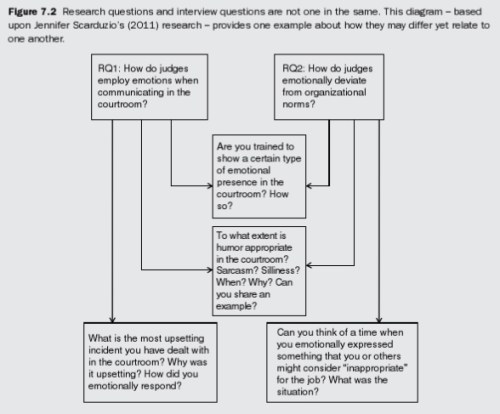
Exercise 7.2 in the text, Qualitative Research Methods (Tracy, 2013) provides a starting list of questions for creating an interview strategy based on your research questions. In Figure 7.2, the text highlights research from Jennifer Scarduzio (2011) that diagrams the difference between a research question and an interview question. This diagram also illustrates some of the guidelines that the textbook lists for good interview questions, including questions that are simple and clear, non-leading, non-threatening (at least at beginning) and promote responses that are open-ended and thoughtful.


7.1 Diagram.jpeg

Researcher’s Notepad 7.1, p. 145


The qualitative research that I am proposing would involve interviews with decision makers at corporations that are now benefit corporations (B Corps) in Oregon. As of 2014, Oregon has a business filing classification for benefit corporations and according to the Secretary of State’s website, there are over 1,000 businesses registered. Separately, (or in addition) corporations can also get B Corp Certified from the non-profit B-Lab. B-Lab’s vision is that “one day all companies compete not only to be the best in the world, but the Best for the World® and as a result society will enjoy a more shared and durable prosperity.”

The research would address the business conditions under which a corporation decides to become a B Corp and investigate the role of communications in the decision-making process. Specifically, it will use personal interviews to learn if there were internal or external communications that influenced the choice to get B Corp status and what role this status could play in future communications. In addition, it will look at the number and the role of the decision-makers in the process.

The personal interviews will provide insight into the framing of the decision, the specific language used when discussing the importance of the social initiative, and how that compares or contrasts with the business’ core competencies. The interviews could also reveal the motivations and responsibilities of each decision maker.

The plan for the population sample will be to use the convenience or opportunistic sample to make the most use of professional connections and proximity for live interviews. The interview will use a semi- structured approach. This will allow for questions around the foundational topics, follow-up on interesting directions, and the freedom to roam when passionate stories surface.

The qualitative data from the interviewees, combined with solid secondary research, will add to the small, but growing base of research around B Corps. B Corp classification was first passed in the United States in Maryland, as recently as 2010, so the research around B Corps is just starting to gain momentum.

Last week, I missed class to pilot a real-time social listening and strategy for a Microsoft event. What follows is a brief overview and quick learnings from that experience.

Situation: Microsoft launching several new products and capabilities at their Bespin event in early May.

Challenge: As Microsoft’s PR team, we know the easy wins are with the tech and developer audiences. Businesses and consumers are a tougher sell, though our PR teams had already made key contacts with influencers in those groups with hope they might tweet during their attendance at the event. The key (and new) area of focus, was the educational audience, with a focus on students, teachers, and administrators. How do we reach those audiences on Twitter and Facebook?

Approach: We proposed to use Netbase (social media monitoring platform) to track success in real time, with a specific focus on Twitter and Facebook, as they were the platforms we were putting paid boosts into, and had quick client access to post with. The views we built out were specifically designed to measure against progress toward those new audiences:

  • Identify content that stimulated the most conversation
  • New feature product associate attributes and emotions on Twitter
  • Tracking and engagement of pre-seeded stories/pre-briefed influencers (ROI)

Wins: What worked for us was in the moment real-time updates on the success of our pre-seeded stories to our business influencers. For example, we were able to provide real time updates of how our Bloomberg story was trending and with what audiences (segmenting consumer vs. business readers). We could prove with data that consumers were engaging through amplification (like retweets and replies) in a way that they had not before.

Another win was leveraging a new outlet/influencer for social content. Refinery29 has a large female millennial base, and a good amount of teachers in their regular readership. They do not regularly write about Microsoft. However, they released a story (with careful seeding through our team) that compared Microsoft’s new laptop with a designer handbag – sleek, useful, and top of the line. This beautiful framing in a headline was perfect social media soundbite content, which our team leveraged by having key executives retweet, and later putting paid Facebook boosts toward.

Learnings: Even with the Refinery29 win, we saw that the educator segment in total had the lowest amount of engagement throughout the event. While this was our smallest segment, the volume was disproportionately lower than the other segments. We had assumed teachers must be on Facebook, since we assumed this was an older audience whose demographic aligned more with Facebook use. However, this was not the case. Teachers did have a Facebook presence, but we found they do not leverage Facebook for professional discourse and maintained a distinct firewall between their professional and personal engagement. This was confirmed when we saw that the Surface Book laptop mentions were higher than Microsoft’s suite of education products that were being announced. The themes around the Surface Book laptop reflected personal interest rather than professional applications.

Posted by: Closed Account | May 14, 2017

Activity 7.1: Self-Reflexive Interviewing

Often in my past career, I was a co-moderator in a focus group, or I was in the back-room with clients, taking notes. Up until now, I don’t believe I’ve considered my physical traits or demographics and if and how they might play a role in interviews and focus groups in soliciting responses.

The things that stand out most about me are that I’m a tall, white, female. I appear confident and hold direct eye contact, which can make some people nervous. My “thinking” face can sometimes appear like a scowl (I’m working on that!). I asked my mom and sister other things that might stand out, and they both pointed out that being feminine in what I wear or even my makeup that day would have an effect in interviews, especially as I consider interviewing a method for my final project. Since I would be interviewing communication executives and decision makers, I think business attire and normal daily makeup will be appropriate.

One piece of feedback I’ve received from employers and mentors alike is that I’m a very thoughtful listener. I’ve been told that my thoughtfulness while listening, slowness to respond, and patience to let others speak makes other people around me feel important and heard, something that I anticipate will be a strength during interviewing. On the flipside, this is also where my direct eye contact could affect some people differently, and instead of making them feel heard, could make them nervous.

When I think through the types of interview, I prefer un-structured the most, as it gives me the flexibility to probe as topics of interest come up. This allows me to capitalize on my strengths of truly listening, instead of already “knowing” what question I’ll ask next.

All of this together, if channeled strategically, should make me an effective interviewer. I think the purpose of this exercise was to reflect on all factors that may influence an interview and responses, when it can be all too easy to solely focus on the questions themselves.

Posted by: Alexa Morris | May 14, 2017

Self-reflexive interviewing

Exercise 7.1 comes from Chapter 7 “Interview Planning and Design” (p. 133). The exercise challenged readers to do a self-reflexive interview.

  1. Here is a brief list of the physical traits and demographics that a participant might see or notice during their interview with me. I am a white, female, blonde-ish hair with blue eyes and about average height. Next, the exercise recommends asking a partner to expand on the list. I asked my classmate, Laura, if there were any obvious traits that I may have missed. Laura described me as, “peppy, exuberant and sharp”. Oftentimes people do not recognize traits about themselves, that may be obvious to others, which is why it is important to ask for others’ perspective. For the interview process, it will be important to listen to how others describe themselves, and also note my own observations.
  2. It’s hard to know what other qualities/characteristics about myself will arise during the interview process. I anticipate briefly sharing about my job and what I am studying in school to build rapport. I hope that by sharing a little about myself that interviewees will feel more comfortable talking about themselves and their experiences.
  3. How will my traits impact the interview process? I foresee my traits and qualities will have an impact in the interview process. It is possible that my enthusiasm for the project could intimidate some participants. While I conduct interviews, it will be important to be engaged as an active listener, which will ensure participants have ample time to share their perspective. My interview style will become evident as I begin to interview individuals. I presume that each interview will have its own challenges. To ensure the interview process goes as smooth as possible, I would use a structured interview format (list of questions used each interview and repeated in the same order). The structured interview strategy will make the process easier to replicate.

The exercise above is the task that self-reflexive interviewers repetitively ask themselves because they must consider how their subjective positions might impact the interview process and the results.

Posted by: estutesman | May 10, 2017

Benefits of Self-Reflexive Interviewing

Exercise 7.1 poses questions based on self-reflexive interviewing, or the process of a researcher recognizing their own physical traits or personal beliefs that could affect their interviewing experience. This exercise asks how the reader would describe herself objectively, as well as how someone else would describe her.

Of course, it can be difficult to look at yourself objectively, but when I try, I decide that I fall into the demographics of white, female, educated, late 20s and above average height. Other notable traits are that I talk with my hands and occasionally have a nervous laugh.

Without telling my husband my opinion, I asked him what he thought subjects would notice about me in an interview situation. He said that they may see me as educated, a good listener, easy to talk to, a “hand talker for sure,” and that my height could potentially be intimidating at first meeting. He also said that he thought that I would keep a professional yet friendly tone, so that participants knew that it wasn’t a casual meeting, but that they could speak honestly about the subject.

I can see these traits being either a benefit or a burden, depending on the type of interview and the subject. For instance, I think my personality could hinder me if I were talking to a masculine man about a sensitive subject. Alternately, I think that my personality would help me when interviewing those with similar demographics and traits to me, such as young, professional women.

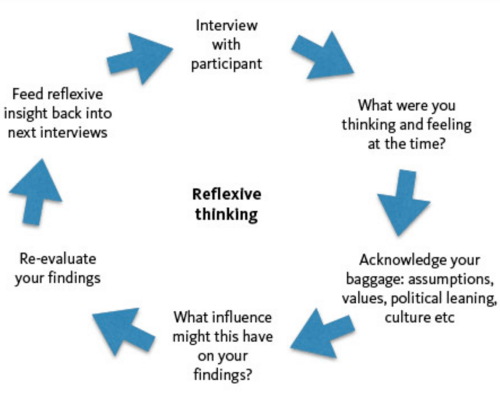
I found the below article and chart that shows how researchers who implement self-reflexive thinking can improve the interview process. Instead of simply interviewing a subject and analyzing the results, this chart encourages researchers to consider their own thoughts, feelings and judgements before approaching their findings. When they do begin to analyze the data, it will be easier for them to recognize what is actually new information, and what was an implicit bias.

Chart.png


https://www.cxpartners.co.uk/our-thinking/improve-your-research-technique-reflexive-thinking-5-practical-tips/


« Newer Posts - Older Posts »

Categories