Posted by: lucaspisano | October 8, 2017

News Engagement Day – O.J. Simpson is released from jail.

Selected from NPR: http://www.npr.org/sections/thetwo-way/2017/10/01/554846774/o-j-simpson-released-from-prison

On October 1st, 2017 O.J. “Juice” Simpson was granted parole after serving nine years for armed burglary in 2007. O.J. Simpson is best known for his possible involvement in the murder of his then wife Nicole Brown Simpson. His initial incarceration in 1994 was a shift in the way the public consumed the news. After this most recent incarceration, I was curious if this scandal held people’s attention the way his original one did.

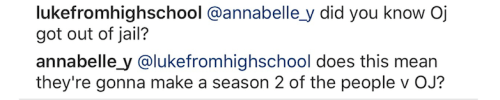
I shared this story with my mother by FaceTime, My girlfriend by tagging her in an instagram story, a friend (I consider left-leaning) by text message, and another friend (I consider right-leaning) also by text. As far the mediums I chose, I was spot on. My Mother responded promptly in a sincere way (watch video). My girlfriend, an avid instagram enthusiast, responded in a funny way. Finally, both my left and right-leaning friends responded with a short statement I can summarize as: “Meh, he did his time”.

My Mother Reactions

Screen Shot 2017-10-08 at 3.01.24 PM.png

Key takeaways: It was interesting to me that someone who had such a polarizing story in American pop culture, is now so disregarded by the public. I also found it interesting how the type of platform I used to reach them influenced the tone of their responses. My girlfriend gave me a funny response, my Mother’s reaction was genuine, and the text messages landed me the least personal responses. It shows the importance of the platform used to communicate a story.

Posted by: selenasierra | October 7, 2017

Los Angeles Daily News: “In effort to ease ‘pain,’ LA County leaders replace Columbus Day with Indigenous Peoples Day”

The first person I shared the story with was my boyfriend (27, face to face – conservative on fiscal issues, moderate on social issues), second person was my best friend back in LA (26, via text – liberal & easily influenced by mainstream media), third person was my mother (59, via phone call – Christian, conservative) and the last person was an old coworker (36, via text – moderate on most issues).

In initially telling my boyfriend, I knew I was going to leave out specific, strong adjectives (I later showed him the real article). While texting my best friend, I started with a one-line text, telling her about the change LA County made and that opened up a conversation to discuss further. After catching up with my mother on our week, I asked if she had heard about the “change of holiday over there.” I was able to keep the story close to the original article because I knew this subject matter wouldn’t touch on any of the issues she is very conservative on. The reaction from my coworker was similar to that of my best friend. They are both Hispanic and hold tightly onto their culture. I did the opposite with these two women than what I did while telling my boyfriend – I kept the strong adjectives in the story while texting. Both women agreed with/were happy about the change.

The audience I relayed the story to is aware of the backstory on Columbus (despite what is taught starting in elementary school). All four people are of Mexican descent and because of this subject, I would prefer not to change the story as this issue would not cause much of a rift.

Posted by: Jeff Collet | October 7, 2017

News Engagement: Supreme Court Takes on Gerrymandering


While our country reels from the devastation of natural and manmade tragedies, coverage of these events can obscure stories that might have received front page coverage. With the Supreme Court case regarding extreme gerrymandering  kicking off this week, I reached out to friends, family, and coworkers to make sure they were aware of this case and its potential to affect our understanding of voting rights. Here is a brief on the tactics I employed with various people:

A.J. (friend)

“Oh yea? Well did you hear about this?”

A.J. and I make sure to keep each other informed on important news. These conversations usually end up ping-ponging into one-upmanship on who read what. Tactically, I take an early opportunity to get all of my talking points in before he returns the serve.

AJ_convo

Kat (wife)

“I can’t listen to you with a three year old yapping in my face.”

My wife has her priorities in order and rarely suffers distractions. She prefers to read the daily rundown from The Skimm for important news. Luckily, they had a blurb in their October 4th edition I was able to point her to.

Kent and Jamie (coworkers)

Awareness through humor

This one was difficult to strategize because typically their socio-political dialogues are sparked by sharing hot takes from primetime and late night comedians. In this case, we had direct conversation on our morning drive to the job site, and I pointed them to an old John Oliver episode for a humorous refresher.

Posted by: ashbeanpdx | October 7, 2017

News Engagement: Sustainable Vodka

Story Selected from NPR News: Creative Distillers Tackle Food Waste, Redefining ‘Getting Trashed’ by Jodi Helmer.

A California distillery is using food waste to create premium vodka and brandy. They receive 1200 pounds of baked goods from the local food bank per week and two pounds of food waste is needed to make a single bottle of vodka. The US disposes of 133 billion pounds of food per year, and among that a third of fruits and vegetables grown end up as food waste.

I shared the story with my mom (via phone call), my husband (face-to-face), my roommate (via Facebook) and a former coworker (via email). To frame up the story for my mom I started by talking about my Imperfect Produce order and then went into the news story. When bringing it up to my husband I talked about how the distillery was working directly with farmers and the food bank to catch food waste at the source, but our conversation eventually moved on to California farm inefficiencies. With my roommate we ended up talking about how the product would taste. And when I emailed my coworker there wasn’t an opportunity for conversation, I just shared with them a cool story about sustainability.

When framing the story to each person I highlighted the details I felt would most be interesting to them without losing the overall message of the story. I also opted to choose a story that wouldn’t insight political or social tensions and be relatable enough to enter everyday conversation.

Posted by: kaylagee91 | October 6, 2017

News Engagement Day – Cameroon

‘Death toll Rises in Cameroon’s Anglophone region unrest’ (Aljazeera)

Here’s what happened: Cameroon’s Unification Day took place this past Sunday, October 1st, in an effort to begin reuniting the divided country. The intended national day of celebration instead resulted in the deaths of 17 Cameroonian protesters. The deceased felt marginalized by the French-speaking majority, and were demanding independence for the English-speaking region of the country before security forces opened fire on the crowd. In the days following, the country’s internet was blocked by government officials for the second time this year. Sunday’s protest is just one of many that Cameroon has seen since last October.

How I relayed the story: an email went out to my mom and coworker (Marisol), my friend Anya received a Facebook message, and my ex got the news through a text. As far as mediums go, I hit the nail on the head with my mom as she responded promptly with points of connection and follow up questions. My ex is not a native English speaker, and he hates reading. Despite communicating through text message which works for him, the content wasn’t palatable because my write up was too long.

Though I feel most confident communicating through writing, I think that my audience would have found the story most accessible in the form of a video as ¾ are visual learners. Key takeaways: it’s about your audience; keep it short and sweet.

Posted by: marionmbarnes | October 4, 2017

News Engagement: Ramona Tale is Moment of Levity

In light of devastating news in recent days – natural disasters, a mass shooting, political upheaval and even the death of beloved cultural icon – I took note of an unexpected story that was both a flash in the pan of levity and a solid example of media transparency at its most fundamental level.

On Oct. 2, an editor for NPR, Christopher Dean Hopkins, mistakenly posted a cryptic-yet-intriguing chronicle of a character named Ramona on the official Facebook page. Twelve minutes later, it disappeared, and a post apologizing for the mistake, indicating the Ramona tale was meant for a personal page, appeared in its place. Yet unexpectedly, NPR’s Facebook followers clamored for more about Ramona, explaining that on a day of heartbreaking news, the delight they’d experienced when reading about her had been the highlight.

On Oct. 3, hoping to start four people’s days on a lighter note, I shared the story with my sister (33, via text, with emojis), my daughter (17, via Twitter), my coworker (36, via Facebook) and my father-in-law (69, via email). I shared the story with my coworker on Facebook and retweeted it to my daughter. I texted it to my sister, but a lot of the details were lost. My father-in-law didn’t find the story as delightful as I did, but that’s likely due to the sterility email often imparts. Likely it would have been better to tell the story aloud to everyone, so that every nuance could be enjoyed.

As a side note, I thought it was interesting how Hopkins corrected the error. He could have simply removed it, but in the interest of transparency, he explained the circumstances. It gave the news outlet an opportunity to build goodwill toward the brand in the face of a potentially embarrassing situation.

Posted by: dylanfrederickblog | October 4, 2017

News Engagement: Learning about Puerto Rico

In the wake of the most devastating hurricane damage in United States History, I wondered how many of my peers and family members were aware of the unique and particularly devastating circumstances that were being experienced by Puerto Rico. Having seen a recent public poll by the Morning Consult that indicated more than half of America does not know Puerto Rick is a U.S territory, I wondered how my friends and family would respond to a news story about it.

I chose an article from the Wall Street Journal titled, “Trump Cites Storm’s Budget Impact in Puerto Rico Visit”. I decidedly selected four individuals who had media preferences that were different for each: My friend Jessica (33, Online news and local newspapers), My wife Heather (26, Facebook & Instagram), My sister Megan (32, Television news), and my friend Donny (31, News apps & websites). As I crafted the story for each person, I considered that person’s perspective toward President Trump (Who adds a level of incendiary controversy to the mildest friends). For my friend Donny, and my wife (spoken in person), I avoided some of the key phrases that were reiterated by news because I knew they consume media in a way that required quick, meaningful yet digestible points. I gave quick facts and explained the heart of the story. For my sister and friend Jessica, I provided an account (via Text Message) that was more of a story format.

I realized how challenging it was to convey the article in an informational and unbiased way.  When I re-crafted the story each time, I wanted to emphasize different parts and realized my emphasis was exposing my beliefs about the article.  I also wondered each time how I could make it more entertaining.  Each time I conveyed the story, the response of the recipient was somewhat aloof.   I pondered which words to change in the future to create a greater level of interest.  Having done this assignment, I feel hypocritical that I expect all news I consume to be unbiased and somewhat entertaining, but I know how challenging that is.

Posted by: dylanfrederickblog | October 2, 2017

A Crystal Ball: Looking into the Future of Media Ethics.

How do we construct an ethical framework for media that both reflects the values and norms of our culture as well as the ability to adapt to future advancements in media that further change the field?

Stephen J.A Ward boldly examines this question and offers a comprehensive framework solution in Radical Media Ethics, A Global Approach. Ward explains, the field of Journalism is being radically and fundamentally changed due to new forms of media and technology. This “new media era” is most prominently defined by immediacy, transparency, partiality and non-professional “citizen journalists” submitting stories. Ward contends that values inherently represented by this “new media era” are contradictory to values that were embodied in the previous era of journalism.

One example is the definition of “accuracy” in an era where stories and information can be instantaneously updated. In dissecting the values and makeup of our global media ethics, scholars like Tsetsura & Valentini have pointed to personal, environmental and professional values and how each of these interact with one another to offer explanation for our current ethical framework. In bridging our new media era and past eras, Ward presents several imperatives to act as the basis of a new set of media ethics. Ward poses practical questions and discussion points to serve as drivers in future dialogue about the new media ethics guidelines.

As future generations of media professionals and scholars are posed with the challenge of finding a framework for our new media era, all facets of conversations will be fundamentally important to guide this discussion.

Posted by: timiracobbs | June 5, 2017

A Metaphor Analysis of Roller Coaster Loops

As encouraged by exercise 10.1.2, I have chosen to conduct a metaphor analysis. 

Reading through some recent essays written by Third Culture Kids on Denizen.com, I noticed a frequent use of metaphors to visualize and explain particular experiences unique to the Third Culture Kid experience.

For the sake of context, Third Culture Kids (TCKs) are the sons and daughters of people whose careers require them to live in other cultures, such as foreign diplomats, international school teachers, missionaries, military members, etc. Their unique blend of cultures and experiences is often difficult to explain, so metaphors can come in handy. According to Lakoff and Johnson (1980), the very essence of a metaphor is understanding and experiencing one kind of thing in terms of another (p. 5).

While reading through various essays, I noticed a TCK would tell a story that the reader can more easily relate to. One of those abstract TCK experiences is when they return to their passport country. The following story metaphor was not found by sorting through coded, isolated lexical units in an Excel spreadsheet. Instead, it was woven throughout the discourse (or article) and required an overall contextual understanding of the text. 

The author described her life as a “roller-coaster of emotions” and noted later that “when you throw in moving across oceans, it takes a few extra loops. One of its loops is returning ‘home’”. While “life is a roller coaster” may seem like a common metaphor, the author has actually made a complex, nuanced description of her experience. This metaphor is a mapping of knowledge about emotions to corresponding knowledge about thrill rides. According to Lakoff (1992), these types of correspondences allow the TCK to convey their emotions about returning home using the knowledge commonly known about thrill rides.

Mapping of LIFE IS A ROLLER COASTER:

  • The TCK →  someone on a thrill ride
  • Life → a roller coaster
  • Emotions → the change in pace and orientation of the ride
  • Moving between continents → taking extra loops
  • Returning home → one loop

With this metaphor, not only does the author activate the reader’s roller-coaster schema, but also keeps it in a heightened state of activation by continuing the metaphor and relating each loop to a cross-continental move. For readers who have experienced riding the loops on a roller coaster, or are familiar with the height and speed at which they take place, there is arguably a partial simulation of some progression of fear, excitement, disorientation, perhaps one’s stomach dropping, perhaps one’s breath catching, or exhilaration. By referencing “extra loops,” one might partially simulate the effect of moving across oceans as being in a state of disorientation. This could be interpreted as exhilarating, dizzying, or perhaps frightening. In this way, the perceptual simulation that is activated by a metaphorical vehicle like “roller coaster” effectively nuances the author’s description of moving across oceans and returning “home”; something that may have otherwise been impossible to describe.  

This and other metaphors found in the essays on Denizen.com uncover some interesting implications about the TCK identity. Story metaphors like the “roller coaster ride” reveal the complex and ambiguous nature of returning home to one’s passport country. Without the use of story metaphors, it could be significantly more difficult, if not impossible, to relate this idea to someone unfamiliar with the TCK experience.

Without qualitative research, metaphors and insights like these would go unnoticed and unexplored.

Resources:

Denizen for third culture kids. (n.d.). Denizen. Retrieved December 3, 2013, from http://www.denizenmag.com

Lakoff, G. (1992). The contemporary theory of metaphor. Metaphor and Thought (2nd edition), Cambridge University Press.

Lakoff, G., & Johnson, M. (1980). Metaphors we live by. Chicago: University of Chicago Press.
Posted by: jillkillsit | June 5, 2017

Exercise 12.1

My project will explore the history of crisis management, the possible motivations of the various players involved, and case studies of crisis management examples. The intended result will be a crisis management best practices guide.

  1. Identifying problems and explaining data. To identify potential problems and explain the data, a puzzle-explication strategy may be the best approach. In order to engage the reader and explain the problems and data, it would be smart to present conflicting data points. For example, I might include a statistic about how consumers feel versus how they act, and why this supports mistreatment by businesses. Once the stage is set with a question of contradictory behavior, it is easy to transition to why the problem actually exists and explanation of what the data says about why the problem exists.
  2. Connecting with key readers/audiences. To best connect with key readers, a convergence or braided narrative would be most effective. Weaving together the story of the subject crisis from different perspectives will give key readers a way to identify with the story, even if each reader plays a different role in real life. For example, Joe the Plumber will probably not connect to Oscar Munoz of United Airlines issuing an email to justify United’s violent passenger removal on an overbooked flight. Vice versa, Mr. Munoz (or other CEOs) will not immediately connect with the plight of the average airline passenger/consumer. Braided narrative would allow me to tell the story of the crisis from both people’s viewpoints. In this way, CEOs might connect with Oscar Munoz and Joe Blow might connect with the passenger. After reading both perspectives when mixed with data and appropriate analysis, perhaps the CEO and the layperson might come to understand or even identify with each other.
  3. Most comfortable with/excited about. The themes/topics strategy is the one with which I am most comfortable. Though I can’t say I’m excited about it. This method is logical and straightforward. It is easiest for me to organize a paper into categories or themes/topics. I would, however, like to stretch my writing skills and perhaps attempt the convergence or braided narrative. Especially in the present world, the power of storytelling has proven to be colossal. Stories are moving, they are powerful, and they are persuasive. As mentioned above, stories help readers to connect to the data presented. It is a great gift to be able to tell a story well. I would welcome the chance (and the challenge) to flex my writing muscles and attempt to package the data and analysis into a convincing and meaningful story. People will be able to connect to it, and they might not feel the scientific distance that is so often imposed by academic works.
  4. Most potential for achieving study’s goals. The method with the most potential for achieving the study’s goals is the chronology/life story style. To understand why trust is so low between consumers and business, it is first important to understand the trajectory that led society to this current low point. The chronology leading to the shareholder-first mentality would be enormously helpful for understanding the state of the business-consumer relationship. Tracking the chronology of social mores about business over time and studying the corresponding crisis issues between business and the consumer would provide eye-opening insight into topics such as: who are the players, what happened, and why did it happen? Subsequent iterative analysis could lead to several conclusions about preventing these types of crisis issues in the future.


« Newer Posts - Older Posts »

Categories