Posted by: coolethan77 | October 15, 2012

Should Artists Consider Social Responsibility First?

Minorities are often marginalized, stereotyped or symbolically annihilated in the media. A recent example is HBO’s hit show “Girls,” written and directed by and starring Lena Dunham, a 26-year-old white woman. The show is set in New York city and revolves around the central character Hannah, played by Dunham, and her circle of friends, all of whom are white.

The portrayals of women in the show are not “active and strong” in an overt sense, but the main criticisms of the show have focused on the very noticeable absence of any minority characters. One writer noted that in one of the early episodes the only black person seen in a show set in one of the most culturally diverse cities in the world was a homeless man begging for money.

I have heard interviews with Dunham in which she explained that it wasn’t a conscious choice to deliberately exclude minorities from her narratives but that she was just writing what she knew. She has promised to focus on integrating more positive minority portrayals in upcoming seasons.

But Dunham’s example is interesting to me because as we often critique media through the lens of media-studies theories and generalizations, we seem to be missing a vital question: Do artists have a responsibility to seek to empower women and minorities by portraying them positively? Or is the onus on the owners, producers and distributors of media products? Furthermore, can stereotyped or conventional portrayals of women and minorities be used to a positive end?
Posted by: Shekhah | October 15, 2012

The Reality in Reality TV

Reading the O’Shaughnessy chapter about reality TV and the criticisms of these shows from an idealistic perspective makes me want to highlight some positive views that weren’t mentioned.

First of all, as a fan of reality TV, I don’t think there are any viewers who would claim that the shows are 100% true. We see the participants with a microphone. We know it is at a studio with an entire studio crew following them all the time, so they are not really fooling us. However, there is a certain amount of reality that we can identify with which is the most important.

Characterizing reality TV as a cultural dumbing-down, escapism and an ideology of competition, as described in the book, is not totally fair. These shows represent the reality we live in every day in our society. It reflects our life with its ugliness and beauty. Are not we competing every day and fighting to win and be better people, no matter who we are?

Besides, some shows have actually contributed to build a better society. In the Arab world, for example, the Emirati show “Million’s Poet” has been seen as a way to unite people and revive the great tradition of reciting poetry. Young men and women compete to be the most talented poet and win over a million dollars.

Can reality TV shows be used as a tool to solve communication problems? Can it solve society’s issues? Can it bridge the gap between the East and the West? 

Posted by: arianeleigh | October 15, 2012

Pornography- A Significant Player

As I was reading part four in Media and Society by O’Shaughnessy and Stadler, I began to find myself reminiscing on my undergrad journalism and cinematography courses. I have learned about narratives, mise-en-scene and shot lists and I began to recall the many movies where I identified these terms. As my mind began to drift, I turned the page and saw the bold word “Pornography.” Pornography? What? Never have I had a media related textbook that spends four pages talking about this forbidden subject.

Pornography accounts for 30% of all internet traffic and is worth over $10 billion, rivaling the Hollywood film industry’s annual U.S. box office revenue (Johnston 2007). These are facts  I have heard before, but never within the confined structure that I know as “media.” As an activist for human trafficking, I know that pornography has close connections with the international issue, but it’s censorship in the U.S. tries to keep the subject stifled.

O’Shaughnessy and Stadler recognize pornography as a “genre in its own right,” one that can be analyzed for its “patterns of repetition and variation, and developments” (O’Shaughnessy 295). I was pleased to see that pornography is being critically looked at next to major media sources such as television, the Internet and Hollywood movies. Pornography is a great example of masculine and feminine ideologies, gender relationships and ideologies of sexuality and sexual behavior… but how powerful is the censorship in the U.S.?

As O’Shaughnessy and Stadler describe, we are constantly being fed a diet of gender, relationship and sexual ideologies that seriously impact our culture and society. So really, we are already being exposed to a negative framework in our countries through what we consider “acceptable media.”

If pornography is so tantalizing and laden with negative stereotypes, then why are we not censoring the mountain of media we consider “acceptable” that bombards our lives with negative portrayals of gender, sex and relationships?

Posted by: robertheinz | October 15, 2012

The Daily Show with Bertolt Brecht or Aristotle?

In Chapter 19, O’Shaughnessy & Stadler point out that comedy can possibly increase awareness of social issues and eventually contribute to social change. This on the other hand is challenged by Marxists like Bertolt Brecht, who argue that comedy encourages people to “accept the status quo, rather than provoking social change” (O’Shaughnessy & Stadler, 2012, p. 327). While reading into this topic I couldn’t help but thinking about my family’s past in the former German Democratic Republic. According to the Marxist ideology, stories are needed to tell us what is wrong with our society and contribute to social change. How awkward is it that the same ideology would play eventually against the same system?

With the autocratic regime in East-Berlin failing to serve the demand for stories that wanted to be heard by the majority of the East-German population, it ultimately opened the door for cathartic West-German productions. Although not favoured by their own government, over 80% of the East-German households were capable of receiving West-German television and radio programs over the airwaves. Through news, documentaries, TV-shows, and comedies, western values entered the East-German minds.

Excessive media censorship and bureaucracy left the GDR government incapable of filling that void for a long time. Despite the popularity of Brecht’s Berliner Ensemble and his influence on the new generation of playwriters in East-Germany, West-German comedies remained popular. Only in the late 70’s and throughout the 80’s stand-up comedies and Brechtian style theatre revealed to be a cornerstone in establishing a counter-hegemony and forum of freedom of speech.

According to O’Shaughnessy & Stadler, cathartic as well as non-cathartic models both question their ability for social change. The East-German transition proves to be a good example for the dynamic when both are a factor. But which one is more influential on our society and how do these experiences translate into our day and age?   Does the Daily Show with Jon Stewart actually increase our awareness of political and social issues? – Or do we tend to accept things with a quick laugh?

Posted by: pcordell | October 15, 2012

Why won’t men identify as women?

Women are rarely represented accurately in American film . (O’Shaughnessy and Stadler 2012, p.275)   Almost exclusively, women characters have to be a man’s fantasy to be included in the story narrative.

As author and critic John Berger states:

One might simplify this by saying men act and women appear.  Men look at women. Women watch themselves being looked at.  (Berger 1972, p.47)

It isn’t as if compelling films of women leaders aren’t being made (Cate Blanchett’s “Elizabeth,” 1998, or Meryl Streep’s “The Iron Lady,”  2011 ) nor haven’t been made in the distant past.

An old Greta Garbo film “Ninotchka” (1939) revolved around a professional business woman. Instead of a subservient homemaker, Garbo’s character was very strong, independent and intellectual as “a stern Russian woman sent to Paris on official business…a higher ranking official…a no nonsense woman.”  (IMDb 2012, http://www.imdb.com/title/tt0031725/)

According to the authors of our textbook, film theorist and filmmaker Laura Mulvey argues:

... in many mainstream films audiences are invited to identify with men and objectify women, regardless of whether they are male or female. Thus female audiences are asked to look through a male perspective, to see things through men’s eyes.  (O’Shaughnessy and Stadler 2012, p.275)

Conversely, why aren’t movie makers expecting men to look through female eyes?  Isn’t this an indication of a greater ill, in not only our American culture, in many societies, that our cultures don’t fully accept women as equals and that males are afraid to identify as female?

Posted by: nallen123 | October 15, 2012

Superiority Complex: Is a gender neutral media within reach?

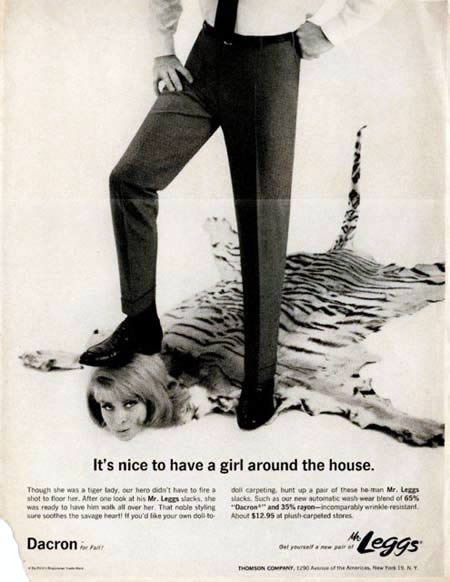
Like Chrissy, I was struck by the reality that the prominent worldview in mainstream media is filtered through a male lens. While researching examples to illustrate how the codes and conventions of a culture can change over time, I looked to advertisements from yesteryear. What I found was shocking. Unfortunately, it wasn’t all that surprising.

It is common knowledge that male superiority ran rampant in America for the greater part of the last century, but for those of us who didn’t live through that era, or for those who have perhaps forgotten what those times were like, it can be difficult to fully appreciate what it all meant. Glimpsing old advertisements provides a powerful blast from the past depicting just how far our culture has, and in some cases, hasn’t, come.

Here are a few of my favorite ads …

“After one look at his Mr. Leggs slacks, she was ready to have him walk all over her.”


“Blinders …. because she shies at new ideas.” At least Electrolux was keyed into the concept that the radically new is often unsettling at first. Too bad they couldn’t find an unoffensive way to illustrate that point.

This one is for the nature lovers. Drummond Sweaters reminds us that “men are better than women! Indoors, women are useful — even pleasant. On a mountain they are something of a drag. So don’t go hauling them up a cliff.”

And, just in case we think blatant sexism is behind us, here’s one from last summer.

QUESTION: Is it realistic to think that mainstream media will ever have a truly gender neutral voice? How will codes and conventions need to change to bring that reality within reach?

Posted by: corrinebuchanan | October 15, 2012

Here Comes Honey Boo Who?

I thought I would use this blog post to bring up the new controversial cultural phenomenon that is, Here Comes Honey Boo Boo.

http://www.youtube.com/watch?v=RS2SzGUwaMI

Here Comes Honey Boo Boo has recently wrapped up their first season and has already signed onto season 2. Throughout the season, it averaged more than 2.4 million viewers and drew a bigger audience then the Republican National Convention. (Kepler, 2012)  (link to full article: http://artsbeat.blogs.nytimes.com/2012/09/28/honey-boo-boo-has-the-ratings-if-not-the-critics/)

Here Comes Honey Boo Boo is not without its critics. In fact, there are a whole lot of them. Here is one example by Tim Goodman, a writer for The Hollywood Reporter,

“So here’s the deal: You know this show is exploitation. TLC knows it. Maybe even Mama and HBB know it, deep down in their rotund bodies. Here Comes Honey Boo Boo is a car crash, and everybody rubber-necks at a car crash, right? It’s human nature.

Yes, except that if you play that card, you also have to realize that human nature comes with the capacity to draw a line, to hold fast against the dehumanization and incremental tearing down of the social fabric, even if this never-ending onslaught of reality television suggests that’s a losing effort. You can say no to visual exploitation. You can say no to TLC. And you can say no to Honey Boo Boo Child.”  (Goodman, August 2012)

Personally, I struggle with this show. I hate to admit it, but I really enjoy watching it and I think the family is hilarious. One of the questions that was raised in our readings that I believe can and should be raised in the case of reality TV, is to consider whether or not it has been created ethically. Do the producers and creators of the show exploit and victimize their subjects? (O’Shaughnessy, p. 308)

In the case of Here Comes Honey Boo Boo I am on the fence. I have no doubt in my mind that the Thompson family knows what they are doing. They have found a way (although unconventional) to make money and provide more income for their family by making fun of themselves, one another and their lifestyle. But as a viewer/ human being, should I know better than to spend my time supporting what many believe is mockery of this poor and unusual family?

This is just one example of the many ethically controversial reality shows. As viewers, how do we judge when the comedy/entertainment ends and the exploitation begins? Can we do more than just stop watching?

Posted by: karlcd | October 15, 2012

Out of Touch

In 2006 when George Clooney was accepting the award for best supporting actor at the Academy Awards he said he was glad that Hollywood is out of touch with America.  It was the year that Brokeback Mountain won three academy awards and The Academy was accused of passing a gay agenda and not representing American values.  During his acceptance speech he spoke eloquently about how his industry addressed hard social issues ahead of others.   An industry that in 1993 talked about gay relationships and AIDS in Philadelphia, or in 1967 tackled racism in Guess Who’s Coming to Dinner.
Brokeback Mountain was such a powerful movie because all the characters in the movie were mulit-dimensional and anyone could relate to them. While the story’s protagonist was a gay man, the viewer could relate to the parents that worried about their child, the spouse that does not understand their partner, or the pain of being in love with someone who could not commit.
Great movies have the ability to expose us to new worlds. These worlds could be in another galaxy, country or decade, but for 90 minutes we are right there beside the characters living their dreams and fears.  While the best movie can inspire us to rethink ourselves, or show us a new point of view there is another side to motion pictures.  An industry that reinforces negative stereotypes and movies where hatred, homophobia, sexism are rewarded.

Do movies make society more accepting of differing social issues or do they reinforce negative stereotypes?

George Clooney at the 2006 Oscars (minute 2:20)

Posted by: ARNoack | October 15, 2012

Pilfering for a Profit

Godfrey Reggio critiques modern-day industrial societies using time-lapse photography in his films Koyaanisqatsi, Powasqaatsi and Naqoyqatsi. It’s interesting that instead of considering the implications of Reggio’s message, advertisers attach their own message to his methods: celebrating modern societies instead of criticizing them. Compare the trailer for Koyaanisqatsi to this contemporary T-Mobile ad. The T-Mobile ad initially seems to echo the intended message of Koyaanisqatsi: that urban environments are unnecessarily frenetic and constrictive. However, the ending enforces the idea that personal enjoyment and fulfillment come through the capitalist media apparatus and technology of our modern society – through television!

Sony also decided to take a critics’ medium into the mainstream. Back in 2005, Sony hired graffiti artists in San Francisco and other large cities to spray-paint cartoon images of kids playing their portable PSP gaming system.  The “street-savvy hipsters” Sony was aiming to attract saw the guerilla marketing campaign as phony and promptly defaced the ads, crossing out the icons and adding derogatory text. Sony’s attempt at co-opting an urban art form dripping with anti-establishment sentiment backfired and graffiti artists quickly reclaimed their canvas.

What are ways that artists, activists and filmmakers use unconventional techniques to critique aspects of society? How do advertisers and the media appropriate these techniques for profit (or loss in Sony’s case)?

Posted by: delphine criscenzo | October 15, 2012

“Do documentaries exploit their subjects?”

In their chapter on reality TV and Documentaries, O’Shaughnessy and Stadler explain that there are two issues that they identify with Documentary films. One of them is the issue of exploiting the “subjects” featured in the film and “victimizing” them. The point they bring is valuable and in my opinion, there are other instances when journalists end up betraying their source in one way or another.

My intention here is not list times when exploitation or betrayal has happen but to introduce a new idea, a new approach to documentary film making and journalism in general: a community-based and participatory research model. Some of my academic background is in Anthropology and it might be news to you, but the reputation of Anthropologists and Archeologists in certain communities is pretty negative. For generations, communities have felt exploited by researchers who studied them, used them as “subjects”, and used their data to publish academic work, got recognition and sometimes financial gain for it while abandoning communities to their own fate. When you think about it, the work of some journalists reflect the practices of these Anthropologists!

A new generation of Anthropologists, often members of communities exploited in the past, has developed a new research model that includes the community in the research process, turning “subjects” into participants. This community-based participatory research model invites researchers to consult with the community and use their knowledge to accomplish something that the community needs or want. The community is therefore involves in the whole process, training happens along the way and the final product needs to be something that both the research and the participants can agree on. This model seems to be applicable to the creation of journalistic matter in my opinion.

Do journalists exploit stories and informants?

« Newer Posts - Older Posts »

Categories