Posted by: kararc | October 22, 2012

NYT debates reality TV

I already posted this week, and this post is technically connected to last week’s reading material, but the editorial coverage about reality television online at the New York Times today is worth mentioning and this is the best way to share with the group. If you haven’t seen the New York Times’ Room for Debate format, it’s worth taking a peek every so often – they feature a new debate (with half a dozen or more relevant debaters) almost every day.

Today’s debate is: Are Reality Shows Worse than Other TV?

Some interesting tidbits:

“[Our] rejection implies that the people we see on reality shows are so embarrassing and uneducated and talentless that their stories are unfit to be broadcast on television. Why? Because their lives are unessential? That’s a pretty intolerant view of the rest of humanity.” Tracie Egan Morrissey, Jezebel

“The ongoing discomfort with reality TV reveals our culture’s tendency to freak out about things that scare us, including how other people interact, think and live.” Andy Dehnart, realityblurred.com

“A lot of reality television is salacious, exploitative and celebratory of violent, abusive and predatory behavior…” Nsenga K. Burton, The Burton Wire
Posted by: coolethan77 | October 22, 2012

What is a Feminist Today?

Since my presentation this week is on Feminism and  Ideologies of Masculinity, I wanted to pose this simple question to everyone because what feminism actually IS today seems to be hotly debated. Third-wave feminism and postfeminism seem to compete to define the state of feminism right now. They are often at odds with each other, yet they often find some congruence as well.

Notice the controversy that stemmed from Katherine Fenton’s comments in the wake of her question about equal pay for women in the last presidential debate. Here’s an interesting quote from a Salon.com article, which highlights the ambiguity surrounding the term feminism today.

“Despite asking a question that raised the hackles of the anti-feminist brigade, Fenton was vehement when I asked her if she’s a feminist. “Absolutely not,” she said. “I’m a 24-year-old woman that lives in the United States and feels like I should be treated the same as anyone else. That makes me a normal human being.

So what do you think feminism is today?

Posted by: sarakroth | October 22, 2012

Gender and Election 2012

The dichotomy between the conversation about feminism and gender roles in Media and Society and the current presidential debate conversations is startling. As a college-educated woman, I’ve been a part of countless conversations about feminism, what it means, where it’s headed, the voice of anti-feminists, etc. I always liked to think that we, as a gender, have come a long way. Likewise, the text quotes, “The reality is that we live in a society and time in Western cultures where differences between men and women have actually become less and less marked over the past fifty years.”

But then I flip on the television and it feels like fifty years of fighting for gender equality never occurred.

Case in point. The Daily Show on Thursday covered the presidential debates discussion of women’s issues, and how women feel about the candidates. Multiple media outlets used the words “turn on” and “turn off” over and over when discussing how women feel about Romney or Obama. Samantha Bee’s subsequent commentary is so poignant, sadly, because this really seems to be the way the GOP believes that women think.

One thing to note – Samantha Bee and the pundits discussing the “women’s vote” are still only taking into account the vote of the upper-middle class white woman, highlighting the Euro-centrism still prominent in most political conversations in America.

How far have we really come in gender equality, if this is how our leaders and media talk about women?

The Daily Show with Jon Stewart Mon – Thurs 11p / 10c
Condescent of a Woman
www.thedailyshow.com
Daily Show Full Episodes Political Humor & Satire Blog The Daily Show on Facebook
Posted by: robertheinz | October 22, 2012

The importance of media literacy

While reading about the representation of sex and gender as well as ethnicity and culture in today’s media world, I had to think about a recent conversation with a friend of mine from the Bay area. A couple of years ago she quit her job in PR and became a teacher at an inner-city school in Oakland, CA with Teach For America. She told me that her class, which only consists of African-American and Latino children from poor social backgrounds, did not have a single computer at their school that is accessible for students. I said: “What, really? In 2012?”.

According to Douglas Kellner, adequate media literacy is important to “understand, interpret, and criticize [the media’s] meanings and messages”.  Without that capability, dominant representations in the media of sex, gender and ethnicity might be just reinstated and “unwillingly forced” on to the illiterate media consumer (Kellner, D., 1994.).

With all the discourse that is surrounding the presidential debates about the importance of education, I believe that we as media professionals have to advocate for better global media literacy and internet access. Media literacy seems like a no-brainer to us – but it sure isn’t for the kids in my friend’s class.

But does the internet really have the potential to break-up this cycle of dominant representations in mass media? Or will it be just more of the same?

Posted by: Shekhah | October 22, 2012

Women and Advertisement the Saudi way!

Recently many newspapers globally published a news article criticizing IKEA for deleting images of women from the Saudi version of its catalogue. IKEA’s decision to align with Saudi cultural standards raised questions in Sweden about their commitment to gender equality. As  a result the company released a statement expressing regret over the issue. Here is some pictures from both catalogs as shown by NPR & LA Times.

http://www.npr.org/blogs/thetwo-way/2012/10/02/162139455/women-erased-from-ikeas-saudi-catalog-company-apologizes

http://www.latimes.com/business/money/la-fi-mo-ikea-women-saudi-catalog-20121001,0,579448.story

The irony is that in Saudi Arabia no one is really angry over the issue. On the contrary, reading some of the comments about the news in a Saudi newspaper shows sexism and segregation toward women. Some threaten to boycott IKEA and any other place that would publish women photos, because they will bring evils to the Saudi culture and will corrupt people’s values. http://sabq.org/M5ofde

Women in Saudi TV commercials must appear in long dresses with head scarves covering their hair. In magazines, censors use the best Photoshop experts, making sure every woman dresses with modesty. Here is how women are shown in advertisement in Saudi Arabia:

http://gawker.com/5947998/saudi-arabias-alternative-to-photoshopping-women-out-of-ads-scribbling-all-over-cleavage

Reading this chapter about feminism is like reading a fairy tale from a Saudi perspective. These things don’t exist there. Unfortunately this wasn’t the case when reading about patriarchy and misogyny.

I’m wondering, in societies where patriarchy is the norm, what will be the role of media in enhancing the situation of women? Would advertisements be seen as a source of oppressing women? Would feminism there be seen as a concept or an ideology?

Posted by: pcordell | October 22, 2012

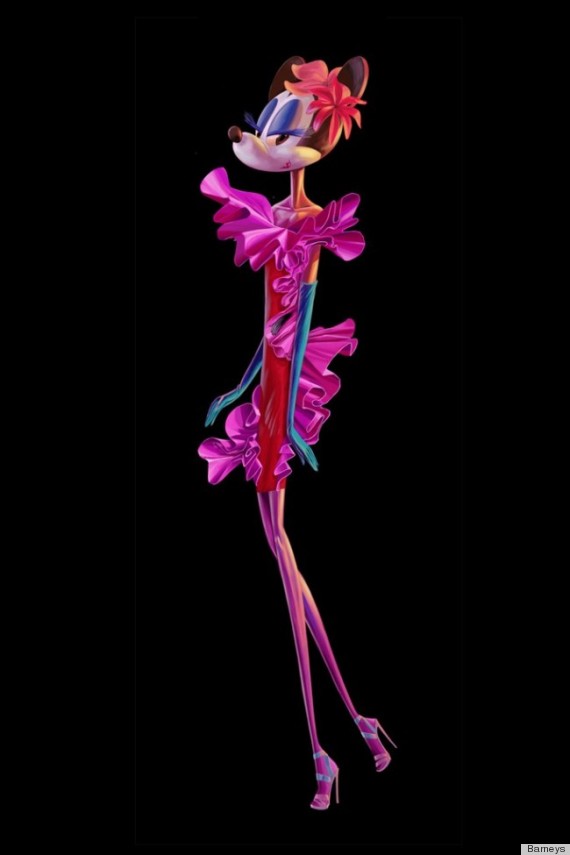
Minnie Mouse as a Size 0

Stadler and O’Shaunessy discuss body appearance manipulation in our textbook Media and Society (2012).   They mention “most media images of women feature models so thin that they have practically ‘no body’ and are “nobodies’ lacking in individuality because they all have the same stereotypical kind of beauty.”  (p.366).

They also say, “This could all be interpreted as yet another media message that young people have to be thin and wear designer labels in order to measure up to media ideals…” (p.366)

This holiday season, Barney’s of New York and Disney are ‘starving’ childhood’s superstar Minnie Mouse into a stick figure so she can model one of their famous evening dresses in a holiday window display.

Image

http://www.huffingtonpost.com/2012/08/29/disney-characters-barneys-supermodels_n_1840220.html

Celebrities are using their popularity with fans (O’Shaunessy & Stadler 2012, p.427 – 430) to influence the conversion of  Minnie Mouse to a 5’11” size O. Self-described fat person Ragen Chastain is circulating a petition on Change.org asking Barney’s and Disney to not change Minnie’s shape:

For a holiday window display, Barney’s and Disney have agreed to showcase Minnie Mouse wearing a designer dress — and distorted so she looks like she’s 5’11” and size 0.

I work with kids who have eating disorders, so I’m not exaggerating when I say the message this sends is deadly. According to one study, hospitalization for children younger than 12 with eating disorders went up 119% from 1999 to 2006. Younger than 12. 

http://www.change.org/petitions/barneys-leave-minnie-mouse-alone?

Can’t  concern for our children’s mental and physical health be expected to trump commercialism?   Aren’t the models journalists choose for shoots in fashion media irresponsibly thin?

Posted by: nallen123 | October 22, 2012

Has Feminism Created a Vacuum for Femininity?

Reading about the three waves of feminism, I wondered at the possibility of the proverbial feminist pendulum being forced to slow down and find it’s center in a place where women can be “separate, but equal” to men. O’Shaughnessy and Stadler offer that “some third-wave feminists argue that there might be important differences between men and women (and between women) and that traditional feminine qualities and characteristics need to be revalidated and endorsed,” and I couldn’t agree more. After decades of fighting to be considered the equals of men, have women lost sight of what it means to be feminine? I ask this question a lot as I navigate what it means to be a woman who is strong and vulnerable, confident and gentle.

The other day a friend posted a link on Facebook to a montage of photos of “gorgeous” regular women. Ten seconds in, viewers are told “something the media doesn’t want you to know: you’re beautiful.” Following is a three-minute slideshow of portraits of women who don’t fit the media-portrayed definition of the term, but who are, in their own ways, undeniably beautiful.

The images are punctuated by a list of “top ten ways to make sure everyone knows [you’re beautiful].” Way #3: “be willing to be vulnerable, so you can also fully experience joy,” caught my attention. Vulnerability hasn’t exactly been championed by women for the past 50 years, and yet there it is, highlighted, in this (mildly) feminist piece.

QUESTIONS: After decades of fighting to be considered the equals of men, have women lost sight of what it means to be feminine? Now that women have secured a basically equal standing among men (at least on paper), might we freely embrace femininity and feminist goals?

Posted by: meredithalawrence | October 22, 2012

Is Beauty Pain?

Is Beauty Pain?

Over the course of my childhood and education I have heard again and again that beauty is pain and I have been presented with ample examples and images re-enforcing this theory, for example corsets and the fact that Chinese women used to be expected to bind their feet, not to mention the beauty rituals women are expected to go through in modern society. But, until I read Chapter 21 I never considered the possibility that the mantra might extend to men.

In their discussion of masculinity O’Shaughnessy and Stadler comment on an ad for a men’s shaving product. They state that this ad “implies that men suffer self-inflicted pain and discomfort every das as part of the price they pay to embody an acceptable (clean-shaven) image of masculinity” (p. 379).

While it is undeniable that shaving has a good deal of possibility for pain for men, I think it pales in comparison to the number of potentially painful things women in our society are expected to do to make themselves beautiful or are told make them feminine, such as waxing or wearing increasingly high-heeled shoes. O”Shaughnessey and Stadler pay this trend little mind and do not compare it to the apparent male trend, which would have added some depth to the argument. I came out of the reading wondering if perhaps I missed something? Are men expected to inflict more pain on themselves than woman for the sake of appearance? Which group does the media expect more self-inflicted pain from?


Posted by: lee E. | October 22, 2012

Some Man Talks about Patriarchy

O’Shaugnessy and Stadler begin Media & Society’s chapter 20 with the statement “Patriarchy is a system based on the law of the father,” (P. 353) and a chapter later we’re asked to continue to conceive of patriarchal systems “as essentially male,” but are now encouraged to think about the ways in which they are damaging to men.

I think if our goal is to continue towards a more balanced system or united front, it’s important to find ways of talking about the current in ways that aren’t immediately shaming to men.  In my view, patriarchy foremost favors performative behaviors that benefit systems of already-established power.   If we lump “men” together,  it becomes easy to forget about those who don’t incline towards that system or what it rewards…and we may be forcing a sort of othering of the sexes actually furthers stereotyping (from both sides) instead of moving us forward.

I would point to the Atlantic Monthly’s recent “Why Women Still Can’t Have It All” article by Anne-Marie Slaughter.  I’m sympathetic, but there are a lot of men who can’t either. Whether you’re a man trying to be the patriarchal perfectionist ideal or a woman, it is crippling and impossible…for some more than others.

Hillary Clinton’s response last week poses an interesting question: Is it the scripted phrasing of a woman who has been rewarded for playing by the patriarchal rules? Or is she the post-feminist ideologue that will begin to help us all deconstruct the patriarchal pedagogy?

Posted by: arianeleigh | October 21, 2012

The Celebrity Effect

The media can be so hard on women, so critical. The word “slut” has become too frequented in our everyday vocabulary and encourages the criticism of women when they dress or act like the media has taught them.

A recent article in the Huffington Post titled, “Trampire: Why the Public Slut Shaming of Kristin Stewart Matters for Young Women,” describes the scrutiny on Kristin Stewart for cheating on Rob Pattison.

Celebrities embody ideologies of achievement, masculinity and femininity and of familial and romantic relationships, O’Shaughnessy and Stadler said (O’Shaughnessy 434).

The media attacked Kristen for cheating on Rob Pattison, calling her a slut and giving her the name “Trampire,” but what message is this sending to all young girls?

Nico Lang of the Huffington Post addresses how Stewart’s one bad decision has caused an outrage among the media and public.

“But for young women, the culture of slut shaming that the Kristin Stewart scandal represents won’t go away. I might not be concerned for K-Stew, but I am concerned for all the young women today who are tuned into this scandal, ones who are learning that it’s not okay to screw up, ever. Chris Brown can publicly beat the hell out of his girlfriend but still be played on the radio and win Grammys. However, if you ever cheat on your boyfriend, your life is over and no one will ever want to be associated with you,” Lang said.

While Ashton Kutcher cheats and still holds his place on Two and a Half Men, Stewart’s contract has been dropped from the sequel for Snow White and the Huntsmen.

Recently on the radio, I heard mention that Pattison may currently be cheating on Stewart… but that would be justified right? Karma or revenge perhaps?

According to O’Shaughnessy and Stadler, the actions of celebrities create the social norms of society.

Should we blame the celebrities or the media for the effect on society’s social norms?


« Newer Posts - Older Posts »

Categories