Posted by: ellenpayne2012 | November 2, 2012

Oregon’s first twitter libel case

You’ve probably seen them. They’re hard to miss. Local Dr. Darm commercials promoting his aesthetic spa practice (body sculpting, take wrinkles away, lose weight!)

That’s why I perked up when I heard last October that blogger Tiffany Craig faced a $1 million dollar lawsuit. Darm charged that she defamed him in her twitter account and blog.  

The Oct. 10, 2011, Oregonian article says “citing a 10-year-old order against the doctor by Oregon’s Medical Board, Craig wrote, in part, that the doctor tried to get sex in exchange for treatment.” Soon after an Oct. 12, 2011, Oregonian article reported that the suit had been dismissed, “as for Craig, she said she’s grateful for Oregon’s anti-SLAPP laws and hopes for the same protection at the federal level someday.”

What is an anti-SLAPP law? It’s a protective response to “a strategic lawsuit against public participation brought to intimidate an opponent into silence. These so-called SLAPP lawsuits are filed with the intent of squashing dissent or independent voices,” states a Sept. 17, 2011, Portland Business Journal article.

This week’s defamation readings point out, “Truth is an absolute defense to a defamation claim. But keep in mind that the truth may be difficult and expensive to prove.” This combined with the anti-SLAPP law probably saved Craig’s bacon in the end.

Question: Does knowing more about these laws encourage you to speak your mind or are you more hesitant now that you’re aware of the legal pitfalls in remixing, blogging or tweeting?
Posted by: itslikethatweb | November 2, 2012

Life Without CDA 230

Out here on the big, lonely frontier of the Internet, it’s comforting to know that there’s a cowboy on our side. That cowboy being, of course, the Electronic Frontier Foundation and it’s disarmingly clever guide for our rights as online publishers. It is strange to think that I knew so little about a platform I’ve used for so long, and honestly, it’s a relief to know that the blogosphere adheres to these regulations.

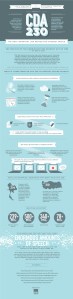
The original article links to a list of related pieces, one of which is this fantastic infographic (too large to post full-size, but click the image below for the expanded version)

In essence, the infographic serves to illustrate how crucial CDA 230 is to the protection of our freedom of speech. The most striking portion, in my mind, is the pair of real life examples of countries that don’t have CDA 230: citizens in Thailand and Turkey have extremely limited freedom of speech online (although presumably that freedom is similarly limited offline). Criticism of leadership and of national identity are particularly frowned upon in both cases, which would absolutely not fly here in the US.

Imagine this year’s election if Americans were barred from voicing criticism about our leaders online. How would the digital landscape be altered with the exclusion of content that questions our government? How would that exclusion affect our overall political discourse?

Posted by: karlcd | November 1, 2012

Thank You – 2 Live Crew

I hate exercise.  I know it is good for you, but I hate it.  It is tedious, hard, time-consuming, and that is why I am glad for the people who exercise for me.  I am not talking about physical exercise, I am talking about exercising your rights.   American University Law Professor Peter Jaszi says “Fair use is a right, but like any right, its reality depends on its exercise”.
  That is why I would like to thank 2 Live Crew for exercising their first amendment right, and fighting all the way to the Supreme Court in the 1994 case Campbell v. Acuff-Rose Music.  This case elevated the importance of fair use, reversed lower courts interpretation of fair use and had cultural significance.   It was a five year fight and in the end 2 Live Crew changed the reality of copy right law.
There are other artists who could of exercised their right to free speech before 2 Live Crew, artists such as De La Soul in 1989, or Weird Al Yankovic in 1983, or Vanilla Ice in 1990.  But these artists all asked for permission to use the samples as part of their work, or when sued over the songs they settled out of court.   So I would like to thank 2 Live Crew for exercising their right (and my right) to free speech and making fair use laws a reality.

2 Live Crew’s song parody of Pretty Woman did not make a lot of money.   If it did, would it still fall under fair use laws?

When Weird Al Yankovic parodies a song he splits the royalties with the copy-write holder.  Do you think he should claim fair use instead?

Posted by: Shekhah | October 29, 2012

When crowdsourcing has consequences!

In Muthukumaraswamy’s study she declared that it is important to note that in many regions around the world, there are dangers associated with crowdsourcing in countries with authoritarian regimes.

Reading this make me want to share some of these challenges in Saudi Arabia.

Earlier this year,Saudi Arabia was ranked the 8th among the most censored countries, according to the Committee to Protect Journalists.  http://cpj.org/reports/2012/05/10-most-censored-countries.php

Saudi Journalists know they can’t express their opinion in traditional media and social media could be even worse. A lot of Saudi people don’t use their real names or pictures when using social media or discussing political, religious or social issues. A new royal decree was passed last year, that has many articles protecting all government figures and punishing anyone who violate it

http://www.saudigazette.com.sa/index.cfm?method=home.regcon&contentID=2011043099479’

If doing so, a person could be detained or risk his own life. Here are two examples :

http://www.csmonitor.com/World/Global-News/2012/0210/Malaysia-may-repatriate-Saudi-who-faces-death-penalty-for-tweets

http://www.washingtonpost.com/wp-dyn/content/article/2007/12/31/AR2007123101915.html

Foreign journalists trying to highlight controversial social or political issues in Saudi Arabia without a written approval from the Ministry of Information have the same risk.

Last year, the government prevented any covering of Shiite protests in the Eastern Province. Local news websites that have reported on the unrest have been shut down and their editors arrested. They expelled Riyadh-based Reuters correspondent for his coverage of political unrest.

http://cpj.org/2012/02/attacks-on-the-press-in-2011-saudi-arabia.php

How can journalists along with citizens improve journalism practices when they have to fight government censorship? As a journalist covering an area that suffers such censorship would you comprise the truth to protect yourself?

Posted by: sarakroth | October 29, 2012

Journalism Ethics and Campaign Advertising

We are currently coming to the end of the most expensive presidential election campaign in American history. The candidates and independent Super PACs have spent well over $1 billion so far, and we still have a week to go.

For me, this week’s readings highlighted just how much the American presidential campaign has become a battle between brands. As “The Lie Factory” cites Whitaker saying in the 1940’s, “We assume we have to get a voter’s attention seven times to make a sale.” At this point, in terms of advertising, it’s almost as if Pepsi is running against Coke.

Even though I am disenfranchised by the state of election advertising, I still expect our media institutions to attempt to provide balanced coverage. The Equal Time Rule requires television broadcasters to provide equal opportunity for advertising airtime.

I always thought that newspapers held themselves to the highest standards in terms of journalistic integrity. More than any other form of media, I expect newspapers to provide balanced news coverage first and foremost. But the Seattle Times’ stunt of creating and running free ads for only one candidate in Washington’s gubernatorial election proves this view incorrect in one of the nation’s largest papers. The Times cited one reason for this move was to explore a new form of revenue generation.

As print journalism struggles to find revenue, can we continue to expect them to maintain the same level of journalistic integrity as they have in the past?

Posted by: coolethan77 | October 29, 2012

‘Big Business has won every skirmish’

Gore Vidal once said, “Apparently, a democracy is a place where numerous elections are held at great cost without issues and with interchangeable candidates.”

While I could list the many ways in which the two major-party candidates for President are “interchangeable,” I’m more concerned with the “great cost” of American elections—particularly how the great costs have grown exponentially since the Supreme Court’s ruling on Citizens United and the implications of that decision.

In the “The Lie Factory,” New Yorker writer Jill Lepore digs into the history of political consulting, focusing on the genesis and evolution of Campaings, Inc., the firm that laid the foundation for the practices that still dominate modern political campaigns. What is most troubling about Lepore’s report is how it illustrates the consistent theme in American politics: The overwhelming power and dominant influence of money.

Noam Chomsky writes that the father of capitalism himself warned against this trend: “Adam Smith said: ‘the principal architects of policy consolidate state power and use it for their interests’ … It’s basically court decisions and lawyers’ decisions, which created a form of private tyranny which is now more massive in many ways than even state tyranny was.”

So since we can see that the current trend is nothing new in our history, what can we do to change it? Cenk Uygur, main host and co-founder of the Internet and talk radio show, The Young Turks, offers this solution. What do you think about his proposal?

Posted by: robertheinz | October 29, 2012

Have we lost our ability for a critical debate?

For the largest part of my parent’s life, their vote didn’t really matter. Neither did their neighbors, friends or colleagues, as elections in the former German “Democratic” Republic were predetermined in favor of the ruling party. Once they had a “real” choice in a reunited Germany, they installed in me how precious our democratic values really are.

It worries me, that the notion that politicians tell you whatever you want to hear to get elected and after that nothing really changes seems far spread. The gap between Washington D.C. (or any capital in the world) and its voters seems to widen. A lot of things play into this effect, but compliant to our reading assignments, campaigns and politics today are strongly influenced by strategies of personalization and “de-issuetization”. These effects are accelerated by the increasing reach of metric-driven political campaigns and their attempt to create political opposition with everything that leaves there media outlets.

But no issue on the political agenda is either black or white by its very nature, only through a machinery of political communications does it become that polarized subject. In the midst of all of this, I am asking myself how the voter’s role has changed. Despite a more participatory media landscape, voters seem more polarized than ever.  Have we lost our ability for a critical debate in order to come to find consent over a controversial issue? Do we need to learn this ability again, as journalism has done most of the critical thinking for us in the past?

Posted by: karlcd | October 29, 2012

Follow the Money!

Sheldon G Adelson.  George Soros.  The Koch Brothers.   These are a few of the people who have invested money in the 2012 election by way of Political Action Committees.  To find out more about the money I searched the Federal Election Commission data base at http://www.fec.gov.  What I found was that together they have donate between 45 and 85 million dollars to PACs for this election.  What I could not find out is what the money was being used for.
It was only after reading about the company Campaigns Inc. that I knew what the money was going to be use for.  Campaigns Inc., was the first political consulting company formed in 1933 in California and is much like today’s Political Action Committees.  PACs follow the same campaign  principles that Campaigns Inc. created in 1933.   The campaign principals include; 1) create an opponent, 2) attack their character, 3) put on a show, 4) have a simple campaign message, 5) don’t explain your position, and 5) repeat.  These 5 steps are exactly what a PAC can do.  The only thing that is illegal for a PAC to do is coordinate their campaigns with the candidate.  Which you don’t need to do when you are only attacking your opponent.

Political Action Committees have been legal for 10 years.  Before 2002 there were limits on the amount a person could invest into a political campaign.  With 2002 Campaign Finance Reform Law one person is now able to spend as much as they want on an election.  Political Action Committees have not changed how the elections are played but they have invited a lot more people into the game.

With more money spent on elections will the electorate become more engaged in government and elections?

Michael Bloomberg is worth 25 Billion, should he be able to spend it all on running for President?

Posted by: meredithalawrence | October 29, 2012

A Little Insight Goes a Long Way

As Del pointed out in her post, and as was illustrated for us the New York Times Magazine piece “Feel the Loathing on the Campaign Trail” and the Seattle PI’s blog post about the Seattle Times’ controversial funding of an ad for the Republican gubernatorial candidate Rob McKenna, in the case of political elections, the news media primarily covers and focuses on major candidates and in that manner limits democracy by not paying attention to alternate candidates.

Similarly, as illustrated in the New Yorker’s article “The Lie Factory” which recounts the rise of Campaigns, Inc., the non-journalistic media can certainly be used to quell the democratic process and scare people into a pre-determined opinion.

But, in so far as the democratic can be defined as giving voice to many different opinions, as we saw in Muthukumaraswamy’s discussion of crowdsourcing in her article “When the Media Meet Crowds of Wisdom,” there are ways in which the news media can increase the number of voices it portrays. For instance, across the nation, some news organizations are starting to use “Public Insight Networks,” which are databases of common-public sources. These networks serve as a way for journalists to contact and often cite sources from the general public who might not otherwise be represented. For instance, this OPB article (http://www.opb.org/news/series/voicesofyoungvoters/voices-of-young-voters/) about young voters, uses sources found using OPB’s Public Insight Network. By reaching out to members of the public through such pathways as Public Insight Networks, does the mainstream media work to foster democracy?

Posted by: arianeleigh | October 29, 2012

The Evolution of Media and Campaign Reporting

The articles had a connecting theme in describing and illustrating the birth of “candidate framing,” sound bites and selling points of campaigns in the 1930s to present day. In the 1930s, Baxter and Whitaker birthed the fine art of political packaging. Their “packaging” had a major impact on the election of officials of their day with a few exceptions breaking the mold and emerging on the other side. They created and fine-tuned the art of directing the message to get the candidate of their choosing elected, no matter what the truth was.

Harry Truman’s attempt at national health care was killed because of sound bites by virtue of their nonstop repetition. In present day, the sound bites are created by the ad campaigns, but they are propelled forward by the news media. Traditional media no longer gives an impersonal, unbiased view as much as it propels the sound byte creations forward.

The Master Character Narratives in Campaign 2012 states “More of what the public hears about candidates also now comes from the campaigns themselves and less from journalists acting as independent reporters or interpreters of who the candidates are.”

Since when did reporting favorability ratings and likeability ratings become the yardsticks on which the news media focuses? Where are the verifiable news source facts of a candidate’s performance?

« Newer Posts - Older Posts »

Categories