Posted by: reddingrob | November 13, 2014

Blogger Protections

While Section 230 of Title 47 of the United States Code protects you from legal action as an information host, it doesn’t help you if you present new information. Under Section 230 you would not be liable for defamatory remarks made in the comments section by a third party.

The Electronic Frontier Foundation’s page on Section 230 Protections states “if you are actively going out and gathering data on your own, then republishing it on your blog, we cannot guarantee that Section 230 would shield you from liability.” That statement may give citizen journalists pause when deciding to start a news blog. If you want to repost information from other sources, then you’re covered. If you do your own reporting, you can be held legally responsible for the content of your posts.

Because blog owners have the flexibility to edit and delete posts should they have any liability for defamatory remarks made on their blog? I can see a case where person X says that the blog creator allowed defamatory remarks about them to remain on the blog, and by not taking the comment down, the host is contributing to the defamation.

While I believe that the host should enjoy some protection from comments made on their site, the blogger should have to abide by their own guidelines on what types of comments they will allow.
Posted by: chrisforde915 | November 13, 2014

Captain Copyright Saves the Day!!!

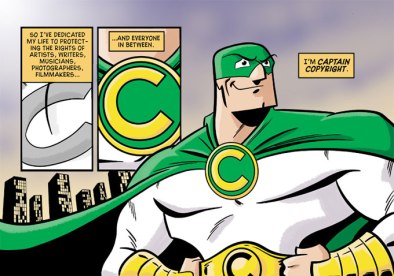
Captain_copyright

Peter Pankey better known as “Peter Gunz” is an american hip hop artist from the Bronx, New York who garnered much success in the 1990’s era of rap. In 1998 Peter released a joint album with fellow Bronx native Sean Hamilton “Lord Tariq” and the duo’s lead single “Deja Vu (Uptown Baby)” quickly became a fan favorite. Climbing the Billboard Hot 100 peaking at #9, earning a platinum record, and grossing over one million dollars in sales, the Bronx rappers financial future seemed promising.

However, it turned out that the highly favored hit with it’s old school vibe and catchy hook owed much of its success due to using a sample of Steely Dan’s “Black Cow” . A sample that was used without going through the proper legal channels to secure Steely’s permission. This led to Steely taking legal action for copyright infringement which he was awarded a six figure settlement ($105,000). Peter and Tariq lost all of their publishing rights and 90% of royalties for the song which were awarded to Steely.

Peter Gunz and Lord Tariq’s fame was short lived following the lawsuit. The group was dismantled and no other albums were released. Their hit song Deja Vu continues to live on earning them respect from hip hop fans, while Steely Dan continues to collect big checks from royalties.

Posted by: eldrickbone | November 13, 2014

David Bowie’s Copyright Oddity

In May 2013, Astronaut Chris Hadfield lived the dream. He played David Bowie’s “Space Oddity” in space. He put up the video on YouTube, but was only granted a one-year license to use the song. In May 2014, the video was taken down. Ottawa Citizen then posted a scathing article, blaming David Bowie for being so selfish and not renewing the license.

A few days later, Ottawa Citizen retracted their article and apologized. Turns out, David Bowie does not own the copyright to Space Oddity. In fact, he does not own the copyrights to over 300 songs that he has wrote and recorded. RCA records owns the rights to all those songs and asking nicely is as much of an influence David Bowie has in the matter.

The lesson here: Do your homework Ottawa Citizen before you publish accusatory articles  Know the basics of copyrights laws. This was not a situation in which anyone was sued for using music illegally in a video. All the proper precautions were taken and no foul play was ever really part of this story. We are even fortunate enough to still be able to enjoy Hadfield’s haunting rendition of the classic.

Posted by: Rachel Baker | November 13, 2014

It was the best of times; it was the worst of times…

…It was legalese time.

From page one, Aufderheide and Jaszi (2012) stated that there is great “lack of clarity around copyright and fair use” (p. 1). And no wonder – legalese continually is a struggle for many of us who could never had made it through law school.

For me, this article brought up many questions rather than answering anything. The article also noted that copyright resources make statements such as, “The Legal Department should therefore be consulted…,” “consult an attorney,” and “Don’t use anyone’s stuff without getting permission and giving credit…” (p. 10). Rather than giving concrete, helpful protocol for correctly handling copyright issues, it vaguely directs people to consult lawyers. However, I find that it is true that I trust my colleagues more than professors, books, or my organization and its lawyers.

Yet, these issues we looked at this week – copyright, fair use, defamation, libel and privacy – are serious and important. Misuse of material can lead to the fall of an empire, as seen through the breakup of the Mars Hill churches with the plagiarized writings by Mark Driscoll. The Driscoll controversy has aired on the Washington Post, the Huffington Post and Slate magazine, among many others – leading to the decline and now sudden death of the mega churches.

With this knowledge of the importance of understanding these laws, I would like to learn more specifics on how the fair use policy can be utilized, especially in the area of social media.

Posted by: jstrieder | November 12, 2014

Who’s in Charge of “Privacy”? Maybe Your Subject.

With all due respect to the Center for Social Media and the EFF, the most important aspects of privacy is not what the law says. It’s what people HOPE it says.

In the real world, everyone has their own opinion about what constitutes an invasion of privacy by a journalist. You will have to answer to your readers and subjects even when the law is on your side.

I was recently shooting video in a Goodwill to cover the store’s grand opening. Two separate individuals approached me with concerns. One asked if I had permission, and when I said yes, he countered with “Are you sure?” He then told his wife in Spanish to be mindful of the camera. Another man simply stated, “I do not give you permission to film me.” I told him that I had permission from the store and that he was in public, but he argued that a Goodwill store was privately owned, so he wasn’t. I said I’d avoid closeups of him.

Most angry subjects, convinced that you have violated his or her rights, will not retain a lawyer or even look up the law. Instead, they will complain to your advertisers, supervisors or sponsors. Or they may take to social media. Or they will confront you in person.

Another question: Is it legal to photograph a minor in public without their parent’s consent? A lot of parents don’t think so.

I found this resource helpful in exploring those questions.

f-17-13-7649618_ZQeK69XQ_tiffany-shackelford

The next guest in our class speaker series was Tiffany Shackelford, Executive Director of the Association of Alternative Newsmedia, whose mission is (lifted from its own website): “to provide services and leadership that ensure the success of its members, and to strengthen alternative journalism through advocacy and education.” Those members include local free papers The Portland Mercury and Willamette Week.

Don’t look to Tiffany for the hand-wringing and Chicken Little-ing found amongst many of her colleagues in journalism. “Sometimes you have to destroy the whole thing before you can rebuild it,” she said. “I kind of feel like we keep trying to fix things that didn’t work in the first place.” This is a perspective in keeping with the spirit of the alternative media, which challenge the staid editorial positions and economic dominance of mainstream news sources.

Rather than bemoan the current status of the Fourth Estate, Shackelford sees cause for optimism. “Maybe we’re living in a golden age of journalism right now,” she mused. Despite the revenue disaster that befell print media over the last fifteen years, Shackelford pointed to the many ways that the internet has enhanced journalism.

Turning conventional wisdom on its ear was the theme of her remarks. The “good ol’ days” of journalism? They were never that good. Journalistic standards of objectivity? They don’t really exist. Journalists should be tech savvy and know how to code for the Web? Nah, she said, while journalists need to know the technology and tools, they should leave the tech to the techies and focus on the core principals of good journalism.

“Citizens deserve quality journalism whether they pay or not,” said the maven of free newspapers. No matter what device delivers our information (“[you’ve] always tucked a newspaper under your armpit . . . so this idea that mobile is a new concept is silly”), a functioning democracy relies on dependable sources of good information. “Journalism is an important to civic life as opera or the ballet,” she said. Will time prove the soundness of her optimistic viewpoint? Check back here in twenty years to find out.

Posted by: katieaoreilly | November 11, 2014

Do political campaigns play by different rules?

39808926_aaa6b0313e1

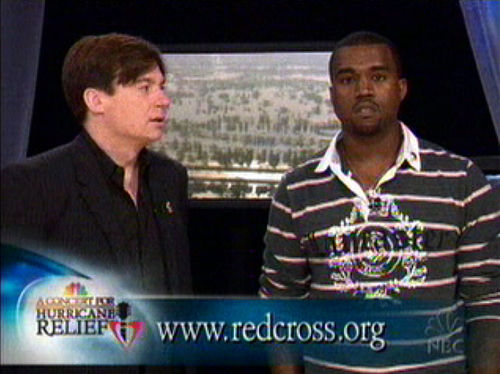
Were Kanye’s post-hurricane comments slanderous?

Following the midterm elections, the tricks employed by political campaigns to sway voters are still fresh in our minds. This year in Oregon, we saw a senatorial candidate accused of plagiarism, ads on opposite sides of the same measure reporting contradictory information, and the governor’s fiance’s past paraded before us as collateral. Par for the course, but I have to wonder, how far can these messages go before they become defamatory?

By law, the rules of defamation apply differently to public figures. Public figures must prove actual malice in a lawsuit, which is no easy feat. Political ads and rhetoric are often incredibly misleading and negatively framed, however campaigns never seem to be chastised for this. True, a political candidate has declared her/himself a public figure by running for office, and according to Deliah Saper, all of a candidate’s history becomes public with them. However, all the information I find on this subject takes the same perspective on the issue, stating that public figures will not win lawsuits over comments made during a campaign. But my concern lies with the voters, not the candidates. Yes, a candidates reputation may be damaged as a result of defamatory content from the opposition, but what effect do these misleading campaign messages have on voters, and why is a candidate’s image the only outcome we worry about?

Posted by: Donna Z. Davis, Ph.D. | November 10, 2014

An interesting read

For your Monday morning coffee break:

Employers Want “Critical Thinkers,” But Do They Know What It Means? | Fast Company | Business + Innovation – http://bit.ly/1ypZnza

Posted by: alansylvestre | November 9, 2014

If you’re not making money, is it considered fair use?

Have you ever been in an academic situation where you’ve needed to use a picture, but you didn’t have the right one? So you proceed to Google for the right image. You find the perfect image for the presentation, paper, video, etc… so you use it without even thinking twice about whether or not you need permission.

The short answer is always. There are few times where you don’t need to ask permission. Even in an academic setting, redistributing images without the written consent of the owner violates the Copyright Clause of the Constitution.

On August 18, 1787, the Copyright Clause was amended to the Constitution by the Constitutional Convention. The clause states that an object, once fixed in a tangible form, is the sole property of the creator. Only they are able to provide permission for the redistribution of their material.

In an academic setting, like a presentation or research paper, too often get published after the original project is finished. Does this violate copyright? Even though you’re not intending to make money off of it, you’ve redistributed the material for another audience, without the written consent of the original author.

When discussing copyright with relation to online imagery and videos, it’s important to understand the source the material is coming from. Did you simply pull it from Wikipedia? Did you find it through a Creative Commons search where it clearly states the material can be redistributed? If I use this image, am I infringing upon somebody’s copyright?

Posted by: johncardenas | November 6, 2014

Yumi, Omi, Mumi…

Half way between Portland and Astoria on Highway 30 there’s a stretch of road about 20 miles long where cellphone service stops. It was right then when Rachel and I had to use our brains. “What’s her name? You know, she was in that one movie with whats-his-face.” That was pretty much all we had to go on. I was driving so I asked Rachel to “just look it up”. That’s when we realized how much of our own memory we had given up to the internet.

It happened slowly. Over the course of several years I’d imagine. One search at at time slowly letting IMDb, wikipedia, and the like become my memory overflow. I started to believe that I didn’t need to hold on to useless information in my brain and to “just look it up”. On page 193 of The Shallows, we learn that letting the web hold our explicit memory is in fact bad for brain development. We actually need to continue to exercise our ability to recall information and that is adds more pressure on our working memory. We need to retain this kind information as a way to preserve and grow our intellect.

“She was in that one movie about swords where she kicked major ass.” ” Oh yeah, she was also in that one where she O.D.’d on heroin and that one dude had to use that huge syringe to bring her back to life.” All together now, “UMA THURMAN!”

« Newer Posts - Older Posts »

Categories