Posted by: Donna Z. Davis, Ph.D. | December 5, 2014
Vote for your favorite Week 9 post here!
Posted in Uncategorized
Posted by: stephanieessin | December 5, 2014
Young and Old: Do kids learn better from a digital platform?
Lucila’s post about getting her daughter to do her reading lessons raised questions surrounding digital natives and whether they are more comfortable learning on the web than in front of a screen. According to our reading, the author was suspicious of those who see a contrast in generational ways we consume media–that is, the young “Internet natives” and the old “Internet immigrants” (227). The reasons behind the author’s suspicions of the contrast are as follows:
-Adults statistically use the Web more than children
-Adults are as infatuated with communication technologies as kids are (Xboxes vs. BlackBerrys)
-Adults and children have the same brain makeup and are affected in similar ways
The author cites a study that states multimedia technologies, like an eBook, will limit, not enhance, learning abilities. To answer Lucila’s question, “Will these studies have the same results when those born under the Web 2.0 become adults?”, the author would say yes. When her daughter grows up, her ability to learn from multimedia technologies will be no different than that of an adult now looking at a screen for the first time.
So what worked about the online reading lessons? Was it that they were more interactive? Or perhaps entertained her more with flashing lights and colors? I think kids are pretty simple people. Perhaps the stimulating sounds and little characters pronouncing the words for her made it more fun. We all like fun.

Posted in Uncategorized
Posted by: jstrieder | December 4, 2014
Does “The Shallows” Explain #Shirtgate?

An illustration from The Spectator
Cultural commentators often weigh in these days on what they perceive as a growing willingness to prioritize inoffensiveness over discourse. This recent column in The Spectator, for example, attacks “Stepford students” on campus and with a headline that declares: “Free speech is so last century. Today’s students want the right to be ‘comfortable.'”
I have tended to dismiss these articles as defensive attempts to push back against cultural changes, such as the growing number of women at the forefront of the sciences.

But when reading Nicholas Carr’s “The Shallows: What the Internet is Doing to Our Brains,” I had an epiphany.
According to Carr, prioritizing inoffensiveness over discourse is a real phenomenon. But it’s a result, not of the influence of feminism, but of getting information online. “We no longer have the patience to await time’s slow and scrupulous winnowing. Inundated at every moment by information of immediate interest, we have little choice but to resort to automated filters, which grant their privilege, instantaneously, to the new and the popular.” (171) Add “more easily processed online,” and you can see why, biologically, a shirt might be more vivid than a description of a space mission.
Carr may even be able to explain trolling wars. “It’s not only deep thinking that requires a calm, attentive mind. It’s also empathy and compassion.” (220) If higher emotions do in fact come from slower neural processes, as he claims, it is to be expected that all people who communicate online will be less empathetic.
Posted in Uncategorized
Posted by: lindsaym88 | December 4, 2014
The Shallows of Nicholas Carr
“The Shallows”, Nicholas Carr’s call to conjure up “a big anti-Net backlash”, falls flat on its face. The internet has reduced our depth of thought to puddles of celebrity Tweets, a swirling eddy of simplicity and hyperactivity. He seems to miss the fact that the internet has given rise to more access to education and knowledge than has ever before been available. He seems to forget a similar “backlash” occurred back when bibles were taken home by en mass and interpreted privately, instead of dictated by ordained priests. He also seems to think that people were incapable of finding distraction while reading way back when…

Proof that people got distracted reading even in the olden days.
The internet is not turning us into mindless drones, but is, I argue, encouraging a new way of thinking and communication. “Fandoms”, for example, are entire groups of people dedicated to the dissection and discussion of a single subject; while not the stuff of James Joyce exactly, you can’t deny it requires the element of mental concentration and engagement.
250 words will not be enough to encompass the depth of my disagreement with Carr’s assertions. Perhaps because I grew and developed in tandem with the internet boom, I have a different relationship and perspective than does Carr. He certainly made no effort to entertain many counter arguments. My final argument can be summed up in the boom of concentration and literary interest that took over the English speaking world and beyond: Harry Potter.
Posted in Uncategorized
Posted by: Rachel B. | December 4, 2014
The Church of Google Doesn’t Have Any Art on the Walls
In film editor Walter Murch’s famous book, “In the Blink of an Eye”, he discusses the industry pre-digital advancement, and how analog systems benefited the craft.
Back when editors had to manually splice together pieces of film, there wasn’t an incredibly efficient way to review or find specific scenes. You had to watch through 10 or 15 minutes of film roll before finding what you were looking for.
Murch writes that being constantly exposed to different parts of the footage had an impact on his art. During his search, he would inevitably be exposed to other scenes, and sometimes discover new or different shots that he’d rather use.
He likens this phenomenon to the source of Picasso’s famous quote, “I do not seek, I find,” where an artist does not pummel through until their original vision is executed, but rather tries to “see” different ways of doing something, until finally the “right” way is discovered.
So what does this have to do with Google? Well, Google makes it a business to know exactly what we mean when we type in “the song with lyrics about thongs” and deliver in milliseconds exactly the results we’re looking for.
This might be an incredibly detrimental tool for the creative mind. If I’m never exposed to anything except my original idea, I’ll never have the chance to discover a new way of doing something. Efficiency has its benefits, but in the search for information that Google has strived to streamline, will the information I wasn’t seeking ever have the chance to reach me?
Posted in Uncategorized
Posted by: JenLuecht | December 4, 2014
New Emails and a Liberal Use of Kale: The High-Speed Delivery of Responses and Rewards
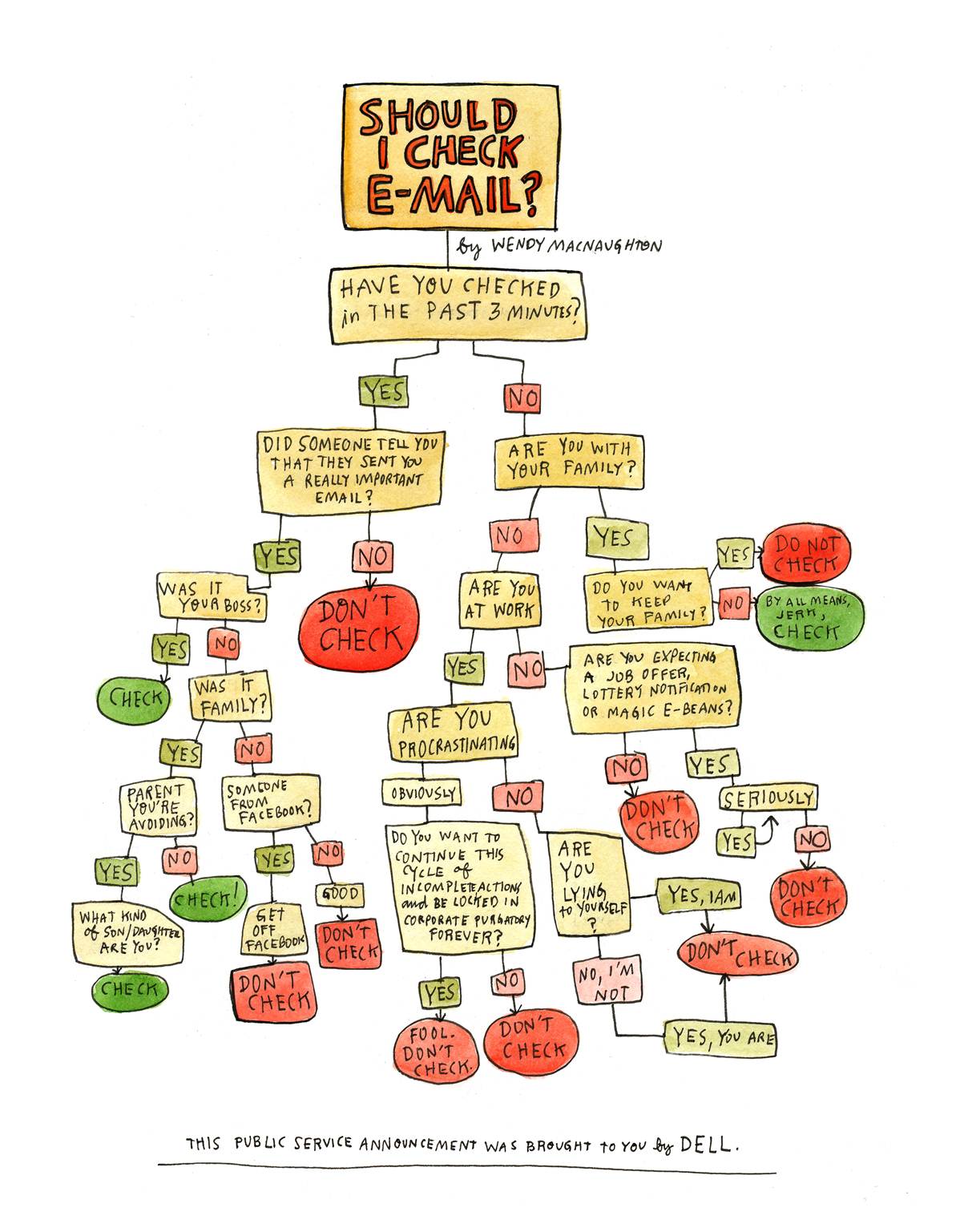
Taken from http://therumpus.net/2012/04/should-i-check-my-email/
In The Shallows: What the Internet is Doing to Our Brains, Carr explains that “the net seizes our attention only to scatter it” (p.116). One of the best examples of this can be found in our daily routine of pausing work to check our inbox for new emails.
I found myself wondering how much time is actually spent in this dance between completing the task at hand and pondering what new message might be waiting for me. So, I decided to keep track of how many times I checked my inbox in one hour.
Brace yourself: In one hour, I checked my inbox 16 times. If we assume each email check – which includes pausing the task at hand, opening the mail application, then turning back to and refocusing on the previous task – took up at least a minute, I am spending a total of 2.13 hours in an 8 hour work day participating in hurried and distracted thinking. Thus, almost a third of my workday is shaped by what Carr calls a dependance on the Internet’s high-speed delivery of responses and rewards.
Additionally, while writing this blog post I stopped four times to write to a coworker on instant messenger (not work related), three times to check my email (yes I am still doing that), and once to watch this all-male version of Beyonce’s new “7/11” music video that includes a liberal use of kale – which a friend had said was necessary to do before proceeding with my day (she was right).
Posted in Uncategorized
Posted by: Rachel Baker | December 4, 2014
A new era
Nicholas Carr, in The Shallows: What the Internet is Doing to Our Brains, strongly discusses the weakening of humans through a learned reliance on technology.
Carr (2011) states, “People who write on a computer are often at a loss when they have to write by hand” (p. 209). He makes the point that when people are used to typing, over time, they lose some ability to write in cursive. Taking it a step further, students in Finland are no longer required to learn cursive in school.
Similarly, Carr (2011) also noted that we have “come to depend on computerized GPS devices to shepherd us around” (p. 212). I find it is true when I am going some place unfamiliar or outside of my routine routes that I instinctively grab for my phone GPS. Perhaps this is because I travel a lot these days. Or, perhaps the common person is going places that were not options prior to navigation systems.
Yet, even Carr’s own digression into “the writing of this book” (p. 198) shows how the mediated mind’s capability to concentrate is diminishing. Personally, I can stay relatively focused in the process of writing this blog post, but I have difficulty sitting down to write a research paper. Are computers shortening our attention spans?
Whatever the case, it is clear that we are entering a different era, where we value technology as an extension of ourselves. Is this a weakness, as Carr states? Or, is it just the grand beginning of a new era?
Posted in Uncategorized | Tags: internet
Posted by: chrisforde915 | December 4, 2014
Re-Wiring Needed, I hope it’s not too late.
In the Shallows: What the Internet is Doing to our Brains, author Nicholas Carr makes it clear that our brain changes based on our experiences. We live in a digital world driven by instant gratification and convenience, seeking any way to simplify our needs and increase productivity. Technological advances specifically over the last five years has really contributed to the way I use and depend on the internet. However, I’ve never considered how these tools were “imposing limitations even as it opens possibilities” (Carr, 2011, p. 209). Most recently, I’ve been spending a lot of time on the internet following the progress of high profiled news stories, including the Mike Brown vs. Darren Wilson case in Ferguson and most recently the Eric Gardner incident that took place in New York.
Having an increased and personal investment to stay informed on any updates or changes in the case, I realized that my patience and threshold to read lengthy articles has significantly decreased. After making it through the first paragraph, I would grow impatient and subconsciously begin to scan the article for key words for a few seconds before throwing in the towel and finding the accompanying video of the story. If a video wasn’t available I would go to Instagram and Twitter in search of quick updates, that were direct and to the point. SNS’s satisfied my need but it raised a greater issue. When did I become wired to expect information quickly in short spurts of 140 characters or less?
Posted in Uncategorized
Posted by: listonjoe | December 4, 2014
The Value of Physical Books

As a consequence of living a digital life, there have been many times that I wish I was able to magically do a Control/Command F (find) to locate a particular section or term in a physical book. As if it would spring open to that page, and highlight the term I sought.
As seductive that particular idea is, Google’s plan for Book Search would allow that to happen in the virtual world.
When I had heard about this effort a few years ago, I instantly thought it was a fantastic idea. Being able to digitally search books would make knowledge acquisition so easy. I hadn’t put much thought into it beyond that.
But, after reading this weeks assignment in Carr’s ‘The Shallows,’ I firmly believe that doing so would further erode our mental ability to “decode” and “deep read” material. I think Carr’s right, and I read with fascination in the prior chapter about how reading online versus print affects not only understanding but re-trains our brains. Based on my personal experience, I believe it to be true.
Even if Google does digitize every book, I can’t imagine that physical books will go away. As consumers we have choice, and I hope we will continue to have the choice to pick up a physical copy when we want. Books are often my refuge not only from the glare of the screen, but from the distractions that erode my comprehension.
Posted in Uncategorized
Posted by: Lucila Cejas | December 4, 2014
Getting a four-year-old to do her reading lessons
While doing our reading for this week, I could overhear my husband and four-year-old daughter doing reading lessons. They have been doing these almost every day for the past months, and it seems like a tedious and frustrating activity for both of them, especially when repetition is involved.
Since he was on call while doing this, the phone started ringing quite often, which delayed the lesson a lot more. Noticing my husband was busy, my ten year-old niece offered to do the reading lesson with her. Instead of using the book, she said she wanted to use a website that was very helpful to her when she was learning how to read.
The website had different lessons according to the level of reading, and it would pronounce words on demand. She had no problem doing these reading lessons, and spent over half an hour doing a variety of them.
Our book points out that reading something online versus reading it on paper is more tiring, and our understanding of the subject is diminished. One of the studies he presents concludes that multimedia technologies “would seem to limit, rather than enhance, information acquisition”.
But how does that apply to what I just witnessed? Was she more interested in doing her reading lesson because it was something new and different? Or did the technology provide her with a learning tool that even a well-crafted lesson book couldn’t? Will these studies have the same results when those born under the Web 2.0 become adults?
Posted in Uncategorized
 Strategically Communicating