Posted by: chrisforde915 | April 6, 2015

Black Girls Rock vs. Traditional Influencers

Black Girls Rock (BGR) is a historic and monumental show that highlights the accomplishments of exceptional women of color. The mission of Black Girls Rock is to change the world by empowering black girls to lead, innovate and serve. To accomplish this goal BGR seek to provide resources and positive exposure for young girls to develop positive identity, build self-esteem and self-worth to combat the often seen negative images promoted in mass media.

Tonight my girlfriend and I had the opportunity to watch the Black Girls Rock 2015 award show. I was thoroughly impressed with the award show and at times found myself smiling uncontrollably the moment the camera would pan across the audience and catch the excitement illuminating from a young girl in the crowd as their favorite musician, actress, or idol graced the stage. Every word spoken, affirmed their worth, highlighting their internal and external beauty, intelligence and constantly built up their confidence.

As I was reading Qualitative Research Methods by Sarah J. Tracy, for this weeks blog post, I was instantly drawn to Exercise 2.2 in Chapter 2. This particular exercise ask to describe an issue or social problem that sparked my curiosity and I knew exactly what I wanted to further explore.

Research Questions:

  • How are young girls affected by the negative imagery of black women in television? What are the lasting impressions carried on into adulthood?
  • At what age do black girls beauty standards and self esteem decrease due to lack of representation in the media?

The emic qualitative study is warranted and valuable in order to pursue the aforementioned research questions.  As a researcher it is imperative to access the perspective of the black girls who are at the forefront of the issue. There has and continue to be negative experiences and perceptions of “traditional” beauty and “acceptable” standard of hair that young black girls face ( Ex: Vanessa Van Dyke). In order to come up with a solution, the point of view of the individuals facing these issues must be addressed and taken into account.

In regards to sensitizing concepts to help focus the research, issues pertaining to self-esteem, self identity, and self-hate definitely align with the research questions. Combining different types of data would be beneficial to answer the research questions and provide solutions. In depth interviews with the girls would provide confidential and secure conversations in a safe environment to really uncover their perspective surrounding a personal and sensitive issue. The use of a narrative inquiry would also prove as a resource to further understand the experiences lived by older women, when they were young girls, to gauge the effect if any it had in their adult life. Lastly, focus groups with young girls, watching cartoons, movies, or television shows and the role that black girls/women are playing would be helpful in identifying how that affects their outlook and identity.
Posted by: JenLuecht | April 6, 2015

Four is better than one…right?

Qualitative Research Methods, Sarah J. Tracy, Exercise 3.2 (p.49)

As someone who cannot be satisfied with just one (explanation, foundation, or even cookie from the jar), I have discovered that four theoretical approaches closely resonate with my own assumptions in research and general philosophies on life.

The first of these is the interpretive paradigm. This paradigm assumes that experience and knowledge are constructed and reproduced through communication, interaction, and practice – a consideration that is essential for communications professionals and scholars. I truly believe that the understanding of reality is, in fact, mediated through the researcher and that nothing can be totally unhindered by our individual awareness (even research). This paradigm would be incredibly useful when interpreting research data and forming conclusions, as it contains in it the assumption that we are all makers of our own experience and interpretation of reality, regardless of how objective we may attempt to be.

A second paradigm that I’ve already hammered in research, again and again, is the postmodern/poststructuralist belief surrounding power relations. This framework suggests that power relations are dispersed, unstable, and plural and it emphasizes the avenues of resistance and change. In my opinion, power relations are one of the most important factors in our societal structures, organizations, and communities, and they will forever influence how individuals interact with one another, whose voice is heard, and what messages will become the status quo.

Closely related to this discussion on power relations is Feminism. It contains the key assumptions that male dominance exists, that it unfairly reduces the societal role and perceived value of women, and that change is ultimately advantageous to the status quo. Although I adamantly believe that this theory is one of the most valuable, I also see potential danger in its constant application. It could encourage a researcher to go into the field with a preconceived notion of change that may or may not actually be needed, along with a potentially false explanation of the “why” and “how” in a population (before the study even begins). In addition, it would also be detrimental to use one’s own past and experience to assume the particular type of change that is needed to shift the power relations in a male dominated group.

And finally, let’s add one more to the group – Ethnography of Communication (EOC). This framework struck a chord with me because it draws from many different intellectual traditions and can be used as both a theoretical perspective and a method in studying the cultural patterns of communications. Because EOC can be both theory and method, it would be particularly useful in promoting successful self-reflexivity during research.

Until this point, I’ve employed a vast amount of postmodern/poststructuralist and Feminist framework in my qualitative research. But now, as a communication masters student, I am enamored with adding the interpretive paradigm and EOC to the mix. Though, before doing this, I will first have to delve further into Tracy’s discussion surrounding the combination of paradigms: how dangerous, or immensely useful, can it can be to blur the lines between them?

Posted by: katieaoreilly | April 6, 2015

Hey baby, what’s your paradigm?

Week one exercise, based on exercise 3.2 in Qualitative Research Methods

We all have our own ways of understanding the world around us. We each have our own sets of rules and norms that help us build our own knowledge base and interpret the world around us, ultimately creating our own reality. In short, we all live in our own little paradigms.

So when it comes to qualitative research, it is no surprise that our personal paradigms head into the field with us. As researchers, we approach each study with a set of beliefs already ingrained. Perhaps we believe the “big-T Truth” is out there waiting to be discovered, or maybe we start research on a subject and just hope to see where it takes us. Each approach is equally valid, and simply yields different results. I most often approach qualitative research through a critical or interpretive paradigm. For me, the most appealing aspect of qualitative research is the ability to discover, understand, and process stories. The critical paradigm tells us that reality and thought are inextricably linked with inherent power relations and often oppression. In that same vein, the interpretive paradigm asserts that both reality and knowledge are socially constructed though experience.

To me, these two paradigms are complimentary. Power structures and oppression are typically the result of socially constructed realities perpetuated through tradition, communication and culture, without which there would be no need for the critical paradigm. I believe there is not a positivist “Truth” out there in the social world waiting to be discovered. Every individual has a story and a reality unique to their own experience that should not be lumped into a larger “trend” for the sake of a clean report.

I see the difference between quantitative research and qualitative research as the divide between the “hard sciences” (like biology, chemistry, etc.) and the “social sciences.” Quantitative researchers want to know if A causes B, whereas qualitative researchers want to understand how A and B influence each other and why. The positivist paradigm, in my opinion, does not leave enough room to answer the “why” question. Personal biases should be acknowledged rather than ignored, and it feels disrespectful to participants to view their personal stories as a piece of evidence that leads to the “Truth” rather than a truth of its own.

My preference toward a critical/interpretive paradigm is what guides my research interests from beginning to end. Issues of feminism and systemic oppression are topics that I am very passionate about, and these paradigms allow me to explore them further. Most importantly, they allow for the possibility of action at the end of a study, based on carefully researched experiences. Taking the time to listen to a subject or fully understand a culture or a group could lead to social justice and positive changes for entire populations.

Posted by: Lucila Cejas | April 6, 2015

Generation Z and Branding

As I read chapter 2 of Qualitative Research Methods by Sarah J. Tracy, I could not help but think about my terminal project. What kind of topic do I want to research? What do I want to learn? What do I want to write about? And most importantly, how can I contribute to the field?

Then it hit me. I realized that since my niece was a small child, I have asked her questions about her communication habits. A digital native generation truly fascinates me. My niece is attached to YouTube, and she watches reviews on products on a regular basis. I find that amazing! I mean, how do you market a generation that has the power of information in their fingertips? Having a good product is no longer enough, and the ability to communicate a company’s core image is crucial to economic success.

There are several questions that arise in my head. How does Generation Z use communication channels? What attracts them to use certain platforms over others? What is their relationship with brands? What attributes does a brand need to have in order to communicate effectively with them?

An emic qualitative study would be a suitable way to approach this research because it will allow me to answer questions based on the patterns that will emerge during interviews and chat sessions. I would run a focus group with qualifying participants to begin a conversation on their communication habits. This will allow me to gather initial insight, which could direct the conversation to specific platforms, possibly continue the conversation over time through Minecraft (6 out 23 kids in my niece’s class uses it, and numbers rise monthly).

This ethnographic study will serve as a comprehensive market research project that could be applied to retail companies looking to lock the Gen Z market or film studios whose main demographic are kids aged 5 to 15 😉 Since it is driven by the promotion aspect of communication, concepts like branding, market, brand identity, and target segments among others will emerge throughout it.

In order to answer my questions, I need to be a bricoleur and piece together all the data gathered: a collection of demographic information from the most popular platforms, current media on Generation Z (Example), focus groups, chat interviews, and possibly surveys on the next generation. Many other pieces will be added as I go along and explore the topic, most likely based on the feedback from the subjects.

Posted by: Rachel Baker | April 5, 2015

A Timely “Tour”

Happy Easter, everyone!

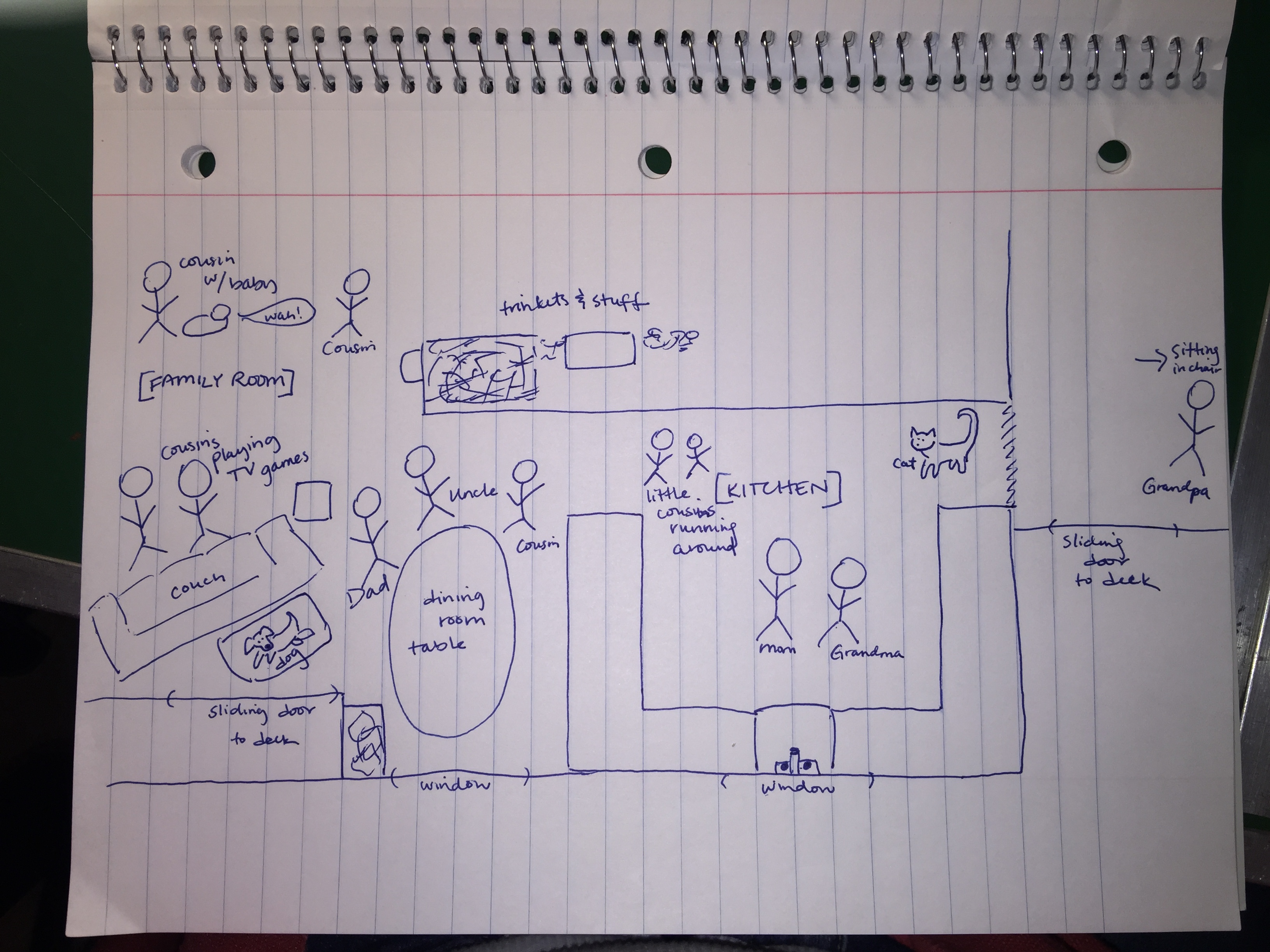
It is fitting that my visual map and narrative tour be centered around my family on this holiday. Like many families, mine had an Easter get-together – this year hosted at my grandparents’ house. The key attendees included my grandparents, parents, uncle, cousins, and myself (not to forget my grandparents’ dog and cat).

Visual map of my grandparents' house at Easter.

Visual map of my grandparents’ house at Easter.

Going to my grandparents house is nostalgic; countless family celebrations and gathering have occurred there over the years. My grandparents live in a nice home on 2.5 acres of Pacific Northwest-wooded property. The main living area of the house is the upstairs floor, with a sprawling living room, formal dining room, kitchen, dining nook, and family room, which are all flanked by what looks like a wall of windows. However, when 16 people gather for holiday festivities, even a relatively large house can seem crowded – especially with children and pets running around, a baby screaming, TV playing, and various “trinkets” littering almost every horizontal space.

It is no wonder that as Grandpa has aged, he has become less social, now choosing to sit in his recliner in the living room, away from the main activity in the family room. My grandma, on the other hand, can always be found in the kitchen. She seems to never sit, instead “working her fingers to the bone” – literally. My mom, oldest girl cousin, and I help Grandma prepare the meal. The men and other cousins sit in the family room, talking or playing games.

What is the reason behind this? Why are the women working while the men talk and teenagers/children play?

I believe there is more to the situation than simply the fact that my family is very “traditional.” I believe cultural ideology plays into the situation, as well. With a strong Southern (United States) and Japanese heritage, my family is deeply rooted in patriarchal notions. The rules and values come from the top (men) down (women and children). Status traditionally is given to the oldest son in the family – called the “chonan” in Japanese.

The patriarch snow monkey, Japan.

And that is what my grandfather is – a chonan. He is the eldest son, and he takes it very seriously. It may seem strange, but I sometimes imagine my grandpa as a solitary patriarch snow monkey from the mountains of Western Japan. Perhaps that is a part of the reason why our family functions the way it does.

From these observations, I believe that a research question of interest is: How do gender roles in different cultures affect family interactions in the home?

(This post is for Week 1, based on Exercise 4.2 of the book Qualitative Research Methods: Collecting evidence, crafting analysis, communicating impact.)

Posted by: listonjoe | April 5, 2015

Who Am I, Anyway?

Assignment Week 1: Chapter 4, Exercise 4.1 (page 77)

In recent years, American universities have seen a huge number of mainland Chinese students travelling to the U.S. to attend college. For centuries, Chinese culture has highly valued education, and with the economic growth and openness of the past 30 years Chinese universities are becoming world-class centers of study. My research would use participant observation to seek an answer to the question, “What draws Chinese students to American universities, as opposed to attending Chinese universities?

The scene of my research would be nearby university campuses with a sizable Chinese student population, such as the University of Oregon or Portland State University. I would contact the university to negotiate access, and contact gatekeepers such as Chinese student associations, as well as personal contacts I might have.

Exercise 4.1 is a “Self-identity audit,’ which seeks to provide me (the instrument/researcher) a greater understanding of my own identity prior to undertaking the study. This allows me to better understand how my personality and other demographic traits might affect the observations I make.

The questions in the exercise are:

  1. What are my demographic markers? In the case of the Chinese student survey, the two most obvious and relevant markers are that I am older than them and Caucasian. Because of these differences, they may not relate as well to me, and may, due to cultural reasons, change the way they communicate with me based on these facts. Being a male may also affect how participants (male and female) communicate with me.
  1.   What are my social attributes? Anecdotally, and from limited observation, many Chinese students here come from wealthy homes in China, and possess a higher social status. My social status is not high, nor am I wealthy. However, because I am not Chinese that may not affect my ability to learn from and communicate with them. My education level is greater than theirs which may allow them to take me and my observations seriously.
  1. How do others describe my personality characteristics? While it might be better to ask my peers this question, I would like to think I am, polite and honest with a tendency towards light-heartedness. It is difficult for me to know how this will affect my research.
  1. What values do people ascribe to me and my body? Once again, my peers might provide more accurate answers to this question. Personally, I believe myself to be friendly, outgoing, occasionally jovial, clever. I am a little overweight, but not so much that it would be a distraction in my research.
  1. How might these identity attributes affect my involvement and reception in a specific research context? A) I feel as if my friendly and honest demeanor would in turn allow me to gather factual and honest information from participants, whose trust I would hope to gain. B) Being male, older and non-Chinese might be filters that prevent me from obtaining all available data. Participants might not trust me, or fail to relate enough to me to feel comfortable being completely honest.
  1. In performing a self-reflexive evaluation, I must note that I have some familiarity with Chinese culture, and speak some Mandarin Chinese. By making this known to participants, it might allow me to overcome other obstacles, such as the age and gender difference, and most importantly the ethnic differences. I also have been a foreign student studying abroad, and while the question I seek to answer isn’t informed by my experience, I can relate in some ways to a student studying at a university thousands of miles from home.
Posted by: Jamie Ann | April 3, 2015

Excuse me, have you seen my verstehen?

Reading Exercises Post 1:4. Jamie Schaub
Chapter 3 Paradigmatic reflections and theoretical foundations, Exercise 3.1 (p. 41)

This exercise answers three questions based on interpretive paradigm’s key concept – Verstehen. To summarize, the author explains verstehen as a way of the observer to describe participants’ perspectives with an emphatic understanding of the participants’ situation in the field. (p41)

The Questions

1. The first question asks me to take a verstehen approach when observing a group of people that I regularly see but rarely engage with. I am to take notes while asking the question, “What is going on here?” I chose my work’s break room. Many years ago, I would meet a group of co-workers and have lunch there. Over time the group stopped meeting, and I started taking my lunch in my office. Fast-forward a couple of years, and a new batch of folks lunch together in the break room. Here are my notes for the question at hand, “What’s going on here?”

  • Different waves of people arrive at different times. The first wave of ‘regulars’ are from 11:30 a.m. – Noon. The second wave are from 11:50 a.m. – Noon. And the third group of people are from 12:30 – 1:00 p.m.
  • Back when I was eating lunch in the break room, the only things we had to isolate ourselves from others was either a newspaper or a book. Now, almost everyone brought a smartphone. Some eaters remained face-down in their screens, others looked up occasionally, and some flip-flopped between conversation and screen-time.

2. Now I have to ‘place myself in the scene.’ I had my lunch from 11:30 a.m. – 12:30 p.m. While I was there, no one read a book or a newspaper. Instead, everyone had their smartphone. And they were doing one or more of the following:

  • texting
  • playing games
  • perusing news/sports sites
  • Facebooking

How do I know the details? Because people casually mentioned their screen-time activity in their conversations. Such as: Blazer game highlights, funny things their kids are texting, game player updates and Facebook reads. This fascinated me.

The people that I talked to and asked why they chose to eat in the break room for their lunch were run-of-the-mill answers, such as: get away from being asked to do something, taking a break from the computer/email, and enjoying co-workers’ company. What I found to be the most interesting answer was from people who were on their smartphone instead of engaging in conversation: Many use their smartphone to disengage from an intimate social setting.

3. Comparing Q1 and Q2 notes, I realized how verstehen enhanced my interpretation of what’s happening in the break room. First, it’s important to check assumptions when observing the field. As much as I had thought that I was neutral and just recording observations, subconsciously I had already made my conclusions. It wasn’t until I wore the verstehen hat did I empathize with participants, and how smartphones are used in social gatherings.

Posted by: Donna Z. Davis, Ph.D. | December 16, 2014

WOW! As we think about citizen journalism…

Read on!

Sowing Mayhem, One Click at a Time
DEC. 14, 2014

“I take risks that other people won’t take because I think the story requires it,” said Charles Johnson, a blogger in California. CreditPeter Duke 

The final speaker in our series lent his perspective on the state of the print media, specifically newspapers.

When he arrived at the Oregonian Media Group just over five months ago to be the editor of the state’s largest daily paper (as well as OMG’s VP of Content), Mark Katches was walking into an environment still reeling from a major restructuring in June 2013, one that had resulted in significant numbers of layoffs.

[For an interesting analysis of the task facing Katches when he started at OMG last July, read Ken Doctor’s Nieman blog post here.]

Katches, however, was no stranger to unsettled newsrooms, having worked for a newspaper that folded in the 1980s. “I know a lot of people talk about disruption in the newspaper industry,” said Katches. “This industry is always going to be in a state of disruption from now on.”

[During his remarks, Katches referred to a leaked New York Times internal memo on that paper’s need for new digital innovation. Read the memo and an analysis of it here.]

Discussing what he called The Oregonian‘s “digital first” culture, Katches said that “I don’t even refer to ourselves as a newspaper anymore.” Instead, the printed paper is really just a curated selection of the vast quantities of content posted to the OMG website, oregonlive.com. For example, they no longer employ photo editors; instead, reporters provide some of their own images, and staff photographers are encouraged to upload virtually all of their images to the website, allowing viewers to sort through large galleries.

“I’m not here to grow our newspaper circulation,” he said, “although we’re not giving up on print.”

Despite the shift in focus away from the printed product–which included a reduction in home delivery days–the former investigative reporter sees a bright future for what he calls “Big-J journalism” at the Oregonian Media Group.  “We’re going to do more big-J journalism than ever before,” he said. Time will tell if Katches and his boss, publisher N. Christian Anderson III, will be able to maintain a thriving digital enterprise with so many wolves growling at the door.

Posted by: Donna Z. Davis, Ph.D. | December 5, 2014

Favorite blog posts to date

Just in case you’d missed it, here’s the list of your favorite blog posts so far! You have one more chance to vote! This week will be a tough choice!

Week 2 – Lucila

Week 3 – Chris

Week 4 – Alan

Week 5 – Stephanie

Week 6 – Eldrick

Week 7 – Superbracker

Week 8 – Katie

Cheers y’all!

« Newer Posts - Older Posts »

Categories